What do you care about? What do You collect?
The purpose of the Smithsonian
Institute, embedded in the will of James Smithson (1765-1829) the illegitimate
son of an English Duke and a wealthy widow… who never stepped foot in the
United States, is “The increase and diffusion of knowledge”.[1] “With 19 museums and the National Zoo, the
Smithsonian is the largest museum, education and research complex in the world”.[2] The purpose of the Smithsonian National
Museum of American History (NMAH) is “the collection, care, and study of
objects that reflect the experience of the American people,” which aligns with
Smithson’s interest in the American experiment. [3] The Division of Medicine and Science within
the NMAH “acquires, preserves, studies, and interprets the material culture of
the biological, medical, and physical sciences.”[4] My purpose and task is to connect my
regionally focused research on ‘Women and Healthcare in Cleveland’ to the
national impact of women as demonstrated through an examination of the
collections in Smithsonian Division of Medicine and Science and its local
affiliate the Western Reserve Historical Society.[5] This research aligns with the strategic goals
of the current Smithsonian Vision and its American Women’s History Initiative–Because
of Her Story, “one of the country’s most ambitious undertakings to research,
collect, document, display and share the compelling story of women.”[6]
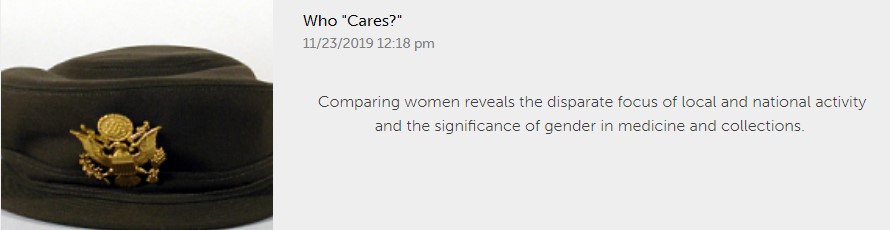
If one attempts to research the story and influence of women, it becomes immediately apparent that “her story” has not been collected or documented in traditional historical catalogues and methodologies. “She” does not lay claim to the firsts, the foundings, and rarely appears among the famous, unless a fatale. To uncover the evidence of women at the local level is difficult; the evidence of women at the national level is almost non-existent. How can it be that half (50.8% in 2010) the population is so poorly recorded?[1] Where are the women? I am using the Smithsonian Learning Lab as a tool for exploring and communicating the connections between Cleveland and Washington, D.C.
“The Smithsonian Center for Learning and Digital Access created the Smithsonian Learning Lab to inspire the discovery and creative use of its rich digital materials—more than a million images, recordings, and texts. It is easy to find something of interest because search results display pictures rather than lists. Whether you’ve found what you were looking for or just discovered something new, it’s easy to personalize it. Add your own notes and tags, incorporate discussion questions, and save and share. The Learning Lab makes it simple.
By encouraging users to create and share personalized collections of Smithsonian assets and user-generated resources, the Learning Lab aspires to build a global community of learners who are passionate about adding to and bringing to light new knowledge, ideas, and insight.”[2]
Women are not the only people “missing” from the historical record in general and museums in particular. There is a relatively large literature dating to Fred Wilson’s ground breaking exhibit, “Mining the Museum” in 1992. Persons of color and uncomfortable ideas, often share the same fate and compound our ignorance of our full and authentic past. For my project, I must examine what can and has been collected and consider what is missing. Or, and I think this is more accurate pursuit, find the ‘hidden women’. Aside from the few who managed a first or married a first or miraculously achieved some rank of notoriety, women are nameless in the collection. But they appear in photographs as assistants, they are the workers in the companies whose products have been collected, they have taken care of supported both the family and the great scientist while “He” achieved success. Reminiscent of the television sitcoms of the late 1960’s Bewitched and I Dream of Jeannie, women made the magic happen behind the scenes. Reflecting on this type of history is not quick and easy. Documenting it (necessary for a historian), is a nightmare. However our collections reinterpreted, may hold some important knowledge treasures that have been lost in the ‘American Experiment’ as it exists today.
The work continues.
[1] U.S. Census. “Age and Sex Composition:2010.” https://www.census.gov/prod/cen2010/briefs/c2010br-03.pdf accessed 11/23/19.
[2] Smithsonian Institute. “About the Smithsonian Learning Lab.” https://learninglab.si.edu/about accessed 11/23/19.
[1] Smithsonian Institution. “Purpose and Vision.” https://www.si.edu/about/mission accessed 11/23/19.
[2] Smithsonian Institution. “About the Smithsonian.” https://www.si.edu/about accessed 11/23/19.
[3] Smithsonian Institution. “Mission & History: National Museum of American History. ”https://americanhistory.si.edu/museum/mission-history accessed 11/23/19.
[4] Smithsonian Institution, “Division of Medicine and Science.” https://americanhistory.si.edu/about/departments/medicine-and-science accessed 11/23/19.
[5] This Internship is part of the Roy Rosensweig Center for History & New Media: Digital Public Humanities Certificate Program within George Mason University.
[6] Smithsonian Institution. “Purpose and Vision” & “Because of Her Story” https://womenshistory.si.edu/about accessed 11/23/19.
