Tag Archives: Digital Humanities

Exploring Questions

What about your internship has been an eye-opening (new or unexpected) experience? What were your initial expectations?

The task in which I am engaged seeks to understand the significance and impact of women’s role in medicine and health care broadly.  The current iteration is focused on identifying the connections and differences/similarities between national and regional experience.  The vehicle for accomplishing this analysis is a comparison between the collections of the Smithsonian Division of Medicine and Science and the Western Reserve Historical Society. 

Recognizing there is an entire body of scholarship on collections, who collects, rationale and preservation issues, etc.; this project focuses on what can be determined about women’s action and influence on healthcare through the analysis of two comparable collections: one nationally focused and one regionally focused.  There is an assumption that since the Western Reserve Historical Society is a Smithsonian Affiliate, their general standards, practices and goals are similar enough to enable a rough comparison.  The unexpected challenge that I am facing is searching the collections effectively.  The archives for the institutions are structured quite differently.  So while I am sure both institutions have the archival material I need; identifying and collecting these resources has been more time consuming task than anticipated.

This past week I attended an annual Digital Humanities Conference.  I considered that even the title is an oxymoron…digital down to the smallest element and humanities which is a full expression of the human experience. As at most academic conferences, new works are presented and the field of study is refined and shaped by the experts and participants who discuss the administrative issues of the year.  Since Digital Humanities is a new field, the challenge of framing the language, tools and practices of the discipline is a significant portion of the conference and important work.  Identifying standards of expertise and hierarchies are important for remuneration and academic credentialing.  However these processes and vocabularies create distances and barriers.  What does the public lose?  How are the humanities constrained and limited when a group of experts claim control over a field?

The grand institutions claim expertise and protect their collections.  The academic disciplines control who can claim authority and expertise.  Their commitment is admirable and the services of collection, protection and preservation vital.  Yet, both raise obstacles and barriers of access to the very material they are trying to promote.  The struggle that I have been facing is frustrating.  While I am used to surmounting administrative hurdles, having available resources and yet not having the common language or processes to facilitate their analysis, is a new thing for me. 

Have these expectations changed now that you are half-way through? How? Why?

While the task has become more time consuming, I have not given up.  Rather, I am widening my understanding and learning the how and why of the institutions with whom I am working.  It is our language that expresses our identity and world view.  The languages of organizations, fields of expertise and the processes we use express identity and meaning.  Communication requires learning these meanings and being able to share them.   Researchers are bridges between worlds, crossing into unknown or hidden territory and bringing this new information back to be used in a new way.  These challenges are reminding me of the need to make my work transparent and to pay significant attention to how I am communicating the ideas that arise from it. 

Sixth Piece of the Puzzle – Technology

Technology is a key component of Digital Learning.  Does that seem like a patently obvious statement?  Yes, but this simple statement has deep ramifications.  For some individuals technology comes easy.  Often these are the individuals who adopt the latest and greatest, are excited about changes and shift between screens, software, hardware and mobile apps like expert skiers navigating moguls.  Assumptions, there is a generational divide in the adoption of technology and soon we will “age out” of our technological hurdle, are misplaced.  In my Community college classes, I find the digital hurdles include: access, poverty, class, mental processing and perspectives.  I have also found that “tech users” are often, not the best instructors, because they do not understand why or how a hurdle exists.

As I have watched the expanding usage of technology, I realized that there was something I was just “not “getting”.  For me the “skills” were not transferable.  Every change in platform, software, hardware, & upgrade became a hurdle.  Another technology I had to learn, which I knew would last only until the next upgrade.  I resented the time spent learning the technology to ‘display history’ as opposed to “doing history”.  Techies argued, “there are great tools that “do everything for you” – just drop in your data!”  But if I “dropped my data”, do I really understand the results?  As we have learned in this certificate program, decisions are made at every step and they shape the outcome of the digital processing.  Manoff

Constructing the “Finding Women in Cleveland” project has been an adventure in digital teaching and learning.  How hard could it be to ‘transform the tour…to place images on a platform and ‘plug in’ images, video and audio?  I was thinking analogically.  I have been challenged to think digitally, to weave technology, historical ideas, urban artifacts and educational goals into the project.  Digital thinking transforms the product; the goal of education transforms the technology, the technology is transformed by the nature of the materials and artifacts, the use of the digital platform transforms the engagement and the process of integration transforms the educational goals.

Just as learning systems were developed to prepare workforces for the industrial age, learning systems must be  transformed for the digital age.  Large machines and large organizations were built to last.  Authorities told us what was important, and keeping “the line” was important.  But if the goal is creativity, flexibility and responsiveness to diverse populations and demands…teaching and learning must be adapted to promote these skills, even in understanding and presenting our past.

Thus, digital learning is incremental, flexible and engaged: “teach me what you are doing, so I can learn by doing, so I can not only participate but evolve.”  The human skill of teaching and learning becomes a collaborative endeavor.  Humanity and individuality is recognized and really, isn’t the goal of education to get people to live together peacefully and prosperously?  We can be lured by the Apple (pun intended); we can focus on the wrong things, mindfulness of what is gained and lost from our traditions and understanding of the past is critical.  We cannot halt the future, nor would we want to, but engagement can be the bridge between generations and the glue that holds the puzzle together.

Notes:

Manoff,​ ​Marlene.​ ​​”The​ ​Materiality​ ​of​ ​Digital​ ​Collections:​ ​Theoretical​ ​and​ ​Historical Perspectives.”​​ ​​Portal:​ Libraries and the Academy ​ ​6,​ ​no.​ ​3​ ​(07,​ ​2006):​ ​311-25.

Exploring Cleveland Historically

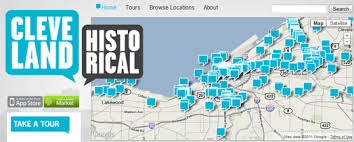
I downloaded the Cleveland Historical, produced by the Center for Public History & Digital Humanities at Cleveland State University.

Mobile Public History App

Cleveland Historical is promoted as a mobile application that provides a GPS-enabled map, historic images from Cleveland’s top archival institutions and an interpretive view of Cleveland and Northeast Ohio history.  I had seen Cleveland Historical in its infancy as it is connected to Cleveland Memory and the CSU Center for Public History.

Center for Public History and Digital Humanities

The on-line version is more of an archival record format.  In its early state, the architecture was clumsy, the images fuzzy and many in the historical community viewed it as a ‘limited repository’.  When I tried to download Cleveland Historical from my home in a nearby suburb, it did bring up lots of great photos for Lakewood and the nearby communities.  Seemingly a random collection of documents and photos, I could not get a clear idea of what was chosen & why.  Either none of the sites had audio or they wouldn’t load.  Basically I reverted to my earlier judgment, ‘Kinda klunky but interesting, at least Cleveland is trying’ (it’s a motto here).

When I tried the mobile app from my office downtown, I was stunned by the difference.  Cleveland Historical really is a dramatic leap forward in technology and engagement!  When I opened it, the GPS-enabled map popped up a series of “Stories” historic images between .25 mi and progressively distant to my immediate location.  The top of the screen navigation bar gave the options: Stories, Tours, Map

  • Clicking on the Story selection brought up related thumbnails. Each entry had thumbnail image, a log distance and name. Clicking the thumbnail brought up a larger photo and historical description.
  • Clicking on the folded map brings up a location map that can be enlarged or reduced, scrolled or there is a bar to get directions which locates with directions the photo you have opened.

Back conveniently takes you back to the previous item.  Several ‘stories’ that have audio & video options indicated in the navigation bar at the top of the page.  Clicking on a headset or movie reel will produce a new list of clips: interviews, reports, images, newsreels.  The user can continue to scroll to distant locations or search on keywords.

Many of the clips and short documentary videos are drawn from CSU’s Cleveland Regional Oral History collection.  Cleveland Historical is designed to be a collaborative project with stories created by teachers, students, professors and community members.  While curated by the Center for Public History + Digital Humanities, the goal is to have the community actively participating in making and remaking its understandings of place and identity.  Tebeau believes “Listening and the human voice, in particular, evoke ‘place’ in visceral and profound ways.” Human voices call forth memory, time, and context.  Other images are drawn from a full range of collections from local institutions such as the Cleveland Museum of Art to family photos or the Cleveland Press, journalistic collection.  The selections are chosen based on location and engagement for example near to the grounds of the prestigious University Circle area with many significant institutions, a thumbnail of the Hessler Street Fair is included (this is an alleyway, which still maintains its original woodblock construction, and hosts a neighborhood festival every year).  The “Tours” option is very useful for visitors, providing walking or driving options to cover a topic area such as the Underground Railroad, Great Migration or history of Rock n Roll!  It did inspire me to ‘get on’ with my project as when I searched on women the thumbnails were obviously architecture or events that included “women” in the text or metadata.  As with all public history, there is more work to be done!  But Cleveland Historical is a very cool app and a great start!

https://clevelandhistorical.org/  accessed 4/8/2018.

Tebeau, Mark. “Listening to the City: Oral History and Place in the Digital Era.” Oral History Review 40.1 (2013): 25-35.

http://urbanhumanist.org/2011/07/30/from-cleveland-historical-to-mobile-historical/ accessed 4/8/2018.

Transforming History Processes

In the past, I have shaped exhibits after the content.  So my process has been focused on identifying the key elements of the project at hand – Subject and artifact centered.  Build the comprehensive history from research around the elements; distill the exhibit from (essentially) my interpretation of the significant history and relationships, engage in dialogue with design experts and then determine how that exhibit can be mounted with in the identified space, open the exhibit, gather feedback.  The readings assigned for Modules 4 and 5 call for a much more engaged approach to all facets of the project – history, design and ‘experience’ of the exhibit …extending into an on-going conversation and continuing impact of the history beyond the immediate exhibit space.

A simplified revised conception of the public humanities project process would be: focused on identifying the key elements of the project at hand – Subject and artifact centered.  Consider the audience for these elements (what will they need to know, how would they use this information). Sherratt.  Build the comprehensive history from research around the elements while engaging professional and audience partners in the process of research, design and engagement. Spichiger, Rabiinowicz, Lubar. Finalize the conception of the history with the team (possibly including an audience test – Colter).  Determine how the exhibit can be mounted with in the identified space, how the previously identified and potential audiences can be informed, engaged and consider potential for on-going collection of history and engagement of the audience (archive building and social media).  Open the Exhibit.  Receive audience feedback and finalize institutional review.

This project process is a dramatic shift from the “Ivory Tower” conception and accomplishment of projects that was the 20th Century model.  Fortunately there is a gallery of digital humanities projects that demonstrate how this format can work for both the physical display of exhibits and new digital forms of exhibits and historical engagement opportunities (web search Digital Humanities Projects on almost any topic or refer to examples listed at the bottom of this page).  Not unexpectedly, the content and quality of these projects can vary based on access to resources and the quality of the personnel involved in the projects.  Quality projects include in the recognition of the need for the curation and maintenance of supportive materials and archive of the metadata to maintain veracity, accessibility and usability of the historical material being created.  Inclusion of the various perspectives involved in the new methodology requires early and expanded identification of the exhibit “team”.  Enhanced and frequent communication (written and face to face) and focused intentional collaboration is needed to assure that all perspectives are truly being considered and incorporated into the ‘story’ being created.  Documentation of resources, metadata, on-going team collaboration are essential to keep the direction and component parts of the project progressing toward the same end product.  Owens, “Metadata”, Brennan & Kelly, Whitelaw, Fisher, Kissane

The value of this updated process is the creation of a more holistic, engaged history.  Social historians of the late 20th Century (Labor, Ethnic & Gender) called for attention to and expansion of the conception of history to include ‘the wider public’, a movement away from the focus on ‘Great Men and Great Deeds’.  However in the early days of this new history, the content and delivery still utilized traditional approaches and methodologies.   Since resources to acquire the history of ‘the wider public’ didn’t exist.  Technological advancements and refinement of digital methods has made access to the interpretation of public documents, GIS infrastructure analysis and inclusion of “the crowd” and a more accurate representation of ‘the wider public’ possible.  Including participation and involvement in the creation of public humanities projects increases the awareness of and access to new historical sources, expands the perspective in the creation and expression of the exhibit, builds a larger and more engaged audience and develops new avenues for future historical questions: What is the historical impact of audience engagement in the development and presentation of their own history?  This type of question is already being developed in the 911 and Hurricane archive.  It is a new and exciting time to be a “stuffy old historian”.

Sheila A Brennan and T. Mills Kelly, “Why Collecting History Online Is Web 1.5,” Roy Rosenzweig Center for History and New Media, March 2009, http://rrchnm.org/essay/why-collecting-history-online-is-web-1-5/  accessed Feb. – Mar. 2018.

Angela Colter, “Testing Content,” A List Apart, December 14, 2010, http://alistapart.com/article/testing-content  accessed Feb. – Mar. 2018.

Erin Kissane, “A Checklist for Content Work,” A List Apart, March 8, 2011, http://alistapart.com/article/a-checklist-for-content-work  accessed Feb. – Mar. 2018.

Steve Lubar, “The Curator Rules,” On Public Humanities, February 7, 2015, https://stevenlubar.wordpress.com/2015/02/07/creative-curation-curatorial-rules-and-when-to-break-them/ accessed Feb.- Mar. 2018.

Metadata,” JISC Digital Media, http://www.jiscdigitalmedia.ac.uk/infokit/metadata/metadata-home accessed Feb.- Mar. 2018.

Trevor Owens, “What Do You Mean by Archive? Genres of Usage for Digital Preservers | The Signal: Digital Preservation,” Blog, The Signal: Digital Preservation, (February 27, 2014), http://blogs.loc.gov/digitalpreservation/2014/02/what-do-you-mean-by-archive-genres-of-usage-for-digital-preservers/  accessed Feb.- Mar. 2018.

Tim Sherratt, “It’s All About the Stuff: Collections, Interfaces, Power, and People,” Journal of Digital Humanities 1, no. 1 (March 9, 2012), http://journalofdigitalhumanities.org/1-1/its-all-about-the-stuff-by-tim-sherratt/  accessed Feb.- Mar. 2018.

Spichiger, L., J. Jacobson, Telling an Old Story in a New Way: Raid on Deerfield: The Many Stories of 1704, in J. Trant and D. Bearman (eds.). Museums and the Web 2005: Proceedings, Toronto: Archives & Museum Informatics, published March 31, 2005.

Richard Rabinowicz, “Eavesdropping at the Well: Interpretive Media in the Slavery in New York Exhibition,” Public Historian 35:3 (August 2013), pp. 8-45.

Michael Whitelaw, “Generous Interfaces for Digital Cultural Heritage Collections,” Digital Humanities Quarterly 9, no. 1 (2015) http://www.digitalhumanities.org/dhq/vol/9/1/000205/000205.html  accessed Feb.- Mar. 2018.

Examples of Digital Public History Websites:


Reflections: DPHF17 WHCC Mapping 1.0

I. Aim of the Project

The aim of the DPHF17 WHCC Mapping 1.0 project is to apply what I am learning in the George Mason University Digital Public Humanities Certificate program to the larger historical project “Women and Health Care in Cleveland” (WHCC).  WHCC has examined many types of ‘connections’ between Cleveland’s institutions and individuals using traditional historical methods and disseminating this information through academic and public avenues.  As the WHCC project evolved, it has expanded including many variables: Public and private institutions, corporate, proprietary and government entities, relationships that span the gamut of intimate families and friends, through organizational and philanthropic to distant resource and approval figureheads.  The increasing size of the corpus data has made digital humanities methods attractive to the WHCC.

For this specific project, I am applying two forms of mapping and network analysis software to a small sample WHCC data set to ascertain our ability to adapt WHCC materials to DH methods. I am anxious to see what these visualizations reveal about the WHCC network of medical care in Cleveland, OH during the period 1850-1870, when the city and public institutions are just organizing.  This project is also being conducted as part of a learning community created within the Digital Humanities Certificate Program.  Collaboration is an intrinsic part of projects created within the field of digital humanities. Close engagement with persons involved in all aspects of the resourcing, researching, production and those who will be engaging with the completed research is part of this methodology. (Ramsay, Stephen, “DH Types”) The production of this project and its partners is an exercise in collaboration.  Also this effort will inform WHCC current and future research and project activities.

II. Sources

WHCC records are comprised of traditional research notes, tabulated and compiled over years of assorted projects and presentations.  These records needed to be transformed into complete, structured and clean databases to form a Subset of data for digital analysis.  The technical process of converting WHCC information from its original Excel Spreadsheet to a .cvs database ready to be utilized for DH analysis is described on the WHCC Project Page.

For this particular reflection, it needs to be recognized how “incomplete” the corpus was from a digital standpoint.  This is part of the “art” of traditional historical analysis – interpreting relationships from ‘limited’ sources.  Various specific details are missing for a majority our people, but the ‘missing’ data is not always the same aspect.  The lack of quantifiable and definitive data results in the critiques, such as “Most historians still trade in text mediated by uncertainty and theory; while historical geographers, strive to tie data to a knowable and certain fragment of the world’s surface”, by social scientists that have more measureable data on which to rest their authority. (Hitchcock, Historyonics)  The time consuming task of transforming the minutia of notes (fortunately frequently recorded in digital formats – Word, Excel, Google etc.) was tedious and required several passes to add  missing elements,  correct items, and standardize references. The purpose as Hitchcock asserts

“makes possible a situation in which historians cease to be mere text merchants, obsessed with the perfect quote, and compelling (if largely un-evidenced) argument; and where geographers {AND HISTORIANS} have a new access to the subtle mappings of the marks of ‘culture’ in its broadest sense – a new way of thinking about the geographical distribution of behaviors and ideas, that bring within a geographical fold questions traditionally preserved for others…..We quite suddenly share a new culture of data – and data can be translated.”  (Hitchcock, Historyonics)

But, recorded in these records were extensive descriptions of relationships, references and speculations about connections that cannot be translated into spreadsheet columns.  This difficulty has been noted:

“Humanistic data are almost by definition uncertain, open to interpretation, flexible, and not easily definable. Node types are concrete; your object either is or is not a book. Every book-type thing shares certain unchanging characteristics.  … This reduction of data comes at a price, one that some argue traditionally divided the humanities and social sciences. If humanists care more about the differences than the regularities, more about what makes an object unique rather than what makes it similar, that is, the very information they are likely to lose by defining their objects as nodes.”…..

“Unfortunately, given that humanistic data are often uncertain and biased to begin with, every arbitrary act of data-cutting has the potential to add further uncertainty and bias to a point where the network no longer provides meaningful results. The ability to cut away just enough data to make the network manageable, but not enough to lose information, is as much an art as it is a science.” (Weingart, “Demystifying Networks”).

An objective of this project is to create a physical picture, while maintaining our awareness that this “picture” is a created artifact.  The primary criteria of removal from our corpus was incomplete addresses, this reduced the initial data set from 772 to 194.  Identifiable geolocations reduced it to 135.  In statistical terms, the test data is comprised of 17% of the full corpus.  The analysis has also been governed more by ‘quantifiable’ units (nodes) and is therefore more broad and superficial than the depth of WHCC records indicate.  For example, Oliver Hazard Payne, the grandson of Oliver Hazard Perry, served in the Civil War and then became a board member of Standard Oil.  He donated to Cornell Medical College, Cleveland’s Lakeside Hospital, the Jewish Orphan Asylum, St. Vincent Charity hospital among others, but died a bachelor.  He left his money to family members including Elizabeth Bingham Blossom, who married Dudley Blossom, who would become the City Welfare Director and gained national prominence transforming “City” into Metropolitan Hospital.  — How does that get put in a spreadsheet?

“There are many networks that can connect the same group of nodes, and many questions that can be asked of any given network, but before trying to use networks to study history, you should be careful to make sure the questions match the network.” (Weingart, Networks Demystified).  In order to accomplish this test within the limited time-frame, specific decisions were made to include rows that had complete data and columns that could be straightforwardly quantified or compared digitally.  These choices dramatically limited the size of the Trial Data Set and the number of visualizations that could be performed.  It is evident that experience in database design would enhance the structure of the database and the end-product.

III. Software that You Worked With:

The tools used for analysis in the DPHF17 WHCC Mapping Project were CARTO and PALLADIO.  A description of the tool and examples of the visualizations produced with them is available on the WHCC Project Page .

There are aspects of “working” in the field of Digital Humanities that completely change your conception of it.  I recognize “plural” in “Digital Humanities” in a much different way than when I began the semester.  At that point, I believed it was interdisciplinary and combined the digital (discrete bits & computers) with humanistic topics.  The primary purpose being to create products and exhibits that contributed to the understanding and snazz of the Humanities. The Digital Humanities are plural in a much deeper and comprehensive way.  In the creation of the DPHF17 WHCC Mapping Project, I have used multiple softwares.  I think a more appropriate way of discussing them is in terms of categories of tools used, as well as specific applications.

Throughout the project process, communication of ideas and transmission of data has been necessary and on-going.  However a straight forward email is only one form.  Daily I was using several platforms based on where I was working and the type of collaboration I was seeking: Microsoft Outlook at work; Gmail for private and college business communications; Blackboard messages for student interaction within my class, as well as blackboard collaboration for class meetings, Slack – was the primary collaboration tool used for course questions and help within our group.  Each one of these platforms is directed to accomplishing similar goals but in targeted and specific ways.  Blackboard (An education management system) is a suite of tools to address the needs of educators and students.  Microsoft Outlook is particularly targeted to business processes and Gmail tries to straddle both business and private communication spheres.  Choice of usage is not always in the hands of the user, but may be dictated by the environment.

Collection and organization of data was also accomplished through many systems.  The course itself had its own course platform “dhcert” which was customized software hosted on Reclaim.  This enabled the dispersal of information and submission of coursework in a paced process that was much more fluid and individually accessible than Blackboard.  I utilized document tools –  Google Docs and Microsoft Word; spreadsheet tools – Excel and Google sheets.  The primary advantage of Google tools being the ability to synchronously edit and collaborate.

Tools for the dissemination of results include: WordPress – This is publishing software which is hosting my blog and also provides a course record.  The capacity in which it was used this semester was more an educational and professional platform than personal journal.  Also discussed and encouraged are further social media tools utilized to “get the word out”, now that newspapers and print media are not as commonly utilized.  These tools included Facebook, Twitter, other people’s blogs, institutional websites and professional networking resources like Linked In and HNet (field specific network) or sites like www.digitalhumanities.cam.ac.uk

The WHCC Project is a ‘location specific’ project.  At various times, I have hand created maps or adapted existing maps to “show” the relationships with which we are working; and how space impacts those relationships.  So I was drawn to the mapping and visualization tools of CARTO and Palladio.  Multiple tools were selected, because I am interested in testing both the visual map interface and the network constellation visual representations.  Texas A&M GeoServices was an essential tool as it was used to transform street addresses into latitude/longitude coordinates as Geo locations. This opensource program was particularly friendly to work with, utilized my Excel sheet with expanded columns formulated the Geo locations for my limited data set quickly.  The Excel sheet was saved as a .cvs file, which once created could be utilized by both platforms, which was a pleasant surprise.  CARTO maps.  It is possible to upload the GIS data, have it appear on a constructed map.  CARTO then allows the user to make various forms of analysis (Histograms, Graphs, Time Series, Density and Grouping) that help show connections and changes over time on the map itself.  CARTO is easy in the sense that its widgets and analysis software will do magic in transforming data into maps.  But it is a time-consuming process to learn CARTO’s idiosyncrasies and getting the various widgets to operate the way you think they should intuitively. CARTO I can utilize 19th century maps digitized in the Cleveland Map collection. I am choosing this software because, we will be looking at this network again in the 1930’s and 1990’s and utilizing the GIS aspects of CARTO will be particularly helpful.

The Palladio platform is easier to work with than CARTO.  However, the ability to customize visualizations is more limited.   Palladio is structured more as a “tool set”.  The tool is selected, the data is plugged in and “poof” the network image appears.  This makes it much more fun for the non-techie to do techie magic.  In projecting a new form of visualization which focuses on the connection and its strength; Palladio helps the user focus on the relationship between objects.  This non-traditional spatial view of relationships helps the user to consider the meaning of the patterns and stimulates new questions.   Using Palladio and CARTO together

 IV.  Problems Completing the Project:

Overall the major challenge of the project was time.  The time-frame of this sub-project and many design elements have been dictated by DPHCert course requirements.  A substantial portion of time for this project has been spent reorganizing, cleaning and supplementing the information that had been gathered in order to create a clean data set that could be loaded into visualization software.  The scope of the current project has been narrowed from a full scale analysis of the WHCC data to testing a portion of the data. Even then, the scope was reduced further as each activity in the project required learning the methodology of a new tool, or expanding on a fragmentary knowledge of it.  While time available to the project was intended to focus on utilization of the digital tools, the preservation of the larger project’s resources became a time critical issue. While this aspect seems extraneous to the DPHF17 project, it is a valuable reminder of human, machine and societal issues that will impact any public project.  Another ‘human’ issue in the completion of this project is isolation from an active DH facility/community.  As I read fellow “ground” students posts, which included references to conversations and evidently lab type resources and assistance, that resulted in professional products; I recognized the depth of my struggle to learn unfamiliar tools and change embedded practices on my own.

V.  Discoveries About Sources:

Preparation of the full corpus data was beyond my ability to complete in the time available in the semester. The Test corpus was determined by a representative sample and having a substantial number of records to process. Limiting the number of columns in the network relationships (determined as necessary during the data cleaning process) was the most disappointing feature of creating the test data. Also after having compiled the test corpus and run the visualizations, I believe I will need to rethink strategy of formulation. Names are important to understanding the relationships in the larger project, but the ‘significance of the names’ is invisible to the computer. The addresses are also significant, but do not tell the full story of the geographic locations.

WHCC spreadsheets were created to compile resources for the purposes of other  sub-projects. This format was not sufficient for effective digital processing. The lack of a fundamental design structure meant that creating a “usable” database was more complex and time consuming than expected. Gaps in the data needed to be filled, extra punctuation and side notes needed to be removed. Addresses has to be placed into standard formats and geolocations calculated. Computer tools can be used for some of these processes, but the interpretation of meaning (even in deciphering aspects within the data structure) requires human analysis.

Choices were made to limit the scope of the project because data was missing or incomplete, but I also discovered that some of the organizational structure even in the newly constructed database was unhelpful.  The original construction of the numbered Charity columns was based on the evidence of commitment or office tenure of the individual.  For the purposes of digital analysis, I believe the columns should be titled by Charity Name.  This would allow a better display of the charities as well as the individual relationships.  Additional dates, (hiring, membership, terms of office etc.) if available would make time sequence analysis possible.

Opening the project up to the public during its ‘working phase’ is not a strategy I would have anticipated or probably considered. The inclusion of public awareness is part of the evolution of my understanding of ‘Digital Humanities’ and exposure to more DH work in a thoughtful way. At our first glance of Digital Harlem, I realized the power and usefulness of its blog. Since this project is somewhat similar to WHCC, in exploring the impact of an aspect of an urban community; I examined this project closely and have been reflecting on its strategy and methodology. WHCC does have a ‘crowdsourcing’ element in its origin and full implementation. Laying the groundwork for that engagement now, seems appropriate,

“[DH] projects allow improved searching and analysis of primary sources, facilitating a researcher in their task and allowing new ways to synthesize, juxtapose, and create knowledge. Although many digitization projects in the Digital Humanities are developed with a core constituency in mind, the resulting resources can be used by a wider audience, and the ramification of opening up access to humanities, arts, and cultural content is just starting to be understood.” (Terras, Digitization and Digital Resources in the Humanities)

 VI.  Highlights of Presentation

WHCC has been collaborative from the beginning in the research, generating community interest and support.  This project has benefitted from and reinforced the significance of that aspect of WHCC practice.  WHCC is an effort to uncover the networks and contributions of previously unrecognized actors in the development of our current health care system.  This project has demonstrated the ability of Digital Humanities methodology and tools to uncover new relationships and generate import research questions. Production of Digital Humanities analysis is time-consuming (expensive) on the front end, but replicable on the back end.

“It is not just that mapped data is seen in its geographical context…large quantities of data, can be combined on a single map, providing an image of the complexity of the past.  You can examine maps of sources at different scales, and discover relationships…by visually detecting spatial patterns that remain hidden in texts and tables.” (Robertson, “Digital Harlem”)

The introduction of this methodology into WHCC proposes a broader understanding of the ‘unrecognized actors’ and a deeper understanding of the embedded nature of the networks within the city.  “Trevor Harris, Jesse Rouse and Susan Bergeron argue, ‘The visual display of information creates a visceral connection to the content that goes beyond what is possible through traditional text documents.’”(In Robertson, “Digital Harlem”)  This project is a step in developing a ‘visceral connection’ within the WHCC.

Notes:

Edelstein, Dan, Findlen, Paula, Ceserani, Giovanna, Winterer, Caroline, and Nicole Coleman. “Historical Research in “A Digital Age: Reflections from the Mapping the Republic of Letters Project.” American History Review, 122, no. 2 (2017): 400-424.

Robertson, Stephen “Putting Harlem on the Map.” In Writing History for the Digital Age.  Jack Dougherty and Kristen Nawrotzki, ed.  University of Michigan Press, 2012.

Hitchcock, Tim. “Place and the Politics of the Past.” Historyonics (blog), July 11, 2012.

Ramsay, Stephen. “DH Types One and Two”. Stephen Ramsay (Blog), 2013.

Terras, Melissa.  “Digitization and Digital Resources in the Humanities.” In Digital Humanities in Practice, ed. Claire Warwick, Melissa Terras, and Julianne Nyhan.  Facet Publishing, 2012.

Weingart, Scott. “Demystifying Networks” Scott Weingart (blog), December 14, 2011.

Weingart, Scott. “Networks Demystified 8: When Networks are Inappropriate.” Scott Weingart (blog), December 5, 2013.
 My Approach to Wikipedia

Wikipedia for better or worse has become the global source for instantaneous reference.  As Roy Rosenzweig noted “We have to pay attention because our students do”. (Can History be Open Source) We should pay attention because Wikipedia is ubiquitous.  It is providing the common platform of information and more significantly has changed the way we access and think about information… we no longer have to memorize and learn basic facts because Wikipedia can provide them faster than we can remember them.  Skipping the process of remembering facts does have consequences for critical thinking and application of knowledge.  However, that is a different issue than the one at hand which is the more immediate issue of ‘What do we need to be aware of when reading a Wikipedia article?’

Wikipedia is great for common facts and dates!  It is probably mostly reliable. When searching for a more comprehensive understanding of a fact, event, issue, or idea, it is a good idea to dig deeper into who is involved in the “construction” of the entry.  The entries are created and corrected by ‘everybody’, but this ‘everybody’ is constituted by individual volunteers who have different goals (and differing amounts of time and interest in working with the entry).  An individual, who has just become familiar with a topic, can be interested in demonstrating what they know about it.  A knowledgeable expert might have corrected and clarified an entry; or someone could just be creating mischief and enter random information.  It is useful to know that there is extensive information, but basically 4 pillars for contributors (identified by Rosenszweig) which shape the content of entries:

  1. ‘Wikipedia is an encyclopedia which summarizes and reports conventional and accepted wisdom on a topic that does not break new ground.’
  2. ‘Articles should be written from a neutral point of view’
  3. While “The third “key policy” is simpler: “don’t infringe copyrights.” The reality appears to be that Wikipedia as a general source ignores attribution and often so do its users.
  4. ‘The fourth pillar of Wikipedia wisdom is “respect other contributors’.

According to David Auerback, “Wikipedia’s users serve collectively as legislature, executive, and judiciary” of its content. (“Encyclopedia Frown”). That is not fully true as Auerback indicates in his own blog, there are priority contributors, Wikipedia editors, and a slew of ‘bots’ that monitor and manage the site.  What this information should mean to the user, is  Wikipedia is “probably mostly reliable”, but it shouldn’t really be a primary source if one is writing a term paper or trying to gain a deep understanding of a subject.  However it is a useful tool for quick references and as a lead to other resources for more information on the topic.

Going deeper than the surface with a Wikipedia entry requires asking a few questions: “How did the article develop, who has been involved in its creation and do I judge the information or resources to be reliable?  These questions can be answered by accessing the full Wikipedia site (not just pulling the data from the search engine synopsis).  At the top of the Wikipedia topic page there are tabs for: the Article, Talk, Read, Edit, and View History.  These provide clarification as to who is involved and the context of the article.  The difference between the Article Tab and the Read Tab appears to be sponsored links and information that are applied to the borders of the web page by Wikipedia itself.  The Read Tab allows you to see just the article.  The Talk Tab provides insight into what the larger community involved with the article interprets about what is going on with the article.  This includes: links to larger Wikipedia Projects & how the article is being used; concerns regarding content, general comments, ideas as to how the site could be changed or improved, requests for additional content and notes about links.  The Edit Tab  is where the source code editing actually takes place.  The View History Tab is the log of the edits (and meta data about them) where a user can see how the entry has been changed over time.

There are numerous advantages to checking the “History”.  It is not hard to do once you know it is there.  It reveals how the currency of the information in the article.  It reveals the nature of the changes that have been made.  The user can check into the authority of the contributors, sort of.  Contributors to  Wikipedia can chose to register or not.  Contributors can choose to provide information about themselves or not.  While examining the Wikipedia page for “Digital Humanities”, I found ‘Sophia Chang’, the most recent contributor, did not register.  Therefore I have no basis on which to evaluate her authority except the quality of the immediate corrections – for which I would have to check alternative sources to ascertain their reliability.  “Cluebot” had ‘reverted possible vandalism’ which alerted me that some information might be suspicious.  Another contributor described themselves as “a student studying geology”.  Since I was a geology minor in college and knew nothing about DH  (Digital Humanities), I am skeptical of LuckyLukasS and the “SoftballJunkie”.  On the other hand, Elijah Meeks, who launched the page in January 2006, is a Digital Humanities Scholar from Stanford University, has published extensively and linked his registration to his own Wikipedia page (which has its own history).  Wikipedia provides several “tracking” devices in the History including the ability to look at statistics, search for specific revisions, search edits by user, etc.  This helps a user verify the authority and reliability.  ElKevbo, who has been a longtime contributor-editor, has advanced degrees in education and technology.  Cheryl27, who did extensive revision of the site in 2016, also did not ‘register’, but her edits did a terrific job of reorganizing and updating the page.  The “talk” surrounding her edits, questioned some of her choices, but did not substantially challenge her content or accuracy.  Since the DH page, in the past month has been viewed an average of 423 times and edited 8 times daily, is still a very current and active topic; there is a highly likelihood that errors will be corrected quickly.

The current iteration of the Digital Humanities page reflects  increasing maturity in the discipline of Digital Humanities (DH).  In the early days of the website, the content was basically a definition that made the connection between a Humanities focus in content through the use of Technological tools.  Listing of projects, resources and literature was fairly static and encyclopedic – consistent with the rest of Wikipedia in the early days.  The first embedded file link (to a visualization map) is made March 7, 2006.  Considering this site promoted the use of digital tools, the lack of visual connections demonstrates the limits of both the discipline and the Wikipedia platform.  Through 2009 the majority of links were to external tools, resources and journals that demonstrated collaboration and the expansion of professional literature in DH and history projects that used digital tools.  During the spring of 2010 there is an effort to emphasize the computing in DH, which is resisted by Simon Mahony, a DH scholar with a “Classics” background from the University of London.  The fact that the discipline was emergent is demonstrated by continuous tweaking of the definition.

The period 2011- 2013 reflects the controversy of whether DH is a “professional” community and attributes that would demonstrate its “academic” credentials: concerns over liability & copyright (Dr. Oldekip), definitions of subfields and terminology (ElKevbo), arguments over size of projects ( Dancing Philosopher), literature fields, Centers and Resources appear and disappear.  The page is occasionally visited by Wikipedia editors and clean-up bots and was frequently attacked in 2013.  During 2013 there was also a notable expansion of named DH Centers – which indicates funding, stability and academic recognition. In May 2015, the “methods” section gets a visualization of the ‘Narrative network of U.S. Elections 2012’ which begins to demonstrate the product outcomes of DH.  By Jan 2017, the page is giving a far more extensive reflection of the discipline (reflecting the editorial work of Cheryl27 & Cats and Things – a graduate student studying Wikipedia).  The Table of Contents has been trimmed to manageable subheadings, a somewhat concise, detailed definition of the field has been created emphasizing tools and methods but retaining the collaboration of humanities and very sophisticated digital process and tools.  The values and methods have become lists with explanations of the ideas such as “open access”, Computational methods, examples of project types and most significantly of the interaction between the processes of project and recognition of the impact of these processes in “creating new knowledge” – “Digital humanities is also involved in the creation of software, providing “environments and tools for producing, curating, and interacting with knowledge that is ‘born digital’ and lives in various digital contexts.” In this context, the field is sometimes known as computational humanities.”https://en.wikipedia.org/w/index.php?title=Digital_humanities&oldid=758451224

The page has been made visually attractive and informative by images and links to real DH projects that demonstrate the use of tools and the variety of types of projects (Digital Archives, Text Mining, Analysis and Visualization, Online Publishing.  The organization of the discipline is demonstrated by having an established academic apparatus: a “history”, organizations, Centers & Institutes, Conferences and Publications, Guides, an extensive list of references and bibliography.

The result of all this activity is a page with a nice layout and ease of navigation. https://en.wikipedia.org/wiki/Digital_humanities  The engagement of DH scholars, such as Johanna Drucker provided a foundation definition of the Digital Humanities that clearly identifies the blending of computational (more than just use of the computer) technology and the fields of humanities; has maintained and enhanced the quality and integrity of the information. I, as an individual new to the Digital Humanities, gained a basic understanding and recognition of the discipline. DH is a field where a deep knowledge of the data and experience with the tools is critical to understand fully what is happening in this processing and how the information limited or vast is being engaged, transformed and created.  Wikipedia takes a community and the collaboration on the DH article is a good reflection of a community within that larger community.

Notes:

Auerbach, David. “Encyclopedia Frown.” Slate, December, 11, 2014.

Rosenzweig, Roy.” Can History be Open Source? Wikipedia and the Future of the Past.”  The Journal of American History Volume 93, Number 1 (June, 2006): 117-46 a.