Tag Archives: Digital Public Humanities

DPH 794: Post 8 InTERNSHIP ReflectIonS

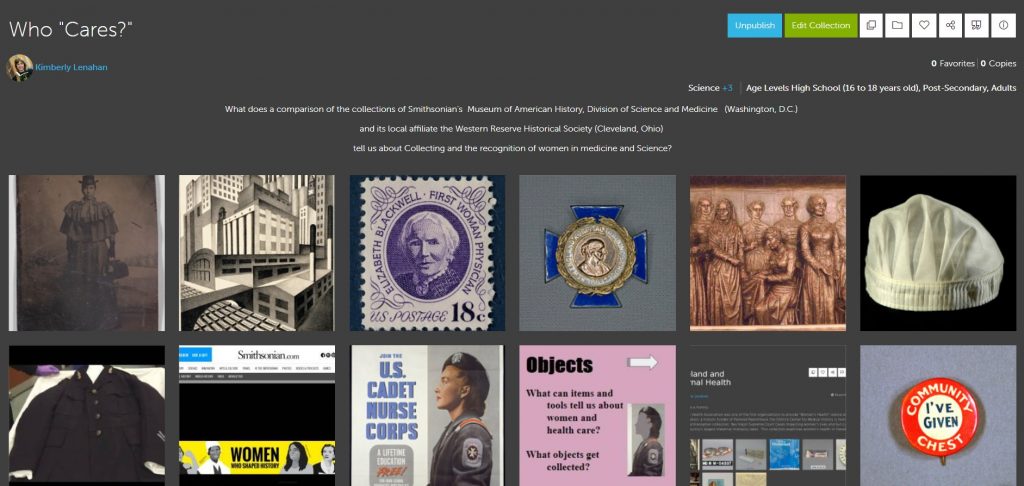
My internship was to create a Smithsonian Learning Lab exhibit that forged a bridge between the Smithsonian National Museum of American History: Medicine and Science Collections Washington, D.C., and those of the Western Reserve Historical Society, Cleveland, Ohio.

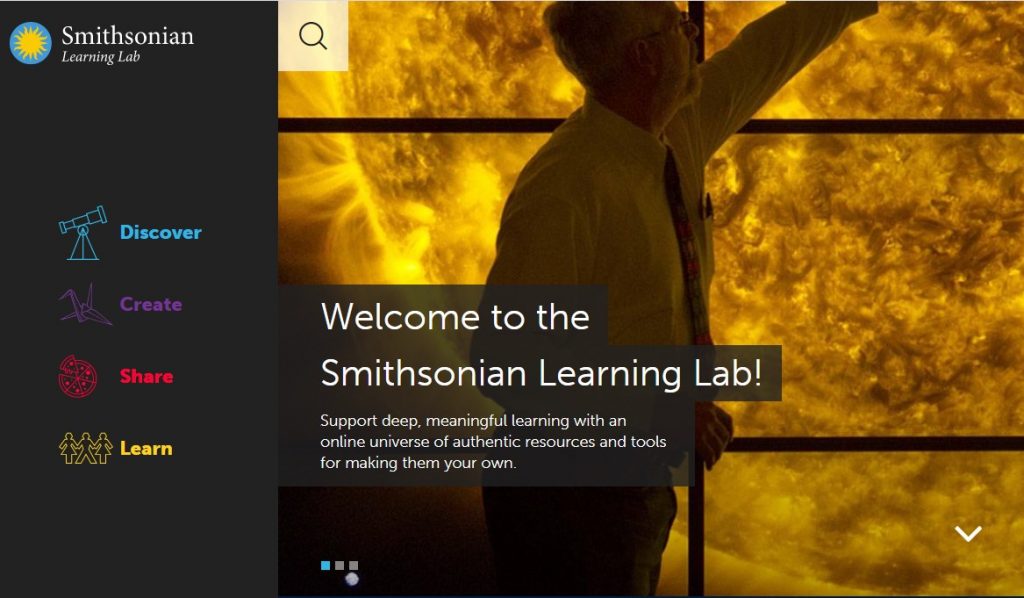
Image of the Home page of the Smithsonian Learning Lab

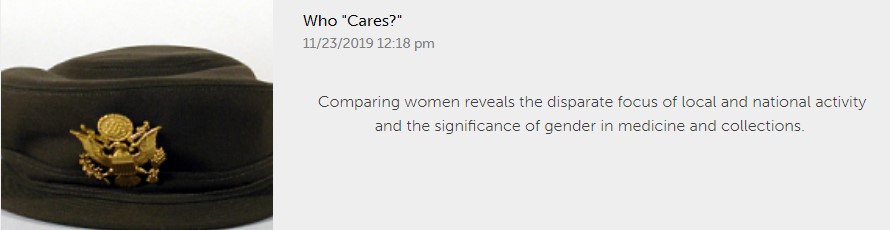
                 Please visit:  “Who Cares”  http://learninglab.si.edu/q/ll-c/3LXidXoP4xkEhBvH

Image of the exhibit created by Kim Lenahan entitled "Who Care" features thumbnails of exhibit artifacts.

“ Because of my internship, I am…”

Proud of the work accomplished: as it broke new ground in highlighting women’s achievements in the area of medicine and science, that it has provided evidence for how women are seldom recognized or their artifacts collected; that it encourages attention to be drawn to women’s lives and stories; that a novel way of promoting this history has been developed on an innovative platform that will encourage use of the collections of NMAH Medicine & Science & the Western Reserve Historical Society.

Comforted by recognizing historic limits of medicine and science, which councils’ patience when I am caring for family members, or in the face my own health challenges. I am more empathetic with the striving of myself and others to achieve recognition. I commiserate with and seek to encourage those who are quiet or who have been overlooked, viewed as ordinary as their heroism may be greater than those whom we applaud.

More courageous having attempted something new, recognized it was more difficult than anticipated and still persevered.  I am less fearful of looking foolish, breaking something, or violating rules.  I am grateful for the space and opportunity to explore, collaborate with experts, rethink the use of standard practices, technological tools, and the limits of location, resources, and connections.

Wiser for having viewed my understanding of women, healthcare, place, and significance from an entirely different perspective.  More thoughtful for having observed and experienced ‘teaching and learning’ in a different environment.

Committed to restoring what has been hidden, to being more intentional in valuing the students, the colleagues, and the people I interact with daily; to collecting their stories and their heritage and thereby the indomitable power of the human spirit.

DPH 794: Progress Blog

What do you care about?  What do You collect?

The purpose of the Smithsonian Institute, embedded in the will of James Smithson (1765-1829) the illegitimate son of an English Duke and a wealthy widow… who never stepped foot in the United States, is “The increase and diffusion of knowledge”.[1]  “With 19 museums and the National Zoo, the Smithsonian is the largest museum, education and research complex in the world”.[2]  The purpose of the Smithsonian National Museum of American History (NMAH) is “the collection, care, and study of objects that reflect the experience of the American people,” which aligns with Smithson’s interest in the American experiment. [3]   The Division of Medicine and Science within the NMAH “acquires, preserves, studies, and interprets the material culture of the biological, medical, and physical sciences.”[4]   My purpose and task is to connect my regionally focused research on ‘Women and Healthcare in Cleveland’ to the national impact of women as demonstrated through an examination of the collections in Smithsonian Division of Medicine and Science and its local affiliate the Western Reserve Historical Society.[5]  This research aligns with the strategic goals of the current Smithsonian Vision and its American Women’s History Initiative–Because of Her Story, “one of the country’s most ambitious undertakings to research, collect, document, display and share the compelling story of women.”[6]

If one attempts to research the story and influence of women, it becomes immediately apparent that “her story” has not been collected or documented in traditional historical catalogues and methodologies.  “She” does not lay claim to the firsts, the foundings, and rarely appears among the famous, unless a fatale.  To uncover the evidence of women at the local level is difficult; the evidence of women at the national level is almost non-existent.  How can it be that half (50.8% in 2010) the population is so poorly recorded?[1]  Where are the women?  I am using the Smithsonian Learning Lab as a tool for exploring and communicating the connections between Cleveland and Washington, D.C.

“The Smithsonian Center for Learning and Digital Access created the Smithsonian Learning Lab to inspire the discovery and creative use of its rich digital materials—more than a million images, recordings, and texts. It is easy to find something of interest because search results display pictures rather than lists. Whether you’ve found what you were looking for or just discovered something new, it’s easy to personalize it. Add your own notes and tags, incorporate discussion questions, and save and share. The Learning Lab makes it simple. 

By encouraging users to create and share personalized collections of Smithsonian assets and user-generated resources, the Learning Lab aspires to build a global community of learners who are passionate about adding to and bringing to light new knowledge, ideas, and insight.”[2]

Women are not the only people “missing” from the historical record in general and museums in particular.  There is a relatively large literature dating to Fred Wilson’s ground breaking exhibit, “Mining the Museum” in 1992. Persons of color and uncomfortable ideas, often share the same fate and compound our ignorance of our full and authentic past.  For my project, I must examine what can and has been collected and consider what is missing.  Or, and I think this is more accurate pursuit, find the ‘hidden women’.  Aside from the few who managed a first or married a first or miraculously achieved some rank of notoriety, women are nameless in the collection.  But they appear in photographs as assistants, they are the workers in the companies whose products have been collected, they have taken care of supported both the family and the great scientist while “He” achieved success.  Reminiscent of the television sitcoms of the late 1960’s Bewitched and I Dream of Jeannie, women made the magic happen behind the scenes.  Reflecting on this type of history is not quick and easy.  Documenting it (necessary for a historian), is a nightmare.  However our collections reinterpreted, may hold some important knowledge treasures that have been lost in the ‘American Experiment’ as it exists today.

The work continues.


[1] U.S. Census. “Age and Sex Composition:2010.”  https://www.census.gov/prod/cen2010/briefs/c2010br-03.pdf  accessed 11/23/19.

[2] Smithsonian Institute.  “About the Smithsonian Learning Lab.” https://learninglab.si.edu/about  accessed 11/23/19.  


[1] Smithsonian Institution. “Purpose and Vision.” https://www.si.edu/about/mission accessed 11/23/19.

[2] Smithsonian Institution. “About the Smithsonian.” https://www.si.edu/about accessed 11/23/19.

[3] Smithsonian Institution. “Mission & History: National Museum of American History. ”https://americanhistory.si.edu/museum/mission-history  accessed 11/23/19. 

[4] Smithsonian Institution, “Division of Medicine and Science.” https://americanhistory.si.edu/about/departments/medicine-and-science  accessed 11/23/19.

[5] This Internship is part of the Roy Rosensweig Center for History & New Media: Digital Public Humanities Certificate Program within George Mason University.

[6] Smithsonian Institution. “Purpose and Vision” & “Because of Her Story” https://womenshistory.si.edu/about  accessed 11/23/19.

DPH Blog POST 7

  1.  What insights do you have about working in digital public humanities as a result of this experience? 

The first thing I have recognized about Digital Public Humanities is the ignorance and confusion about it among the public and in academia.

     When I introduce myself or attempt to explain my project, colleagues and acquaintances have difficulty both with the concept of “Humanities” as a multi-disciplinary subject and as an academic field of research.  I remind them of longer standing multi-disciplinary areas: American Studies, Ethnic Studies, Gender Studies, Labor Studies, etc.  Explain that “Studies” allows the individual the opportunity to draw from many disciplinary perspectives: History, Language, Literature, Psychology, Sociology, Religion, in order to form a fuller interpretation and understanding of a topic or society.  Then comes the inevitable follow up question, “What makes it “digital”?  Visual interpretation, academic interaction across media, crowd interaction  and using new tools based to access massive data bases (Big Data, GIS and Public Records) allow us to aggregate and reconstruct our interpretations of human activity and expression.

Another perception is that a ‘discipline’ or ‘area of study’ it is needed, but the “Humanities” aspect, even more importantly the “History” aspect needs to be affirmed as integral to the field.

     Academics seize on the “new tools” and think the field is strictly about learning how to use or create programs.  The idea of the impact of tools on interpretation is not “new” in American History, Charles & Mary Beard had to defend their “new” methods.  Socially, we have adopted computers as aids to searching and collecting, but just as we have discovered ‘scientific medicine’ has biases and unintended consequences; we are just in the infancy of discovering how computing will shape and inform our culture.

     “Professionalization” in the field is running ahead of its articulation of itself.  I attended a digital humanities conference this past summer (which I will not publicly defame).  It claimed design to facilitate the merging of technical skills and disciplines; but sessions skewed technical, discipline based or ‘sponsored’ by organizations with an agenda.  Cross disciplinary dialogue and integration was limited.  I have also noticed that already a “boiler plate” has been adopted by Human Resource Professionals, who have been charged with creating job descriptions for this new unfamiliar field.  In the short term (3 years) I have been studying the field, already an extraordinary number of Digital Humanities job openings are requiring Library Science degrees.  Library Science certainly aligns well, but for many projects, the analysis and interpretation of the humanities based disciplines is critical to meeting the goals of creativity, human insight and the creation of new knowledge.

Like any other Humanities discipline, research requires time and money. 

     Knowledge does not come cheap.  Research is a journey in detection.  Uncovering or following the threads of an idea require time-consuming investigation.  In Digital Humanities, a portion of the cost is in new tools: creating, gaining experience with or licenses.  Presentation requires preparation time and resources.  As we move from text-based to visual culture, the cost of digitizing must be incorporated.  Access to text has become cheaper, faster, but compilation, resolution, transference of images, while less cumbersome is still evolving.  Storage is still an issue.

Finally, ‘It Takes a Village!”

      Historians have always relied on communities; archivists & librarians that lead us to materials, experts that share insight or stories pertaining to streams in our topics and other artists, poets and scholars.  Digital Public Humanities requires a broader inclusion of technical skills, technicians and new emphasis on artistic and commercial skills.

Cleveland Foodbank www.Clevelandmemory.org

2. What new questions or ideas do you have as a result of this experience?

    Can Historians continue to capture and make ‘human experience over time’ relevant?  As the digital age has overtaken us, a culture of “immediacy” has also emerged.  Students and ‘the public’ want information that is immediately relevant, aesthetically designed and easy to digest.  “Pondering the Past” is not in fashion.  ‘Looking back’ to search for answers is devalued in the face of creating new solutions, methods and future goals.  Even the short 400 years of American Experience is being condensed or eliminated in our schools in favor of teaching more “applicable” skills.  I came to Digital Public Humanities in my search to make my discipline; that emphasizes reflection on the past, interpreting the deeper meanings of human experience and tracking historic patterns and forces to foster richer and strategic decision making, more relevant and accessible.  I am still asking, “How can I help people recognize the value of their past?”

Making History!

What skills or knowledge from your coursework are you using in your internship?  Have you noticed a difference between theory and practice? Why or Why not?  This is a challenging question for me, because I have been attempting to merge history and Digital Public Humanities (DPH) and it is difficult for me to now isolate them.  ‘What are the skills of DPH and how does the theory and practice differ from traditional history’ and is what the essence of my internship’ and another effort to merge the two (history and digital humanities).

During the process of arranging for this internship and coinciding with it; I have had some planned, some unanticipated, professional and personal opportunities providing DPH engagement experience.  These ventures have provided their own insights into the theory and practice.  As I have made a concerted effort to immerse myself in all things digital humanities over the past 2 years, the experiences tend to wind together in my brain.

In terms of theory, my natural bent is to the work of Sam Wineburg who discusses the nature of historical thinking and Digital Humanities processes reflecting on the intellectual differences between the two.[1] He applies historical thinking methodology to the data gathered through digital means, in other words, ‘digital humanities’ is just a new historical methodology.  That is what I thought when I decided I wanted to learn what ‘digital humanities’ was all about.  However, every historian is taught the significance of methodology and how the body of research impact interpretation.  The use of the term “corpus” has transformed the meaning of historical research to include digital textual and linguistic analysis rather than the socio-cultural contextual analysis traditionally practiced.  Digital historians seek to incorporate the digital into our research, which changes where we search for sources and eventually influence our interpretation.  

In my internship, I am seeking to create a new corpus from established collections and then interpret and present the findings using digital strategies.  To date, I have found helpful in this process, theory that is ‘methods’ rich, such as the work of Sheila Brennan and T. Mills Kelly.  Although I am not creating a crowd-sourcing project; their framing has been helpful.  I have applied their “lessons” in content collection, technical issues, attracting visitors & building trust with potential contributors and most  important adding 25% (50% if you are a newbie like me) to TIME Estimates.  Their idea that “low barrier entry is critical”I found very applicable when recruiting partners for this internship.  I promoted maximum benefit, minimal work and management to my supervising institutions as the “low barrier entry”.  Institutional collections, even when you think you are familiar with them, have their own idiosyncrasies and the assistance of ‘the insider’ is essential.[2] The literature of digital methods AND historical thinking is helping as I process the form of the Smithsonian Learning Lab collection I am creating.[3]  However, the experts make it appear so easy.  The challenges of research, the interference of daily obstacles and filling in the gaps of technical knowledge sometimes make this adventure feel more tedious then inspiring.  But then I remember: I am creating new knowledge, in a new way……Making History!


[1] Wineburg, Sam. “Why Historical Thinking is Not About History.” History News 71, no. 2 Spring. 2016.

[2] Brennan, Sheila A., and T. Mills Kelly. “Why Collecting History Online is Web 1.5” Roy Rosenzweig Center for History and New Media. 2009.

[3] Examples include: Kelly, T. Mills. “The History Curriculum in 2023.” edwired (blog). January 2013.  Schrum, K. (2012). “A tale of two goldfish bowls . . . Or what’s right with digital storytelling.” In D. Cohen & T. Scheinfeldt (Eds.) Hacking the academy: A book crowdsourced in one week. Ann Arbor, MI, University of Michigan Press. Calder, Lendol.  “Uncoverage: Toward a Signature Pedagogy for the History Survey”. Journal of American History.  P. 1358-1370. March 2006.

George Mason DPH Internship Blog 1: Mission

The Smithsonian Division of Medicine and Science acquires, preserves, studies, and interprets the material culture of the biological, medical, and physical sciences. Connected to this particular project, the Staff of the division collects, researches, and disseminates information in the areas of the history of medicine and health, dentistry, pharmacy, psychology, disability and public health among other scientific areas.

The Mission of the Western Reserve Historical Society is to inspire people to discover the American experience by exploring the tangible history of Northeast Ohio.  The core values of the Western Reserve Historical Society rest upon four common words: integrity, stewardship, connectivity and innovation, with particular meaning for an institution dedicated to preserving and sharing the history of the people and communities of Northeast Ohio.

My role is the explorer: uncovering the hidden history and discovering the connections among local and national women who played a role in innovation, practice, delivery and policy-making in health care in Cleveland and Northeast OH.  The goal is to collect and catalog resources and present the history that lies within the archives of the Division of Science and Medicine and the archives of the Western Reserve Historical Society.

My role is interpreter:  identifying and highlighting intersections between the collections of the Smithsonian and its associate institution, the Western Reserve Historical Society.  Utilizing digital tools, I hope to visualize and exhibit how local women in the past influenced and were influenced by nationally prominent leaders, innovations and ideas. 

This internship supports the missions of the institutions which are aligned in the purpose acquiring, preserving, interpreting and sharing their material cultures to audiences.  This project will demonstrate how women’s experience and contributions in health care have local and national influence, utilizing the materials and archives of the institutions.   The development of products including: summary history, topic catalogue and digital project piece, will utilize and promote the collections of the institutions.  This history will inspire others to further ‘seek connections in the collections’ and gain a better understanding of hidden history.

I am excited to collect and identify this hidden history; create an accessible resource that can be shared by the institutions; and most excited to use digital tools and visualization to transform and share our understanding of women’s role in health care history.  There is a danger that perhaps there is no connection, but that is interesting also!  The mission is to explore, record, discover and share!  Seems totally AWESOME to me!

Phe Fyi Fo Fum… a giant journey!

PHE: Public Humanities Experience

This semester has been a journey in Public Humanities scholarship and engagement.  Juggling the creation of a public engagement web page for a university archive ‘special collection’ while learning about the theory underlying that engagement has been challenging.  Students like to dream high and while studying are exposed to the best practices, which builds high hopes and expectations.  We explored exciting Digital Public Websites such as “Bracero History Archive” (2010); The Great Chicago Fire and the Web of Memory (1999)and Driving Through Time: The Digital Blue Ridge Parkway.  Learning has been directed toward thinking about the unique aspects of humanities interaction as well as the structural & interpretive components of web presence and websites.

The goal of my particular journey has been to develop a web resource that will provide awareness of resources, connections between resources, encourage scholarship and research and promote on going work on Women and their history in Northeast Ohio.  The real ‘engagement’ aspects of my experience forced me into the application of political, strategic politics as well as challenges of hardware and software, all while being confronted with insights of experts who exposed fallacies in practices and promoted a deeper awareness of audience needs and the connections between tools and conveyance of information.  Each aspect of the education, challenged my conception of the project.  The struggle with deadlines certainly simulated real life production pressure.  Meeting with collaborating individuals and institutions resulted in constant refinement and the dynamic challenge of conflicting goals and interpretations.

Ideas are made real by experiences and when they take place in the public setting they create true human engagement.

FYI: For Your Information

The purpose of digital humanities is to engage people in the ideas, purposes and actions of the world about them.  This does not sound so difficult until it is realized that communicating big and complex ideas to individuals who vary in age, culture, intellectual experience and ability is also being mediated by space, context and technology.  “Interaction (between presenter & receiver) is almost always necessary to accomplish your goals.”  Perspectives and cultures not only of people, but of the ‘organizations of collection’ themselves, among the objectives of the public education, and the audience which varies in capability & experience are all approaching this communication very differently.  It is only through building relationships, that clear and engaging communication can be developed.[1]  It is not merely thinking about the idea we wish to communicate, it is about rethinking about what the visitor is able to receive.  The idea of thinking about “visitors” to public museums, institutions and parks in terms of ‘relationships’ results in a radically different engagement.[2]  When “visiting” was solely defined by physical space, often difficult and expensive to access the “engagement” was much different than when access  to technology demands multi-sensory and multi-platform intersection.  Even though it still may be difficult and expensive to create, it is necessary for the audience to perceive the information we are trying to exchange.

If we want the audience to understand appreciate and act upon or incorporate our information; we must understand and intersect with their modes of communication.

FO: Field Operations

While Citizen Archivist,  The Postville Project and Digital Harlem have provided ideal types for my own ideas, it is not until I got into trying to create a project, that the complexity, collaboration and comprehensive strategy of these undertakings became evident.  These websites are masters of design and integration.  The elements of my project seemed fairly simple:

  • create a list of resource links to make resources accessible in a centralized portal
  • install an exhibit space where women’s history can be demonstrated
  • provide a contact sheet so that information can be exchanged and
  • enable a dynamic space where interesting projects can be announced and engage contribution

Immediately I was challenged by the concept of ‘is my concept of sharing information’ really sharing?[3]  Or am I maintaining control over the sharing, which is not really sharing.  Is there a deeper way to engage?  Am I providing a “newsletter” or a collaborative space?  Am I providing a design that invites the user into the topic and enables them to develop their own thinking as well as absorbing mine?[4]

Considering the audience as a specific individual, is an exercise forced me, as the creator of the site, to move from general concepts and overblown expectations as to who would really access this site.  It also made clear that engaging the content from different perspectives, helps define and present that content in more accessible ways.[5]  I experienced these different perspectives in meetings where interested potential users asked me questions I couldn’t answer.  So much for being an authority on the topic.  But even more humbling was translating my vision into technical reality.  Tools have always been limited.  They are extensions and helpers, but they are not the same thing as a concept.  The vision must be altered by what is possible to accomplish with the tool.  If the tool is insufficient it must be altered or exchanged for a different tool.  I tried to force a dynamic collaborative website concept into a tool that was meant for identifying and collecting things.  If I had technologic expertise or a collaborative team, I might have been able to adapt the tool.  However, I am also working with an established system and there was an unwillingness to adapt their system to my vision.  Back to the drawing board for reconception of how to convey my meaning within and established format.  It was necessary to share control, concept and expression.[6]

FUM: Formative Understandings & Musings

I had envisioned myself as an open and forward thinker.  My journey into digital humanities has challenged that self-conception.  I realize how my training in critical thinking has created its own set of biases and obstacles to communication.  Considering users as specific people with needs has shaped my thinking in terms of content selection. It also demands a broadening my use of tools, to facilitate my communication, rather than expecting others to put forth the effort to grasp my meaning.  Using technology has made me more aware of the multiple layers of interfaces and how that may limit our expressions and reshape our interpretations by focusing our content in “easily accessible tools or images”.  It has deepened my appreciation of the past and the present.  It has sharpened my awareness of the need to communicate ideas more frequently and engagingly.  It has indeed been a giant journey!

[1] Allen-Greil, D., et al. “Social Media and Organizational Change.” In J. Trant and D. Bearman (eds.) Museums and the Web 2011: Proceedings.Toronto: Archives & Museum Informatics. Published March 31, 2011. And Corbett, Katharine T. and Howard S. (Dick) Miller. “A Shared Inquiry into Shared Inquiry.” The Public Historian 28.1 (2006): 15-38.

[2] Lindsay, Anne. “#VirtualTourist: Embracing Our Audience through Public History Web Experience.” The Public Historian 35.1 (February 2013): 67-86.

[3] Michael Frisch, “From A Shared Authority to the Digital Kitchen, and Back,” in Letting Go?: Sharing Historical Authority in a User-Generated World. Edited by Bill Adair, Benjamin Filene, and Laura Koloski (Philadelphia: The Pew Center for Arts and Heritage, 2011) 126-137.

[4]Tim Sherratt, “It’s All About the Stuff: Collections, Interfaces, Power, and People,” Journal of Digital Humanities 1, no. 1 (March 9, 2012), http://journalofdigitalhumanities.org/1-1/its-all-about-the-stuff-by-tim-sherratt/

[5] Tim Sherratt, “It’s All About the Stuff: Collections, Interfaces, Power, and People,” Journal of Digital Humanities 1, no. 1 (March 9, 2012) and Steve Lubar, “Exhibit and Exhibit Labels Workshop, On Public Humanities, March 31, 2015.

[6] Tammy S. Gordon, “Community Exhibition: History, Identity, and Dialogue,” Private History in Public: Exhibition and the Settings of Everyday Life (Lanham: AltaMira Press, 2010). 33-57 plus notes.
“Progress” Blog

“Progress means getting nearer to the place you want to be. And if you have taken a wrong turning, then to go forward does not get you any nearer.If you are on the wrong road, progress means doing an about-turn and walking back to the right road; and in that case the man who turns back soonest is the most progressive man.”
― C.S. Lewis, Mere Christianity

So the question for this weekly progress report is “what constitutes progress?”

I am learning the ins and outs of Digital Humanities – I am evolving in terms of my understanding of the larger significance of changing presentation modes from text to Digital Formats.  There is improvement in my abilities to navigate tutorials and digital interfaces that are growing with practice, practice, practice.  This practice IS frustrating, but skills are skills and skills get developed through repetition.  Preferably the practice would be fruitful, rather than fruitless. I spent hours in tutorials, I then searched for videos on the tutorials, and user forums.  I have contacted complete strangers and asked for help.  I called in somewhat helpful techies, but they got frustrated also.  I studied other’s exhibits…. trying to figure out how they were adapting the same theme I was using and getting very different results.  I spent more hours with dual screens following the directions and trying to make my page work.  I have something similar to the plan…but not quite what I had envisioned.  I have another section to go… but don’t even know how to attempt it or if it is possible to do.

The challenge for the traditional historian is the shift in time.  Traditional historians spend time in documents and research, not in presentation.  The loss of research time to computer construction is quite frustrating because it feels like “wasted” time.  A portion of the frustration arises out of unrealistic expectations.  Omeka is “an open-source platform” for digital archives and collections.  It is described as,  “makes web-publishing easy”.  Furthermore, “The developers at the Center for History and New Media have done a wonderful job providing a concise and understandable tutorial for first-time Omeka users”.  Teaching Hist.org   There should be a caveat behind these words…..’if you are already a developer, have computer programing or web skills.

Our public humanities literature promotes awareness of audience.  Review of local history and community websites demonstrates their need to define themselves as relevant to outsiders.  I have become acutely aware of ‘unintended bias’.  While struggling to navigate digital tools and production, I am wondering if my historical content is as difficult for digital natives to learn or appreciate, as learning the digital platforms is for me.  I think about the classes I teach and I believe it is.  Historians have jargon and expectations – surely you know when the U.S. Constitution was signed.  ‘Everyone understands that there are 3 branches of government in the U.S. and why the Supreme Court decisions are significant’…but really, not so much.  In on-line tutorials, it is evident the person who wrote the tutorial knows the product.  Their knowledge assumes digital literacy in the person to whom they are explaining the process. I find myself spending as much time looking up instructional terms or for other sites explanations of the tutorial ideas, as I do actually implementing the tutorial. There is a gap between the novice user and the literature around web design and development.  There are gaps between the historian and the historical novice.  There are gaps between the person or organization creating a public humanities exhibit and the audience.

Some of the challenges I have faced are:  It took me 2 weeks to get my page sort of working and then I realized there was a problem with the version of the Omeka Exhibit Builder I was using (from others working on similar projects – all along, I thought the problem was me).  I upgraded my exhibit builder and lost my exhibit in the process.  Working with Support is difficult, because even Support acts like you should have a certain degree of expertise to even be attempting this, ‘What were you thinking?’  …’I don’t know, I believed your promo that this software is designed for the non-techie?’.

I have made progress in: The Support site told me to change the source code….yeah, right – well I did, but it didn’t work…so fortunately I was able to change it back.  But I actually had the courage to change the SOURCE CODE!  I have learned, I am capable of following instructions that are more and less helpful.  Dual screens are really helpful.  I have realized that techies in person are much like the tutorials – they are thrilled with what they are doing …while I struggle to follow.   This has led to a critical realization … when I talk history, I am thrilled with what I am doing and people may be finding it hard to follow.

History must be a public endeavor.  The world can become isolated in digital silos.  The rewards of digital history are more understanding and connection.  Humanities engagement teaches how other people think and how to conquer obstacles and how to work together.  Learning new tools and skills is time consuming  and frustrating and making the world PROGRESS!

Notes:

https://quotation.io/page/quote/progress-means-getting-nearer-place-want  accessed 3/30/18

http://teachinghistory.org/digital-classroom/tech-for-teachers/25115  accessed 3/30/18

Some of the work shaping my thinking:  Tim Sherratt, “It’s All About the Stuff: Collections, Interfaces, Power, and People,” Journal of Digital Humanities 1, no. 1 (March 9, 2012), http://journalofdigitalhumanities.org/1-1/its-all-about-the-stuff-by-tim-sherratt/; Michael Whitelaw, “Generous Interfaces for Digital Cultural Heritage Collections,” Digital Humanities Quarterly 9, no. 1 (2015) http://www.digitalhumanities.org/dhq/vol/9/1/000205/000205.html; John Kuo Wei Tchen, “Creating a Dialogic Museum: The Chinatown History Museum Experiment,” in Museums and Communities: The Politics of Public Culture, edited by Ivan Karp, Christine Mullen Kreamer, and Steven D. Lavine (Washington, DC: Smithsonian Institution Press, 1992) 285-326.  Katharine T. Corbett and Howard S. (Dick) Miller, “A Shared Inquiry into Shared Inquiry,” The Public Historian, Vol. 28, No. 1 (Winter 2006) 15-38.  Michael Frisch, “From A Shared Authority to the Digital Kitchen, and Back,” in Letting Go?: Sharing Historical Authority in a User-Generated World. Edited by Bill Adair, Benjamin Filene, and Laura Koloski (Philadelphia: The Pew Center for Arts and Heritage, 2011) 126-137.  Spichiger, L., J. Jacobson, Telling an Old Story in a New Way: Raid on Deerfield: The Many Stories of 1704 , in J. Trant and D. Bearman (eds.). Museums and the Web 2005: Proceedings, Toronto: Archives & Museum Informatics, published March 31, 2005. http://www.museumsandtheweb.com/mw2005/papers/spichiger/spichiger.html