Category Archives: Reviews

DPH 794: Post 8 InTERNSHIP ReflectIonS

My internship was to create a Smithsonian Learning Lab exhibit that forged a bridge between the Smithsonian National Museum of American History: Medicine and Science Collections Washington, D.C., and those of the Western Reserve Historical Society, Cleveland, Ohio.

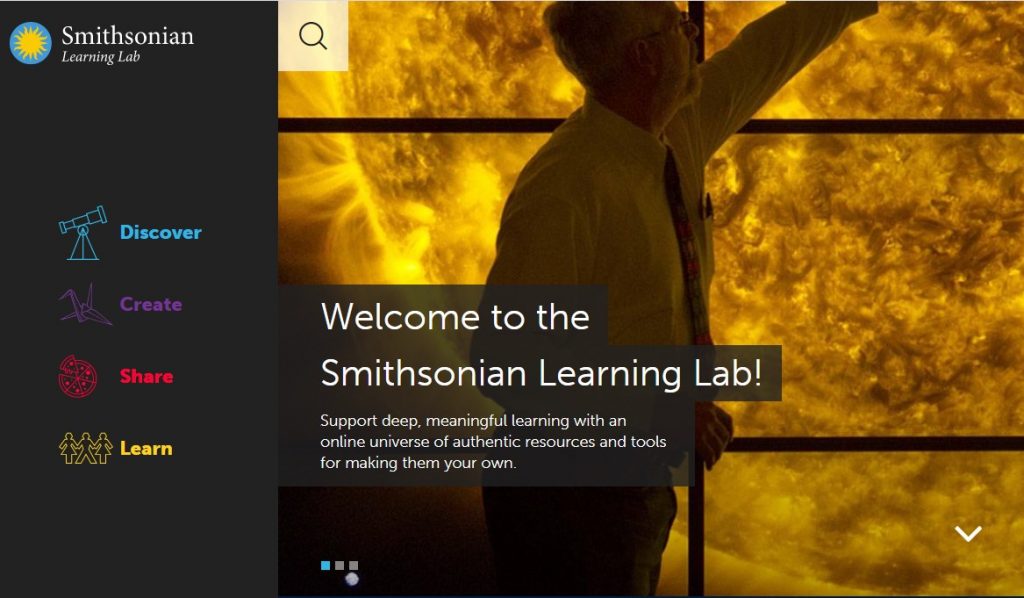
Image of the Home page of the Smithsonian Learning Lab

                 Please visit:  “Who Cares”  http://learninglab.si.edu/q/ll-c/3LXidXoP4xkEhBvH

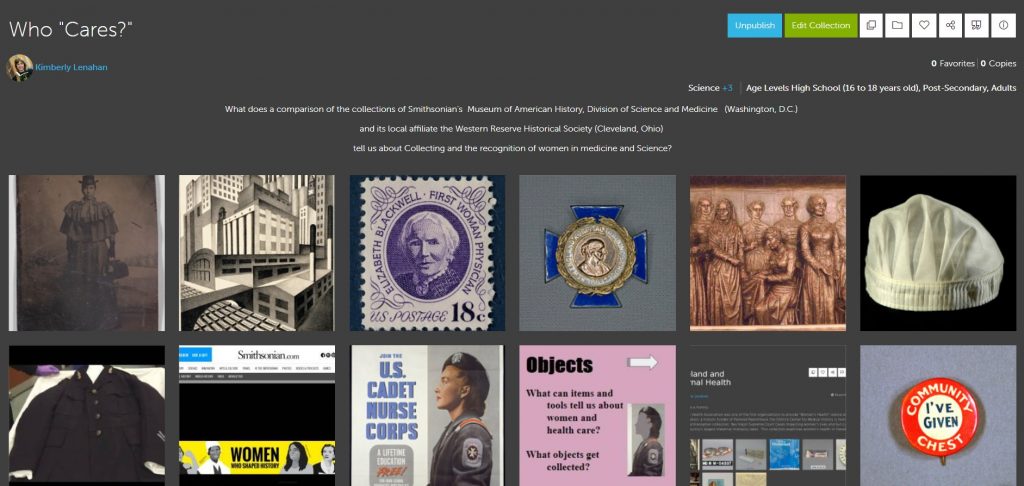
Image of the exhibit created by Kim Lenahan entitled "Who Care" features thumbnails of exhibit artifacts.

“ Because of my internship, I am…”

Proud of the work accomplished: as it broke new ground in highlighting women’s achievements in the area of medicine and science, that it has provided evidence for how women are seldom recognized or their artifacts collected; that it encourages attention to be drawn to women’s lives and stories; that a novel way of promoting this history has been developed on an innovative platform that will encourage use of the collections of NMAH Medicine & Science & the Western Reserve Historical Society.

Comforted by recognizing historic limits of medicine and science, which councils’ patience when I am caring for family members, or in the face my own health challenges. I am more empathetic with the striving of myself and others to achieve recognition. I commiserate with and seek to encourage those who are quiet or who have been overlooked, viewed as ordinary as their heroism may be greater than those whom we applaud.

More courageous having attempted something new, recognized it was more difficult than anticipated and still persevered.  I am less fearful of looking foolish, breaking something, or violating rules.  I am grateful for the space and opportunity to explore, collaborate with experts, rethink the use of standard practices, technological tools, and the limits of location, resources, and connections.

Wiser for having viewed my understanding of women, healthcare, place, and significance from an entirely different perspective.  More thoughtful for having observed and experienced ‘teaching and learning’ in a different environment.

Committed to restoring what has been hidden, to being more intentional in valuing the students, the colleagues, and the people I interact with daily; to collecting their stories and their heritage and thereby the indomitable power of the human spirit.

Thinking about Thinking & Learning

This is not news but…a very interesting and extremely useful component of on-line learning is the flexibility to watch & learn on your own schedule.  Also, to stop a lecture or interview to listen again and/or to reflect on what is being said.

Internet Book Archive/ Flicker

Erin Bush’s advice to rethink the syllabus caused me to ‘rethink’ the way I am thinking about Learning Objectives.  I have been considering learning objectives as a checklist rather than a scaffold. My process had been to designing a course and then return to the objectives to assure they were all being met.   However, thinking about objectives as “engagements” and then layering them into a course in a novel idea for me.   Her reflections on considering what resources she would have to create, also stimulated my thinking regarding how I am approaching resources.  These considerations will be impacting how I design my fall courses.

The challenges expressed by Wieringa and Sharp, were similar to the issues that stimulated my interest in the George Mason Digital Public Humanities course.  Their goal of practice, which mirrors my own concern with developing historical writing, helped me recognize that shorter length and greater diversity (actually lowering what was demanded in each assignment) might help meet the ultimate goal in a more realistic fashion.

Examples and interpretive styles demonstrated in the Hardy, Swain and Pethel & Gris interviews have expanded my awareness of tools.  Specific application and adaptation of: Smithsonian resources, guides that others have created and utilization of the wider array of primary and secondary sources online; will need development.  The stimulation renews my enthusiasm and energy for thinking more carefully about the essence of teaching and learning.

I appreciated Andris Straumanis’ reflection, not so much for new ideas, but significant disciplinary insights.  His comment on helping students understand the role of poetry in 19th Century journalism reminds us of teaching the details of historical context.  His recognition of the significance of working with other students in this course reminds us of the importance of collaboration, not only with fellow students, but with colleagues inside and outside of our disciplines.  As internet resources become vaster and we collaborate on-line with other experts in our own areas, it is important to remember that talking with people and listening to the experience of others can profoundly impact our awareness.


Oral Tech!

Oral History Metadata Synchronizer    http://www.oralhistoryonline.org/

“The Louie B. Nunn Center for Oral History at the University of Kentucky Libraries OHMS provides users word-level search capability and a time-correlated transcript or indexed interview connecting the textual search term to the corresponding moment in the recorded interview online.

  • OHMS Application: The OHMS application is where the work is done. This is the back-end, web-based application where interviews are imported, and metadata is created.  In the OHMS application transcripts are time-coded and/or interviews are indexed.  Upon completion, the interview record (including the synchronized transcript and/or time-coded index) are exported as an XML file.  When located on a web server, the OHMS XML file is what interfaces with your content management system through the OHMS Viewer.
  • OHMS Viewer: The OHMS viewer is the user interface of ohms. When an interview is called by the repository, the OHMS viewer loads, calling select interview level metadata and the intra interview level metadata created in the OHMS Application from the corresponding xml file.”

Examples  http://www.oralhistoryonline.org/examples/

Does this look like a commercial?  I apologize.  Although I am not currently working with Oral History, I have conducted and tried to utilize oral history in the deep dark past before the interviews were videotaped and indexed.  It was painstaking and the quality variable.  Like many others, I turned to easier sources for my work. This cool new tool is a game changer because it makes Oral History Accessible!  Examining the Resource & guides  indicates that the production is by no means a magic wand.  But the structure eases the transcription process and the data tools make all the production worthwhile, because at the end of it, more people will be able to access the content.  I immediately sent the link to all my friends doing Oral History, who probably already knew about it, because they DO oral history.

There’s No Place Like Home

Landscape, Environment, Location, Community, Local Culture, are really terms that describe Public History, in a space some people call “Home”.  People’s homes and pasts, are their identity.  Public history has a dual responsibility to convey information about the past, but it also has to resonate with the culture it is expressing.  Good public history creates a story that so well reflects people’s identities and captures their memories, that even difficult subjects can be addressed.  Traditionally, history has been drawn from objects and documents that people can feel and touch.  Stories written, passed down orally or conveyed in song or drama helped to portray the human experience through direct contact.

Digital public history expands the tools used to interpret and connect to the past.  For example in “World War One: Love and Sorrow – A hybrid exhibition mobile experience.” Visitors choose from among eight characters in a mobile application to guide their museum experience.  This character and Bluetooth technology helps them personalize and focus on specific aspects in the themes of the exhibit: ‘Spirit of the Times’, War Experience, Wounds, War at Home & Life after with the ultimate goal of exploring the true cost of war.  The character & technology particularly enable the visitor to identify with the Victorian Gaze, encounter stories that are usually avoided, and engage and debate in new ways and expand access to resources and the exhibition beyond the gallery through on-line support.  Technology creates an excitement and a new interesting way to challenge what might first appear to be a familiar past.

Digital History is mediated.  It is viewed through a lens that may be video (camera angles and focus determined by the director) or captured and digitized documents, images, or collections. These processes make the object more accessible and usually more visible or clear, but the context, texture and dimension may be lost.  Often the creation of Digital History requires the assistance of experts who may not be from the local community.  Involving the local community in the creation of these histories can result in better understanding and authentic experience that makes history ‘come alive’.  All history is about connections between people and the forces that are operating around them.  Even when it is local, it is reflective engagement with a period that no longer exists.  Effort is required to make intersections between the past and present both familiar and informative.  Mobile Apps, collected as galleries in sites such as Historypin, Clio & Curatescape Projects, make these connections for resident and visitor (actual or virtual) highlighting the uniqueness and significance of our homes.

Home on the Range

Mobile technology is also providing ways to engage with specific stories of the past in real time and place.  Curatescape Projects, Histories of the National Mall, Museum of London, Street Museum, Walking Cinema, and Murder on Beacon Hill are sites that enable users to access history based on  their physical location bringing up stories that are identified by GPS signals.  Instant information is a daily experience. Providing information when visitors need it addresses the culture that expects choices and is highly time sensitive.  Walls are tumbling.  Institutions that can meet potential audiences at the moment their interest is generated, in styles that are familiar actually draws them into a relationship.  Positive, preference-based experiences helps patrons “get the most out of a visit without having to dig through information that isn’t of interest … this concept while relatively new to museums, is common practice in industry.”  Baer et al.   Learning does not happen only in classrooms.  Having a web presence, makes the museum or public heritage site an active and accessible resource.

According to Mark Tebeau, “oral history and digital practice share an underlying activist endeavor, one that breaks down traditional power relations and re-imagines communities as part of the process of scholarly production.” The Curetescape platform developed first in Cleveland Historical “integrates public history, oral history, and digital humanities practice.”  It provides an alternative perspective by focusing on the storytelling process.  Rather than objects or images, tales are sought from the community and recorded and the stories of the city are collected.  Voices of the past, as well as image and interpretation are immediately available in the geo-located spot. Mobile technology is like a tap on the public shoulder, raising awareness of the connections of culture and inviting further investigation.  It makes public institutions relevant in daily activity and on the street!

ET Phone Home

Integrating the analysis of “landscape” and digital humanities reinforces specific practices and raises new awareness of some practical considerations in my mind.  It is significant that that all “homes” are not the same.  Reflecting on how and why a ‘place’ has its own unique character and how people live and interact in that space, is enriching to both the people that live there and visitors.  Locating actions, events, connections and people to a specific spot helps make them real.  ‘Anchoring’ locations, serves the same purpose as a timeline, enabling us to identify connections of human activity and aspiration.

When we tell our stories we need to recognize that people come from different homes that impact their experience of the story.  This ‘home’ arises not only from their cultural background which may differ from the site of the story, but also in their interests and means of engagement:

  • The “Idea” person likes to understand how the ‘big picture’ works.
  • The “People” person is attracted to personal and emotional connections.
  • The “Object” person is attracted by the aesthetics of the object.
  • The “Physical” person seeks physical and sensory experiences.

Baer, et al. “Beyond the Screen”

Our stories will be better appreciated and understood if we include ‘handles of familiarity’ for our audiences to grasp and connect.  There are practical considerations of presentations no matter the location: do people have access to the technology, are the instructions clear, what are the difficulties a stranger might experience, etc.  “Design” is the tool we can use to reflect on the entire experience of the engagement.  The design process includes far more than colors or letter styling.  If we approach digital humanities projects with the concept of collaborative design, an inclusiveness of expertise, resource, engagement, audience,  tools, and perspectives, we have a much higher chance of success.

“The purpose of a museum experience, public heritage site, (or good digital humanities project) is to create ‘memorable moments’”. Hart  Homes are spaces filled with the good and the difficult and they shape our experience.  When we open our homes, guests bring new ideas.  We share our experiences and our stories.  Our lives are understanding increases and our lives are richer.

Notes:

Tebeau, Mark. “Listening to the City: Oral History and Place in the Digital Era.” Oral History Review 40.1 (2013): 25-35.

Hart, T. and Brownbill, J. “World War One: Love and Sorrow – A hybrid exhibition mobile experience.” In Museums and the Web Asia 2014, N. Proctor & R. Cherry (eds). Silver Spring, MD: Museums and the Web. Published September 19, 2014.

Baer, Brad, Emily Fry and Daniel Davis. “Beyond the Screen: Creating interactives that are location, time, preference, and skill responsive.” MW2014: Museums and the Web 2014. Published February 1, 2014.

Exploring Cleveland Historically

I downloaded the Cleveland Historical, produced by the Center for Public History & Digital Humanities at Cleveland State University.

Mobile Public History App

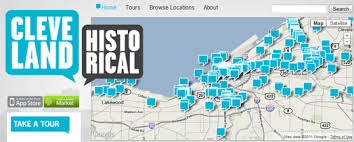
Cleveland Historical is promoted as a mobile application that provides a GPS-enabled map, historic images from Cleveland’s top archival institutions and an interpretive view of Cleveland and Northeast Ohio history.  I had seen Cleveland Historical in its infancy as it is connected to Cleveland Memory and the CSU Center for Public History.

Center for Public History and Digital Humanities

The on-line version is more of an archival record format.  In its early state, the architecture was clumsy, the images fuzzy and many in the historical community viewed it as a ‘limited repository’.  When I tried to download Cleveland Historical from my home in a nearby suburb, it did bring up lots of great photos for Lakewood and the nearby communities.  Seemingly a random collection of documents and photos, I could not get a clear idea of what was chosen & why.  Either none of the sites had audio or they wouldn’t load.  Basically I reverted to my earlier judgment, ‘Kinda klunky but interesting, at least Cleveland is trying’ (it’s a motto here).

When I tried the mobile app from my office downtown, I was stunned by the difference.  Cleveland Historical really is a dramatic leap forward in technology and engagement!  When I opened it, the GPS-enabled map popped up a series of “Stories” historic images between .25 mi and progressively distant to my immediate location.  The top of the screen navigation bar gave the options: Stories, Tours, Map

  • Clicking on the Story selection brought up related thumbnails. Each entry had thumbnail image, a log distance and name. Clicking the thumbnail brought up a larger photo and historical description.
  • Clicking on the folded map brings up a location map that can be enlarged or reduced, scrolled or there is a bar to get directions which locates with directions the photo you have opened.

Back conveniently takes you back to the previous item.  Several ‘stories’ that have audio & video options indicated in the navigation bar at the top of the page.  Clicking on a headset or movie reel will produce a new list of clips: interviews, reports, images, newsreels.  The user can continue to scroll to distant locations or search on keywords.

Many of the clips and short documentary videos are drawn from CSU’s Cleveland Regional Oral History collection.  Cleveland Historical is designed to be a collaborative project with stories created by teachers, students, professors and community members.  While curated by the Center for Public History + Digital Humanities, the goal is to have the community actively participating in making and remaking its understandings of place and identity.  Tebeau believes “Listening and the human voice, in particular, evoke ‘place’ in visceral and profound ways.” Human voices call forth memory, time, and context.  Other images are drawn from a full range of collections from local institutions such as the Cleveland Museum of Art to family photos or the Cleveland Press, journalistic collection.  The selections are chosen based on location and engagement for example near to the grounds of the prestigious University Circle area with many significant institutions, a thumbnail of the Hessler Street Fair is included (this is an alleyway, which still maintains its original woodblock construction, and hosts a neighborhood festival every year).  The “Tours” option is very useful for visitors, providing walking or driving options to cover a topic area such as the Underground Railroad, Great Migration or history of Rock n Roll!  It did inspire me to ‘get on’ with my project as when I searched on women the thumbnails were obviously architecture or events that included “women” in the text or metadata.  As with all public history, there is more work to be done!  But Cleveland Historical is a very cool app and a great start!

https://clevelandhistorical.org/  accessed 4/8/2018.

Tebeau, Mark. “Listening to the City: Oral History and Place in the Digital Era.” Oral History Review 40.1 (2013): 25-35.

http://urbanhumanist.org/2011/07/30/from-cleveland-historical-to-mobile-historical/ accessed 4/8/2018.

Ruminating on Website Identity

Examining a series of Local and Community History Websites, the sentiments of Ronald Grele are again raised to mind; “Whose Public, Whose History?” and, just “What is the Goal of Public History?” Community sites reflect an remarkable range of purposes, quality, types of engagement, public and private predilections and an amazing array of human stuff.  The virtual world is really not that different from the real world.  The presence of the luxuries of time and resources are evident; but not always synonymous with quality.

The real challenges of creating a local or affinity-group history is understanding; the difference between what is unique and what is common, what might be interesting to others and creating a visual presence that captures these ideas.  In some ways the old days of dusty papers and books were better.  Words could express and develop images of the past in the minds of the reader.   Web culture demands less text and more representational content.  Digital technology inserts a visible design and technological interfaces into the conversation between historian and audience. Connecting (clicking & scrolling) to move from themes and content areas to the next has to be easy.  The storyline or development of ideas has to be refined to the ‘digital level’, so that areas of the webpage can be defined and stored.  Collecting a quantity of truly authentic representational images can be extremely difficult for complex ideas or scarce artifacts.

Creating a web presence also requires a merging of skill sets.  People who have the technological capabilities to construct the website, have to play well with the people who have knowledge about the entity or information they are trying to share.  An example of failure to express an “identity” is seen in the overbold, multifaceted Ohio History Connection website. Whereas the very simple, Low Country Digital History Initiative places the user immediately into a context.  Information, scope of activity, clear identity and purpose of the organizational website OutHistory.org is effectively packaged in its newsletter style landing page.  Whereas, the compartmentalized, catalogue feel of The Portal to Texas History leads more to observation than engagement.

Denise D. Meringolo explained that the essence of Public History has always been to find ways to communicate ideas to the public.  Intentionally comparing websites, shifts the attention from searching for content, to considering what the sites are trying to accomplish.  Is the site able to establish communion with its user?  The process of engaging the community and audience of a website has been explored and analyzed by John Kuo Wei Tchen.  The power of this “unseen” aspect of website development is reflected in the effectiveness or inability of a site to present itself and inspire desire in the user to pause and ‘visit’ for awhile.

Some lessons I have drawn include:

-little details are important (the repeating background of the ‘at first’ interesting map of Washington, gets old).

-a visitor has no context why would the Gale Family library be interesting to me, although the members of the Minnesota Historical Society, probably know.

– efforts to be inclusive can also be exclusive and misrepresentative.  Another problem for Minnesota whose images all present cute children or diverse groups.  The ethnicity of MN is primarily Scandinavian & Northern European (http://www.exploreminnesota.com/travel-ideas/discover-minnesotas-ethnic-heritage/) but one would not learn this from scrolling through the website.

-be careful of technology!!! The rapid, blinking, disruptive scrolling headline of Virtual Watervliet was totally annoying to someone who was trying to consider what was contained or linked on the rest of the landing page.  I moved on quickly.

-design!  Most of these pages are really quite similar in format, but colors, styles and placement make phenomenal differences.

– I definitely need a navigation bar which I was resisting.  But less can be more (compare the simple but effective navigation of Connecticut History to the overdone three rows in Ohio History Connection (most of which link to giving or spending).

The Postville Project while not my favorite in terms of design or projecting an identity, contained several appealing features that are very applicable to my project.  These include: upfront explanation of the project purpose, small snapshots as opposed to the full moving header, the sideways scroll for the featured collections, and the way “Collections” link list is handled with the tab in the navigation bar is the primary motivation for my changing attitude about including a navigation bar.  Digital Harlem remains my ‘mentor’ site in terms of research and project development, but Postville presents a more manageable example of a “project in process”.

Websites with their assets and detriments, subject matter and design presented in endless variety contribute to our knowledge and encourage us to communicate the diversity and wonder of human experience.

Notes:

Grele, Ronald J. “Whose Public? Whose History? What is the Goal of Public History?“ The Public Historian, Vol. 3, No. 1 (Winter, 1981), 40-48.

Kuo Wei Tchen, John. “Creating a Dialogic Museum: The Chinatown History Museum Experiment,” in Museums and Communities: The Politics of Public Culture, edited by Ivan Karp, Christine Mullen Kreamer, and Steven D. Lavine (Washington, DC: Smithsonian Institution Press, 1992) 285-326.

Meringolo, Denise D. Museums, Monuments, and National Parks: Toward a New Genealogy of Public History (Amherst: Univ. of Massachusetts Press, 2012).

Collecting DIGITAL Public History

Digital collections first allowed for the “movement” of text.  Ease of correction improved attention to the words, increasing editing, which promoted clarity, and actually, more content.  This movement drew more attention to placement of the words on the page, and the evolution of ‘text’ (a newspaper term) in ‘space’ as opposed to on a page.  Technological innovations have placed the power of movement, placement and publication into the hands of an individual, away from big machines with numerous workers.  (An unintended consequence has been the loss of jobs in the publishing industries, but that is another story).  For public history, this “movement” has resulted in reformulating “the exhibit” from a static “display” into an “engagement process”.  Audiences have become used to instant access to information and overloaded by the constant barrage of information both useful and useless.  Public history has needed to innovate to capture and engage (hold the attention of) its audiences in order to help them slow down and help them reflect upon the meaning of their past, present and future.

Ronald Grele’s, “Whose Public?  Whose History?” critiques traditional history for focusing on the grand “dramas of wide sweep and broad interpretation, up-beat pageants which trace a major theme in American culture and point to the inevitable success of the United States as a nation.” He asserts the creation of a “monograph {reading} elite”, “isolation from peers and the market place” are the results from this form of historical work.  Grele calls for skill based historians that can enable the public to “do their own history”.  Progressive historians have been around for a long time and so have the critiques of their work, my own favorites being the work of Charles and Mary Beard, Gerda Lerner, Estelle B. Freedman and the courage of Stacy Shift to tackle ‘familiar’ public histories with new approaches.  My own question of Grele would be, ‘Have “members of the public” had the time to reflect deeply on their own circumstances in context?’  Analysis of recent voting history demonstrates that in interpretation of one’s own place in society is skewed by many factors. (NYT, Vance)  I agree with Grele that a participatory engagement with history will promote “understanding their role in shaping and interpreting events” but I also believe that time for a historian to focus on analysis is equally important as the skills of presentation and engagement.  In a perfect world, the expansion of both areas would be an economic engine providing jobs and an informed, active democracy (though, if that isn’t progressive, I don’t know what is).

In the meantime, new digital tools, like Omeka, provide assistance to the historian or public institution enabling them to:

  • access collections previously restricted by distance and preservation requirements
  • illustrate ideas with popular and archival resources
  • create global audiences
  • encourage response and interplay with artifacts and ideas
  • provide resources to both examine and perhaps challenge traditional beliefs
  • generate global conversations
  • stimulate new ideas and public action

It is therefore crucial that we utilize the digital resources and platforms to encourage public interest, memory and reflection utilizing familiar and intriguing mechanisms (images, questions, puzzles, games, instant information).  When the attention has been captured, it becomes the historian’s job to expand the perspective, depth of awareness and suggest consideration of the varied meanings of these histories.

Understanding the history of Cleveland Women can benefit by incorporating the tools, resources, platforms and utilizing the theories of Digital Public History.  Three projects, among the multitudinous, excellent projects that have been created; have particularly captured me as guides for addressing the history of women in Cleveland: Citizen Archivist Dashboard, Digital Harlem and the Western Reserve Historical Society.  These sites are obviously very professional and were created through large budgets which can cover the costs of time, teams, multi-partner collaboration, and expertise of all types including: historians, archivists, designers, artists, IT systems architects, developers, programmers, etc. But, each of these sites contains elements and draws attention to aspects which the Cleveland Women needs to incorporate to target its audience and enable historical thinking about the role and significance of women in Cleveland’s past.

  1. I am beginning with Citizen Archivist Dashboard because the particular aspect of this site is a bit further down the road for Cleveland Women – Community Engagement through Crowdsourcing. Citizen Archivist Dashboard has the same ability that I experienced in one other site New York Public Library’s Building Inspector, you get on that site and do not leave for at least an hour.  (Well, I really only spend 10-15 min at a time on Building Inspector but I went there whenever I was bored on the phone or waiting for an appointment, until I quit cold turkey). However, Citizen Archivist Dashboard not only provided the capture and engagement of Building Inspector it actually stimulated investigation and historical reflection and analysis.  Bright colors and design, positive and powerful messaging “You Can Transcribe It”, “You Can Tag It”, “You Can Make it Happen” invite the audience to participate.  Clear directions on the crowdsourcing page and direct links to the archive home page; which again uses color and easy click navigation buttons, while providing both attractive and engaging feature elements and connections to the various types of activities a user would need to access within the site.  This site has the innocent surfer embedded in exploring history before they know what happened!
  2. WESTERN RESERVE HISTORICAL SOCIETY    …The newly redesigned Western Reserve Historical Society site is another site geared toward inviting the visitor with clear design and easy navigation. While Citizen Archivist Dashboard invites the user to help with the work of the National Archive and/or utilize the collection, the Western Reserve Historical Society primarily invites the user to visit the various sites of the society and/or utilize the collection. Both sites use “motion” headlines, block areas, clear type and color, reinforcing the concept that these digital resource sites need to keep the audience and its needs and desires first and ease the passage into the depth of content.  The resource trove now made more accessible from the Western Reserve Historical Society is extremely valuable for the source material and work of Cleveland Women.  A caveat to the accessibility of the archival collection on this particular page is that the featured “Research & Collections” tab is targeted to a general audience and provides links and access to the museum & site public collections, whereas the access to the research collections is on the small navigation bar at the very top of the page under the title “Online Catalog”, easily overlooked.
  3. Digital Harlem is closest to the form of analysis and community history that is being explored in Cleveland Women. History is explored primarily through the lens of community, focusing on physical setting and the connections between relationships as they play out in that physical setting.  Digital Harlem has provided a model pathway for digital historical analysis. Specifically it allows for the compilation of the various aspects of a large amount of information in manageable chunks through categorized accessible databases. It provides the context of place through mapping tools.  It enables exploration of the ‘impact of time’ through user interface with the timeline.  It provides a ‘historical analysis’ (context) page where on-going interpretation and research can be engaged.  Content, tools and resources that both general and research audiences can access are easily found.  It encourages engagement and contribution to the project in various ways.  Digital Harlem provides both immediate access to historical information, drawing in both general and specialized audiences, to grapple with the full scope of historical themes, relationships and complex webs that exploring a community encounters.

Omeka provides a platform to begin collecting the individual items and structuring the elements of a history similar to Digital Harlem, but clear and uniquely focused on Cleveland Women.

VISITING THE WESTERN RESERVE HISTORICAL SOCIETY

The Western Reserve Historical Society & https://www.wrhs.org/    © 2018 – Western Reserve Historical Society. All Rights Reserved. Design of this website provided by The George Gund Foundation.

Western Reserve Historical Society (WRHS) is the oldest existing cultural institution in Northeast Ohio and is celebrating its 150th Anniversary this year.  Begun as a private society, its mission is ‘inspiring people to discover the American experience by exploring the tangible history of Northeast OH.’  It’s collections preserve the history of Cleveland, the Western Reserve and the “Great West”.   One of the largest privately supported historical societies, the WRHS includes museums, Crawford Auto and Aviation Collection, Hale Farm and Village, and outlying sites (Ency Clev Hist)  A quick glance at the diversity and activity of the museum is presented on its Anniversary Page, “Sharing Our Stories” .

The inspiration for the establishment of the historical society in 1867 was the passing of the heirs of the first generation of settlers, sentiments engendered by the end of the Civil War, transitions in Cleveland as industrialization, interior migration and external immigration was beginning to dramatically change the landscape and culture of Northeast Ohio.  In its early days, the Society served primarily as a repository for books, artifacts and collections from wealthy Cleveland families.  The History Center is a multi-building facility that houses the majority of these collections and a significant regional research archive.  Although the facility is rather rambling due to connections between historic buildings and additions, recent renovations and design innovations have rendered a rational progression through the eclectic collections.   The interpretive point of view is the presentation, celebration and reflection on the local history of Northeast Ohio; the industrial, banking, mercantile and civic elites and also the artifacts of families, industries, the social, commercial, educational and entertainment fabric of the city.

Two combined mansions:

Side view of the Western Reserve Historical Society

the Hay House (Secretary of State John Hay) and the McKinney House  (Harry Payne Bingham, descendent of Admiral Oliver Hazard Perry & one of the heirs to Oliver Hazard Payne, Treasurer of Standard Oil) make up the physical plant of the History Center which contains the museum and research library .  Exhibit spaces are centered in rooms or the architectural connecting spaces between rooms, a glass atrium addition contains the magnificent carousal of the Euclid Beach Amusement Park which both preserves the artifact and allows visitors to ride it year round (a privilege in Northeast Ohio winter).  When inside, the only rooms that “feel” like a home are those intended specifically to demonstrate the lifestyle of the previous owners.  The rest of the space has been redesigned and fitted to provide display, education and engagement.  The audience for this museum is eclectic because the museum sits in University Circle which is one of the Educational and Visitor attractions of Cleveland.  Adjacent to the Western Reserve History Center (WRHC) is the Cleveland Botanical Gardens; The Natural History Museum, The Cleveland Museum of Art, Case Western Reserve University and the Cleveland Veterans Administration Hospital.  Just down the road is the world renowned, “Cleveland Clinic”.   The area attracts regional, national and international visitors of all education levels and interests.  Many visitors will visit for the vintage carousel ride, the Crawford Auto/Aviation collection, the Halle Costume Wing or to do genealogical or historical research in the library.  So the audience consists primarily of tourists, local Clevelanders and researchers.  The Sunday I visited, the weather was cold and wet.  Quite a few grandparents with children and families were visiting.

Having long experience as a museum, the History Center artfully and professionally displays collections.  The Crawford Auto and Aviation museum consumes the basement floor with a diverse and exquisite collection of automobiles and some aircraft that demonstrate the evolution of engines and manufacturing.  In celebration of the anniversary, a new exhibit that displays the diversity of Cleveland was developed.  Eclectic and popular culture based, this exhibit is spectacular, but also informative with some unique features like “mini-collections” in drawers that explain an aspect of Cleveland History like prohibition and the Mob raids of Elliot Ness, or Halle’s Department Store dinnerware or documents, letters and prototypes from Cleveland’s earliest manufacturers.  More traditional museum platforms, exhibit cases, floor and wall displays, are augmented with technological additions of video players, touch screens that allow the visitor to choose areas of interest, and audio recordings.  The museum, while meandering, is easy to follow and the guest is provided a map upon entry.  The large exhibit halls allow space for crowds, and special events, and encourage the visitor to flow through the room by interest.  Whereas the corridors are more intimate spaces and unique displays may fill a nook and surprise (as well as delight) the visitor.  In the Auto and Aviation portion there is some interactive and directional lighting to help the visitor identify key features of the mechanical items and processes.  Museum staff (I was there on an off-season Sunday) was somewhat limited to reception, gift shop, carousel operator and a few docents.  I am sure the security was discrete but vigilant.   Contact would have to be initiated by the visitor which is consistent with the heritage of respectful demure associated with the Western Reserve (settled by New England Puritans and Congregationalists).  There was a play area for children in one of the rear quadrants of the museum allowing for excess energy to be discharged and for visiting families to exchange babysitting and exhibit browsing shifts.   I was quite impressed with the new modifications of the museum and felt that each area was quite integrated with its topic, unique, interesting and usually multi-functional – fitting the needs of the various age groups and interests of visitors.

The Digital Presence of the Western Reserve Historical Society is also new! It has also been funded and launched as part of the 150th Celebration.  The site does an excellent job of subtly merging the traditional character (in the banner) with a vibrant and arresting interphase to all facets of the Society.  The tab bar with dropdown menus can quickly take the visitor to any specific purpose for which they are accessing the site: site and museum exhibits, research and collections information, event and membership, facility rental, specific visitor information, and of course, an on-line gift shop.  A rotating scroll banner displays the collections and signature events currently happening at the Society and then there is a menu of mini image favicons which also link to the sub-pages on aspects of the society which contain more text information, images, instructional graphics and links.

The primary “argument” of the site is marketing!  Enticing the user to access, become engaged and then physically visit the WRHS.  It also presents the facets of Cleveland History, regional lifestyle and invites exploration (of the history), engagement (in research, community and with the museum), and experience (events, educational programs, exhibits, social affairs, awareness of the city).  The primary audience for the site is the same as the museum, but with a wider focus to regional residents and invitation to potential visitors.  Access portals to the research archives, library and digital collections of the WRHS enhance its potential as a national research resource.  The varied sources of menu options (favicon, tab, sidebar and hotlinks) make the site extremely easy to navigate, although familiarity with the actual institution probably makes the assumptions about the content easier.  There is an intuitive promotion of “History” first, but marketing features are prominent.  The site is geared to entice the user to “come” to the WRHS.  Pictures are bright and filled with happy people.  Exhibits and events are “teasers” which give the user a “taste”, but not a full understanding of the richness of their historical content.  The exception is access to the library & research collections.  Scholars can get quite a bit of material on-line and a full knowledge of the scope of the archival records, although the researcher is also invited to visit to take full advantage of the collections.   The website is an excellent reflection of the collections and programming of the WRHS.

Participation on the site is restricted to accessing information.  But the style and design do invite exploration through the various aspects of the page to “discover” what the WRHS holds.  The user definitely gets the idea that WRHS is “the place to be”.  This site itself was commissioned through the George Gund Foundation and funding from the Ohio Arts Council and other sources.  I did not discover the actual creators of the site.  Users are given detailed information on how to contact WRHS staff.  The success of the site is in attraction and basic access to create a greater understanding of the resources of the society and the promotion of Cleveland.  I think it is extraordinarily effective.  As a historian, I would like more than a “taste” of the history, but as a researcher, I am pleased with the access.  I guess I will have to visit more often.

Encyclopedia of Cleveland History.  http://case.edu/ech/articles/w/western-reserve-historical-society/ accessed 2/7/18.

Reflections: DPHF17 WHCC Mapping 1.0

I. Aim of the Project

The aim of the DPHF17 WHCC Mapping 1.0 project is to apply what I am learning in the George Mason University Digital Public Humanities Certificate program to the larger historical project “Women and Health Care in Cleveland” (WHCC).  WHCC has examined many types of ‘connections’ between Cleveland’s institutions and individuals using traditional historical methods and disseminating this information through academic and public avenues.  As the WHCC project evolved, it has expanded including many variables: Public and private institutions, corporate, proprietary and government entities, relationships that span the gamut of intimate families and friends, through organizational and philanthropic to distant resource and approval figureheads.  The increasing size of the corpus data has made digital humanities methods attractive to the WHCC.

For this specific project, I am applying two forms of mapping and network analysis software to a small sample WHCC data set to ascertain our ability to adapt WHCC materials to DH methods. I am anxious to see what these visualizations reveal about the WHCC network of medical care in Cleveland, OH during the period 1850-1870, when the city and public institutions are just organizing.  This project is also being conducted as part of a learning community created within the Digital Humanities Certificate Program.  Collaboration is an intrinsic part of projects created within the field of digital humanities. Close engagement with persons involved in all aspects of the resourcing, researching, production and those who will be engaging with the completed research is part of this methodology. (Ramsay, Stephen, “DH Types”) The production of this project and its partners is an exercise in collaboration.  Also this effort will inform WHCC current and future research and project activities.

II. Sources

WHCC records are comprised of traditional research notes, tabulated and compiled over years of assorted projects and presentations.  These records needed to be transformed into complete, structured and clean databases to form a Subset of data for digital analysis.  The technical process of converting WHCC information from its original Excel Spreadsheet to a .cvs database ready to be utilized for DH analysis is described on the WHCC Project Page.

For this particular reflection, it needs to be recognized how “incomplete” the corpus was from a digital standpoint.  This is part of the “art” of traditional historical analysis – interpreting relationships from ‘limited’ sources.  Various specific details are missing for a majority our people, but the ‘missing’ data is not always the same aspect.  The lack of quantifiable and definitive data results in the critiques, such as “Most historians still trade in text mediated by uncertainty and theory; while historical geographers, strive to tie data to a knowable and certain fragment of the world’s surface”, by social scientists that have more measureable data on which to rest their authority. (Hitchcock, Historyonics)  The time consuming task of transforming the minutia of notes (fortunately frequently recorded in digital formats – Word, Excel, Google etc.) was tedious and required several passes to add  missing elements,  correct items, and standardize references. The purpose as Hitchcock asserts

“makes possible a situation in which historians cease to be mere text merchants, obsessed with the perfect quote, and compelling (if largely un-evidenced) argument; and where geographers {AND HISTORIANS} have a new access to the subtle mappings of the marks of ‘culture’ in its broadest sense – a new way of thinking about the geographical distribution of behaviors and ideas, that bring within a geographical fold questions traditionally preserved for others…..We quite suddenly share a new culture of data – and data can be translated.”  (Hitchcock, Historyonics)

But, recorded in these records were extensive descriptions of relationships, references and speculations about connections that cannot be translated into spreadsheet columns.  This difficulty has been noted:

“Humanistic data are almost by definition uncertain, open to interpretation, flexible, and not easily definable. Node types are concrete; your object either is or is not a book. Every book-type thing shares certain unchanging characteristics.  … This reduction of data comes at a price, one that some argue traditionally divided the humanities and social sciences. If humanists care more about the differences than the regularities, more about what makes an object unique rather than what makes it similar, that is, the very information they are likely to lose by defining their objects as nodes.”…..

“Unfortunately, given that humanistic data are often uncertain and biased to begin with, every arbitrary act of data-cutting has the potential to add further uncertainty and bias to a point where the network no longer provides meaningful results. The ability to cut away just enough data to make the network manageable, but not enough to lose information, is as much an art as it is a science.” (Weingart, “Demystifying Networks”).

An objective of this project is to create a physical picture, while maintaining our awareness that this “picture” is a created artifact.  The primary criteria of removal from our corpus was incomplete addresses, this reduced the initial data set from 772 to 194.  Identifiable geolocations reduced it to 135.  In statistical terms, the test data is comprised of 17% of the full corpus.  The analysis has also been governed more by ‘quantifiable’ units (nodes) and is therefore more broad and superficial than the depth of WHCC records indicate.  For example, Oliver Hazard Payne, the grandson of Oliver Hazard Perry, served in the Civil War and then became a board member of Standard Oil.  He donated to Cornell Medical College, Cleveland’s Lakeside Hospital, the Jewish Orphan Asylum, St. Vincent Charity hospital among others, but died a bachelor.  He left his money to family members including Elizabeth Bingham Blossom, who married Dudley Blossom, who would become the City Welfare Director and gained national prominence transforming “City” into Metropolitan Hospital.  — How does that get put in a spreadsheet?

“There are many networks that can connect the same group of nodes, and many questions that can be asked of any given network, but before trying to use networks to study history, you should be careful to make sure the questions match the network.” (Weingart, Networks Demystified).  In order to accomplish this test within the limited time-frame, specific decisions were made to include rows that had complete data and columns that could be straightforwardly quantified or compared digitally.  These choices dramatically limited the size of the Trial Data Set and the number of visualizations that could be performed.  It is evident that experience in database design would enhance the structure of the database and the end-product.

III. Software that You Worked With:

The tools used for analysis in the DPHF17 WHCC Mapping Project were CARTO and PALLADIO.  A description of the tool and examples of the visualizations produced with them is available on the WHCC Project Page .

There are aspects of “working” in the field of Digital Humanities that completely change your conception of it.  I recognize “plural” in “Digital Humanities” in a much different way than when I began the semester.  At that point, I believed it was interdisciplinary and combined the digital (discrete bits & computers) with humanistic topics.  The primary purpose being to create products and exhibits that contributed to the understanding and snazz of the Humanities. The Digital Humanities are plural in a much deeper and comprehensive way.  In the creation of the DPHF17 WHCC Mapping Project, I have used multiple softwares.  I think a more appropriate way of discussing them is in terms of categories of tools used, as well as specific applications.

Throughout the project process, communication of ideas and transmission of data has been necessary and on-going.  However a straight forward email is only one form.  Daily I was using several platforms based on where I was working and the type of collaboration I was seeking: Microsoft Outlook at work; Gmail for private and college business communications; Blackboard messages for student interaction within my class, as well as blackboard collaboration for class meetings, Slack – was the primary collaboration tool used for course questions and help within our group.  Each one of these platforms is directed to accomplishing similar goals but in targeted and specific ways.  Blackboard (An education management system) is a suite of tools to address the needs of educators and students.  Microsoft Outlook is particularly targeted to business processes and Gmail tries to straddle both business and private communication spheres.  Choice of usage is not always in the hands of the user, but may be dictated by the environment.

Collection and organization of data was also accomplished through many systems.  The course itself had its own course platform “dhcert” which was customized software hosted on Reclaim.  This enabled the dispersal of information and submission of coursework in a paced process that was much more fluid and individually accessible than Blackboard.  I utilized document tools –  Google Docs and Microsoft Word; spreadsheet tools – Excel and Google sheets.  The primary advantage of Google tools being the ability to synchronously edit and collaborate.

Tools for the dissemination of results include: WordPress – This is publishing software which is hosting my blog and also provides a course record.  The capacity in which it was used this semester was more an educational and professional platform than personal journal.  Also discussed and encouraged are further social media tools utilized to “get the word out”, now that newspapers and print media are not as commonly utilized.  These tools included Facebook, Twitter, other people’s blogs, institutional websites and professional networking resources like Linked In and HNet (field specific network) or sites like www.digitalhumanities.cam.ac.uk

The WHCC Project is a ‘location specific’ project.  At various times, I have hand created maps or adapted existing maps to “show” the relationships with which we are working; and how space impacts those relationships.  So I was drawn to the mapping and visualization tools of CARTO and Palladio.  Multiple tools were selected, because I am interested in testing both the visual map interface and the network constellation visual representations.  Texas A&M GeoServices was an essential tool as it was used to transform street addresses into latitude/longitude coordinates as Geo locations. This opensource program was particularly friendly to work with, utilized my Excel sheet with expanded columns formulated the Geo locations for my limited data set quickly.  The Excel sheet was saved as a .cvs file, which once created could be utilized by both platforms, which was a pleasant surprise.  CARTO maps.  It is possible to upload the GIS data, have it appear on a constructed map.  CARTO then allows the user to make various forms of analysis (Histograms, Graphs, Time Series, Density and Grouping) that help show connections and changes over time on the map itself.  CARTO is easy in the sense that its widgets and analysis software will do magic in transforming data into maps.  But it is a time-consuming process to learn CARTO’s idiosyncrasies and getting the various widgets to operate the way you think they should intuitively. CARTO I can utilize 19th century maps digitized in the Cleveland Map collection. I am choosing this software because, we will be looking at this network again in the 1930’s and 1990’s and utilizing the GIS aspects of CARTO will be particularly helpful.

The Palladio platform is easier to work with than CARTO.  However, the ability to customize visualizations is more limited.   Palladio is structured more as a “tool set”.  The tool is selected, the data is plugged in and “poof” the network image appears.  This makes it much more fun for the non-techie to do techie magic.  In projecting a new form of visualization which focuses on the connection and its strength; Palladio helps the user focus on the relationship between objects.  This non-traditional spatial view of relationships helps the user to consider the meaning of the patterns and stimulates new questions.   Using Palladio and CARTO together

 IV.  Problems Completing the Project:

Overall the major challenge of the project was time.  The time-frame of this sub-project and many design elements have been dictated by DPHCert course requirements.  A substantial portion of time for this project has been spent reorganizing, cleaning and supplementing the information that had been gathered in order to create a clean data set that could be loaded into visualization software.  The scope of the current project has been narrowed from a full scale analysis of the WHCC data to testing a portion of the data. Even then, the scope was reduced further as each activity in the project required learning the methodology of a new tool, or expanding on a fragmentary knowledge of it.  While time available to the project was intended to focus on utilization of the digital tools, the preservation of the larger project’s resources became a time critical issue. While this aspect seems extraneous to the DPHF17 project, it is a valuable reminder of human, machine and societal issues that will impact any public project.  Another ‘human’ issue in the completion of this project is isolation from an active DH facility/community.  As I read fellow “ground” students posts, which included references to conversations and evidently lab type resources and assistance, that resulted in professional products; I recognized the depth of my struggle to learn unfamiliar tools and change embedded practices on my own.

V.  Discoveries About Sources:

Preparation of the full corpus data was beyond my ability to complete in the time available in the semester. The Test corpus was determined by a representative sample and having a substantial number of records to process. Limiting the number of columns in the network relationships (determined as necessary during the data cleaning process) was the most disappointing feature of creating the test data. Also after having compiled the test corpus and run the visualizations, I believe I will need to rethink strategy of formulation. Names are important to understanding the relationships in the larger project, but the ‘significance of the names’ is invisible to the computer. The addresses are also significant, but do not tell the full story of the geographic locations.

WHCC spreadsheets were created to compile resources for the purposes of other  sub-projects. This format was not sufficient for effective digital processing. The lack of a fundamental design structure meant that creating a “usable” database was more complex and time consuming than expected. Gaps in the data needed to be filled, extra punctuation and side notes needed to be removed. Addresses has to be placed into standard formats and geolocations calculated. Computer tools can be used for some of these processes, but the interpretation of meaning (even in deciphering aspects within the data structure) requires human analysis.

Choices were made to limit the scope of the project because data was missing or incomplete, but I also discovered that some of the organizational structure even in the newly constructed database was unhelpful.  The original construction of the numbered Charity columns was based on the evidence of commitment or office tenure of the individual.  For the purposes of digital analysis, I believe the columns should be titled by Charity Name.  This would allow a better display of the charities as well as the individual relationships.  Additional dates, (hiring, membership, terms of office etc.) if available would make time sequence analysis possible.

Opening the project up to the public during its ‘working phase’ is not a strategy I would have anticipated or probably considered. The inclusion of public awareness is part of the evolution of my understanding of ‘Digital Humanities’ and exposure to more DH work in a thoughtful way. At our first glance of Digital Harlem, I realized the power and usefulness of its blog. Since this project is somewhat similar to WHCC, in exploring the impact of an aspect of an urban community; I examined this project closely and have been reflecting on its strategy and methodology. WHCC does have a ‘crowdsourcing’ element in its origin and full implementation. Laying the groundwork for that engagement now, seems appropriate,

“[DH] projects allow improved searching and analysis of primary sources, facilitating a researcher in their task and allowing new ways to synthesize, juxtapose, and create knowledge. Although many digitization projects in the Digital Humanities are developed with a core constituency in mind, the resulting resources can be used by a wider audience, and the ramification of opening up access to humanities, arts, and cultural content is just starting to be understood.” (Terras, Digitization and Digital Resources in the Humanities)

 VI.  Highlights of Presentation

WHCC has been collaborative from the beginning in the research, generating community interest and support.  This project has benefitted from and reinforced the significance of that aspect of WHCC practice.  WHCC is an effort to uncover the networks and contributions of previously unrecognized actors in the development of our current health care system.  This project has demonstrated the ability of Digital Humanities methodology and tools to uncover new relationships and generate import research questions. Production of Digital Humanities analysis is time-consuming (expensive) on the front end, but replicable on the back end.

“It is not just that mapped data is seen in its geographical context…large quantities of data, can be combined on a single map, providing an image of the complexity of the past.  You can examine maps of sources at different scales, and discover relationships…by visually detecting spatial patterns that remain hidden in texts and tables.” (Robertson, “Digital Harlem”)

The introduction of this methodology into WHCC proposes a broader understanding of the ‘unrecognized actors’ and a deeper understanding of the embedded nature of the networks within the city.  “Trevor Harris, Jesse Rouse and Susan Bergeron argue, ‘The visual display of information creates a visceral connection to the content that goes beyond what is possible through traditional text documents.’”(In Robertson, “Digital Harlem”)  This project is a step in developing a ‘visceral connection’ within the WHCC.

Notes:

Edelstein, Dan, Findlen, Paula, Ceserani, Giovanna, Winterer, Caroline, and Nicole Coleman. “Historical Research in “A Digital Age: Reflections from the Mapping the Republic of Letters Project.” American History Review, 122, no. 2 (2017): 400-424.

Robertson, Stephen “Putting Harlem on the Map.” In Writing History for the Digital Age.  Jack Dougherty and Kristen Nawrotzki, ed.  University of Michigan Press, 2012.

Hitchcock, Tim. “Place and the Politics of the Past.” Historyonics (blog), July 11, 2012.

Ramsay, Stephen. “DH Types One and Two”. Stephen Ramsay (Blog), 2013.

Terras, Melissa.  “Digitization and Digital Resources in the Humanities.” In Digital Humanities in Practice, ed. Claire Warwick, Melissa Terras, and Julianne Nyhan.  Facet Publishing, 2012.

Weingart, Scott. “Demystifying Networks” Scott Weingart (blog), December 14, 2011.

Weingart, Scott. “Networks Demystified 8: When Networks are Inappropriate.” Scott Weingart (blog), December 5, 2013.
What to do with Crowdsourcing?

“Crowdsourcing” is a new way of engaging volunteers not directly connected with or employed in the work of Digital Project or organization.  It involves attracting attention to a project, recruiting individuals to help with (supply the labor, complete the tasks for) a project, educating them as to what is required to complete the tasks, finding a way to edit or monitor the quality of their work and sustain the involvement of the contributors until the task is completed.  “Recruiting volunteers” is not a new idea, non-profit organizations have always recruited volunteers to help with tasks.   But, advancements in technology have created both the tools to create new and larger corpus of archival data; and also the means to reach large numbers of potential contributors who can provide assistance in accomplishing tasks related to its processing through digital connections and platforms.

Digitizing documents can preserve records and provide immense amounts of data, but making these digital records accessible often requires additional tasks that cannot be done by computers.  Review and correction of errors in optical scanning, interpreting the meaning of documents, indexing, cataloguing and preparing digital archives for computer processing requires human action and interpretation.  Digital ‘Crowdsourcing Projects’ have developed techniques – both mechanical and social to attract persons to help complete these large and time-consuming processes.   I have studied and compared four specific active digital crowdsourcing projects:

Trove (http://trove.nla.gov.au/result?q=Text%20correction) developed by the National Library of Australia has a 20 year history of crowdsourcing.  First in the assembly of its digital collection calling for the submissions of digital artifacts and newspapers and more recently it has reached out to engaging the general public for completing the monumental task of correcting the OCR text of the Newspapers that have been scanned.  Trove, according to Tim Sherratt is a “Collection of Collections” on all things Australian. (Youtube=APa6-03hWkU) Trove serves as a service resource digitally housing and referral to other significant collections. The newspaper collection “has over 150 million articles covering 150 years of Australian History”.  This collection is the most used part of Trove.  Text Correction, tagging and commenting on this collection has corrected more than 100 million lines of text, “the equivalent of 270 standard work years of effort”. (Ayres, ‘Singing for their Supper’).

Transcribing Bentham (http://www.transcribe-bentham.da.ulcc.ac.uk/td/Transcribe_Bentham)

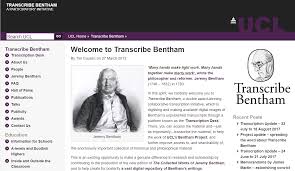
 is located at the University College of London.  This project uses crowds of volunteers to help transcribe the 60,000 folios of unpublished manuscripts of Jeremy Bentham, enlightenment philosopher of Democracy and the father and utilitarianism.  The goal is to complete the publication of all Bentham’s collected writings. (Causer, et al, “Crowdsourcing and editing”).   Individuals register and then participate in transcribing the manuscripts into a textbox using a customized tool bar.  This creates the pre-edit compilation of the manuscripts for the published works and also forms basic encoding that makes the collection accessible in the digital format.  (Causer, p. 120).

Papers of the War Department (http://wardepartmentpapers.org/transcribe.php) is an effort to restore the archive of the U.S. War Department which burned to the ground in 1800.  An extraordinary effort was made to compile the ‘lost’ documents by scanning copies that had been sent to other institutions across the country and Europe.  While the documents were assembled from the 3,500 institutions a rough sort of index was constructed.  The Roy Rosenzweig Center for History and New Media built a website with nearly 45,000 documents to make full text transcription and correction June 2007.  The project uses a tool called Scripto a text compiler module that will work with existing content management systems.  The success of this project in garnering massive participation has been somewhat limited, but the “lessons learned” about crowdsourcing and tool development have made the contributions of the Papers of the War Department project substantial.

One of the “latest and greatest” crowdsourcing projects’ which has been able to capitalize on these lessons is NYPL’s Building Inspector (http://buildinginspector.nypl.org/).  This project was created with the intent of “gamification” (making the task feel like a game).  Fire and Insurance maps of New York City from the 1850’s to 1950 were digitized.  Because the maps were made to different scales and from different angles, the digitized information was then vectorized (this is a mathematical process which creates lines from the digital point data creating a graphing matrix.  The Python Program was used to extract the polygons that formed the building footprints on the maps (80,000 polygons). For the mapping tasks NYPL labs have adapted LeafletJS (a the leading open-source JavaScript library for mobile-friendly interactive maps). Building Inspector is deployed on Heroku, with map tiles on Amazon’s CloudFront The adaptations for recognizing the buildings are tools developed by NYPL but have been made available on Github.  These tools made it possible to identify recognizable building outlines.  The goal of the overall project is to create year by year of maps that can be overlayed and manipulated to show the physical (and social) changes of New York City.

The current “Building Inspector” project is to gain help in verifying and identifying the the polygons of the various digital maps.  There are 5 types of crowd sourced tasks in “Building Inspector”. The 5 tasks: I. Check Footprints presents a map section. A building footprint on the map is defined by red dots, the user simple clicks one of three colored boxes (No, Fix, Yes) to say if the dots match the shape of the building. II. Fix Footprints presents a small section of the map with a building outline. The corners of the buildings are marked by balloon pins. The “inspector” is asked to move, add, delete pins until the building shape is correctly outlined. III. For the Numbering tool, a small map section with numbers is presented. The “inspector” clicks next to the number by the building and a box appears, then the “inspector” types in the number verifying the address of the building. IV. The colors of the buildings (which represent materials and use) are displayed and the inspector clicks on the correct colored box to verify the color of the building. V. For identifying place names on the maps, a flag appears with a box. The “inspector” scrolls around the map to locate the name or location of the object.

A crowdsourcing project requires crowd participation to be successful.  Individuals participated in Transcribing Bentham and the Papers of the War Department because they were interested in the specific history and documents with which they were working.   Sharon Leon observes, “None of these projects are ‘If you build it, they will come.  It just doesn’t work that way.  People will not randomly find you.” (Crowdsourcing: Papers of the War Dept.) Melissa Terras describes “the goal as being to locate 25-30 core users with whom a relationship can be developed, who are committed to the project, locked on the goal and pitching in.” (Crowdsourcing:​ ​Transcribe​ ​Bentham)  Notice these two projects are transcription projects which require patience, diligence and accuracy.  Trove described by Tim Sherritt “as a community, with large numbers of users and some really passionate users….Text correction is one of the most active features on the site… 150 million newspaper articles covering 150 years of Australian history.  There is something in there to attract anyone’s interest. (Sherritt, Crowdsourcing Trove)

Ayers brings this to a finer point…

“an average of more than 60,000 unique users visit Trove every day…. By July 2013, more than 100 million lines of newspaper text had been corrected by members of the public. We have estimated that this equates to more than 425,000 volunteer hours, or 270 standard Australian work years. Costed at the Library’s lowest pay rate, this means that text correctors have contributed more than AU$17 million in value to the service.” (Ayers, “Singing”)

Building Inspector inspired “77,447 inspections the first day ..(it) was available. ..By the 3rd day 163,035 inspections had been completed.” (Summers, “inkdroid”). To date 12 maps have been completed (http://buildinginspector.nypl.org/about  accessed 11/27/17).  According to Mauricio Giraldo Arteaga the Lead Building Inspector developer/designer, it is because “people like to help the library”. (Summers)  Trove’s Marie-Louise Ayres believes “Trove text correctors are primarily motivated by their personal research interests, by the sense of being involved in something ‘bigger than them’ and ‘of lasting value’, and by a very strong sense of giving back or ‘singing for their supper’” (Ayers).  The lesson I am taking away from these experts is that you need to understanding your project well enough to know who your potential crowd is and how they will benefit from participating.

Effective marketing is also useful, but needs to be strategic.  An article about the War Department Papers was published in the New York Times attracting interest, but the site was not ready for participation and missed the bump. (Leon)  Whereas Building Inspector’s released “with the (apparent) coordination with an article at Wired, and subsequent follow up on the nypl_labs Twitter account.” (Summers).  All of these projects also works to create a “relationship” with its users, mainly through time and information.  Trove’s “Engagement features: include tallies. For example:

  • 111,952 newspaper text corrections today
  • 1,453 images from users this month
  • 15,923 items tagged this week
  • 2,054 comments added this month

Building Inspector provides logs for its user on their personal contribution as well as the instantaneous gratification of seeing the polygon corrected! The transcription project editors keep communication flowing with their users on a more personal basis.  Humans are not machines and while they may volunteer, they appreciate the recognition that comes with it.

My own contributions to the Papers of the War Department and Building Inspector have mirrored the above analysis.  While I was more interested in the Papers, I was hoping to find some recognition of my locations connected to my NJ family; I quickly became frustrated with the interface.  I was less interested in helping the NY Public Library, but “Inspecting” is so easy and rewarding that I have done it several times while talking on the phone just to keep myself occupied.  The ability to get connected quickly and easily (Ayers observes that ‘long process, having to register, etc. are less likely to engage new users) is crucial.  Being informed and feeling that your work is valued, easy to follow directions or quick responsiveness to questions are ‘Warm Fuzzies’ necessary to keep your crowd sourcing.  So crowdsourcing requires a great deal of effort in preparation and management, but the value of then having a built ‘audience’ that contributes, shares, promotes and potentially engages with the project in new ways is of great value and an exciting prospect.

Notes:

Ayres,​ ​Marie-Louise.​ ​​”‘Singing​ ​for​ ​their​ ​supper’:​ ​Trove,​ ​Australian​ ​newspapers,​ ​and​ ​the crowd.”​​ ​Paper​ ​presented​ ​at​ ​IFLA​ ​WLIC,​ ​Singapore,​ ​July​ ​31,​ ​2013.​ ​National​ ​Library​ ​of Australia.

Causer,​ ​Tim,​ ​Justin​ ​Tonra,​ ​and​ ​Valerie​ ​Wallace.​ ​“Transcription​ ​Maximized;​ ​expense minimized?​ ​Crowdsourcing​ ​and​ ​Editing:​ ​​The

​       Collected​ Works of Jeremy​ Bentham.” Literary​ and​ Linguistic Computing ​ ​ ​27,​ ​no.​ ​2​ ​(2012):​ ​119-137.

Crowdsourcing:​ ​Transcribe​ ​Bentham https://www.youtube.com/watch?v=XB2J4pJQodo

Leon,​ ​Sharon​ ​M.​ ​“Build,​ ​Analyse​ ​and​ ​Generalise:​ ​Community​ ​Transcription​ ​of​ ​the​ ​Papers of​ ​the​ ​War​ ​Department​ ​and​ ​the Development​ ​of​ ​Scripto.”​ ​In​ ​​Crowdsourcing Our​ Cultural Heritage, edited​ ​by​ ​Mia​ ​Ridge.​ ​UK:​ ​Ashgate,​ ​2014.

Crowdsourcing:​ ​Trove https://www.youtube.com/watch?v=APa6-03hWkU

Summers,​ ​Ed.​ ​“NYPL’s​ ​Building​ ​Inspector.”​ ​​inkdroid​ (blog),​ ​October​ ​22,​ ​2013. http://inkdroid.org/journal/2013/10/22/nypls-building-inspector/​.