Category Archives: Guides

Transforming History Processes

In the past, I have shaped exhibits after the content.  So my process has been focused on identifying the key elements of the project at hand – Subject and artifact centered.  Build the comprehensive history from research around the elements; distill the exhibit from (essentially) my interpretation of the significant history and relationships, engage in dialogue with design experts and then determine how that exhibit can be mounted with in the identified space, open the exhibit, gather feedback.  The readings assigned for Modules 4 and 5 call for a much more engaged approach to all facets of the project – history, design and ‘experience’ of the exhibit …extending into an on-going conversation and continuing impact of the history beyond the immediate exhibit space.

A simplified revised conception of the public humanities project process would be: focused on identifying the key elements of the project at hand – Subject and artifact centered.  Consider the audience for these elements (what will they need to know, how would they use this information). Sherratt.  Build the comprehensive history from research around the elements while engaging professional and audience partners in the process of research, design and engagement. Spichiger, Rabiinowicz, Lubar. Finalize the conception of the history with the team (possibly including an audience test – Colter).  Determine how the exhibit can be mounted with in the identified space, how the previously identified and potential audiences can be informed, engaged and consider potential for on-going collection of history and engagement of the audience (archive building and social media).  Open the Exhibit.  Receive audience feedback and finalize institutional review.

This project process is a dramatic shift from the “Ivory Tower” conception and accomplishment of projects that was the 20th Century model.  Fortunately there is a gallery of digital humanities projects that demonstrate how this format can work for both the physical display of exhibits and new digital forms of exhibits and historical engagement opportunities (web search Digital Humanities Projects on almost any topic or refer to examples listed at the bottom of this page).  Not unexpectedly, the content and quality of these projects can vary based on access to resources and the quality of the personnel involved in the projects.  Quality projects include in the recognition of the need for the curation and maintenance of supportive materials and archive of the metadata to maintain veracity, accessibility and usability of the historical material being created.  Inclusion of the various perspectives involved in the new methodology requires early and expanded identification of the exhibit “team”.  Enhanced and frequent communication (written and face to face) and focused intentional collaboration is needed to assure that all perspectives are truly being considered and incorporated into the ‘story’ being created.  Documentation of resources, metadata, on-going team collaboration are essential to keep the direction and component parts of the project progressing toward the same end product.  Owens, “Metadata”, Brennan & Kelly, Whitelaw, Fisher, Kissane

The value of this updated process is the creation of a more holistic, engaged history.  Social historians of the late 20th Century (Labor, Ethnic & Gender) called for attention to and expansion of the conception of history to include ‘the wider public’, a movement away from the focus on ‘Great Men and Great Deeds’.  However in the early days of this new history, the content and delivery still utilized traditional approaches and methodologies.   Since resources to acquire the history of ‘the wider public’ didn’t exist.  Technological advancements and refinement of digital methods has made access to the interpretation of public documents, GIS infrastructure analysis and inclusion of “the crowd” and a more accurate representation of ‘the wider public’ possible.  Including participation and involvement in the creation of public humanities projects increases the awareness of and access to new historical sources, expands the perspective in the creation and expression of the exhibit, builds a larger and more engaged audience and develops new avenues for future historical questions: What is the historical impact of audience engagement in the development and presentation of their own history?  This type of question is already being developed in the 911 and Hurricane archive.  It is a new and exciting time to be a “stuffy old historian”.

Sheila A Brennan and T. Mills Kelly, “Why Collecting History Online Is Web 1.5,” Roy Rosenzweig Center for History and New Media, March 2009, http://rrchnm.org/essay/why-collecting-history-online-is-web-1-5/  accessed Feb. – Mar. 2018.

Angela Colter, “Testing Content,” A List Apart, December 14, 2010, http://alistapart.com/article/testing-content  accessed Feb. – Mar. 2018.

Erin Kissane, “A Checklist for Content Work,” A List Apart, March 8, 2011, http://alistapart.com/article/a-checklist-for-content-work  accessed Feb. – Mar. 2018.

Steve Lubar, “The Curator Rules,” On Public Humanities, February 7, 2015, https://stevenlubar.wordpress.com/2015/02/07/creative-curation-curatorial-rules-and-when-to-break-them/ accessed Feb.- Mar. 2018.

Metadata,” JISC Digital Media, http://www.jiscdigitalmedia.ac.uk/infokit/metadata/metadata-home accessed Feb.- Mar. 2018.

Trevor Owens, “What Do You Mean by Archive? Genres of Usage for Digital Preservers | The Signal: Digital Preservation,” Blog, The Signal: Digital Preservation, (February 27, 2014), http://blogs.loc.gov/digitalpreservation/2014/02/what-do-you-mean-by-archive-genres-of-usage-for-digital-preservers/  accessed Feb.- Mar. 2018.

Tim Sherratt, “It’s All About the Stuff: Collections, Interfaces, Power, and People,” Journal of Digital Humanities 1, no. 1 (March 9, 2012), http://journalofdigitalhumanities.org/1-1/its-all-about-the-stuff-by-tim-sherratt/  accessed Feb.- Mar. 2018.

Spichiger, L., J. Jacobson, Telling an Old Story in a New Way: Raid on Deerfield: The Many Stories of 1704, in J. Trant and D. Bearman (eds.). Museums and the Web 2005: Proceedings, Toronto: Archives & Museum Informatics, published March 31, 2005.

Richard Rabinowicz, “Eavesdropping at the Well: Interpretive Media in the Slavery in New York Exhibition,” Public Historian 35:3 (August 2013), pp. 8-45.

Michael Whitelaw, “Generous Interfaces for Digital Cultural Heritage Collections,” Digital Humanities Quarterly 9, no. 1 (2015) http://www.digitalhumanities.org/dhq/vol/9/1/000205/000205.html  accessed Feb.- Mar. 2018.

Examples of Digital Public History Websites:


What to do with Crowdsourcing?

“Crowdsourcing” is a new way of engaging volunteers not directly connected with or employed in the work of Digital Project or organization.  It involves attracting attention to a project, recruiting individuals to help with (supply the labor, complete the tasks for) a project, educating them as to what is required to complete the tasks, finding a way to edit or monitor the quality of their work and sustain the involvement of the contributors until the task is completed.  “Recruiting volunteers” is not a new idea, non-profit organizations have always recruited volunteers to help with tasks.   But, advancements in technology have created both the tools to create new and larger corpus of archival data; and also the means to reach large numbers of potential contributors who can provide assistance in accomplishing tasks related to its processing through digital connections and platforms.

Digitizing documents can preserve records and provide immense amounts of data, but making these digital records accessible often requires additional tasks that cannot be done by computers.  Review and correction of errors in optical scanning, interpreting the meaning of documents, indexing, cataloguing and preparing digital archives for computer processing requires human action and interpretation.  Digital ‘Crowdsourcing Projects’ have developed techniques – both mechanical and social to attract persons to help complete these large and time-consuming processes.   I have studied and compared four specific active digital crowdsourcing projects:

Trove (http://trove.nla.gov.au/result?q=Text%20correction) developed by the National Library of Australia has a 20 year history of crowdsourcing.  First in the assembly of its digital collection calling for the submissions of digital artifacts and newspapers and more recently it has reached out to engaging the general public for completing the monumental task of correcting the OCR text of the Newspapers that have been scanned.  Trove, according to Tim Sherratt is a “Collection of Collections” on all things Australian. (Youtube=APa6-03hWkU) Trove serves as a service resource digitally housing and referral to other significant collections. The newspaper collection “has over 150 million articles covering 150 years of Australian History”.  This collection is the most used part of Trove.  Text Correction, tagging and commenting on this collection has corrected more than 100 million lines of text, “the equivalent of 270 standard work years of effort”. (Ayres, ‘Singing for their Supper’).

Transcribing Bentham (http://www.transcribe-bentham.da.ulcc.ac.uk/td/Transcribe_Bentham)

 is located at the University College of London.  This project uses crowds of volunteers to help transcribe the 60,000 folios of unpublished manuscripts of Jeremy Bentham, enlightenment philosopher of Democracy and the father and utilitarianism.  The goal is to complete the publication of all Bentham’s collected writings. (Causer, et al, “Crowdsourcing and editing”).   Individuals register and then participate in transcribing the manuscripts into a textbox using a customized tool bar.  This creates the pre-edit compilation of the manuscripts for the published works and also forms basic encoding that makes the collection accessible in the digital format.  (Causer, p. 120).

Papers of the War Department (http://wardepartmentpapers.org/transcribe.php) is an effort to restore the archive of the U.S. War Department which burned to the ground in 1800.  An extraordinary effort was made to compile the ‘lost’ documents by scanning copies that had been sent to other institutions across the country and Europe.  While the documents were assembled from the 3,500 institutions a rough sort of index was constructed.  The Roy Rosenzweig Center for History and New Media built a website with nearly 45,000 documents to make full text transcription and correction June 2007.  The project uses a tool called Scripto a text compiler module that will work with existing content management systems.  The success of this project in garnering massive participation has been somewhat limited, but the “lessons learned” about crowdsourcing and tool development have made the contributions of the Papers of the War Department project substantial.

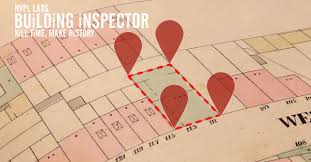
One of the “latest and greatest” crowdsourcing projects’ which has been able to capitalize on these lessons is NYPL’s Building Inspector (http://buildinginspector.nypl.org/).  This project was created with the intent of “gamification” (making the task feel like a game).  Fire and Insurance maps of New York City from the 1850’s to 1950 were digitized.  Because the maps were made to different scales and from different angles, the digitized information was then vectorized (this is a mathematical process which creates lines from the digital point data creating a graphing matrix.  The Python Program was used to extract the polygons that formed the building footprints on the maps (80,000 polygons). For the mapping tasks NYPL labs have adapted LeafletJS (a the leading open-source JavaScript library for mobile-friendly interactive maps). Building Inspector is deployed on Heroku, with map tiles on Amazon’s CloudFront The adaptations for recognizing the buildings are tools developed by NYPL but have been made available on Github.  These tools made it possible to identify recognizable building outlines.  The goal of the overall project is to create year by year of maps that can be overlayed and manipulated to show the physical (and social) changes of New York City.

The current “Building Inspector” project is to gain help in verifying and identifying the the polygons of the various digital maps.  There are 5 types of crowd sourced tasks in “Building Inspector”. The 5 tasks: I. Check Footprints presents a map section. A building footprint on the map is defined by red dots, the user simple clicks one of three colored boxes (No, Fix, Yes) to say if the dots match the shape of the building. II. Fix Footprints presents a small section of the map with a building outline. The corners of the buildings are marked by balloon pins. The “inspector” is asked to move, add, delete pins until the building shape is correctly outlined. III. For the Numbering tool, a small map section with numbers is presented. The “inspector” clicks next to the number by the building and a box appears, then the “inspector” types in the number verifying the address of the building. IV. The colors of the buildings (which represent materials and use) are displayed and the inspector clicks on the correct colored box to verify the color of the building. V. For identifying place names on the maps, a flag appears with a box. The “inspector” scrolls around the map to locate the name or location of the object.

A crowdsourcing project requires crowd participation to be successful.  Individuals participated in Transcribing Bentham and the Papers of the War Department because they were interested in the specific history and documents with which they were working.   Sharon Leon observes, “None of these projects are ‘If you build it, they will come.  It just doesn’t work that way.  People will not randomly find you.” (Crowdsourcing: Papers of the War Dept.) Melissa Terras describes “the goal as being to locate 25-30 core users with whom a relationship can be developed, who are committed to the project, locked on the goal and pitching in.” (Crowdsourcing:​ ​Transcribe​ ​Bentham)  Notice these two projects are transcription projects which require patience, diligence and accuracy.  Trove described by Tim Sherritt “as a community, with large numbers of users and some really passionate users….Text correction is one of the most active features on the site… 150 million newspaper articles covering 150 years of Australian history.  There is something in there to attract anyone’s interest. (Sherritt, Crowdsourcing Trove)

Ayers brings this to a finer point…

“an average of more than 60,000 unique users visit Trove every day…. By July 2013, more than 100 million lines of newspaper text had been corrected by members of the public. We have estimated that this equates to more than 425,000 volunteer hours, or 270 standard Australian work years. Costed at the Library’s lowest pay rate, this means that text correctors have contributed more than AU$17 million in value to the service.” (Ayers, “Singing”)

Building Inspector inspired “77,447 inspections the first day ..(it) was available. ..By the 3rd day 163,035 inspections had been completed.” (Summers, “inkdroid”). To date 12 maps have been completed (http://buildinginspector.nypl.org/about  accessed 11/27/17).  According to Mauricio Giraldo Arteaga the Lead Building Inspector developer/designer, it is because “people like to help the library”. (Summers)  Trove’s Marie-Louise Ayres believes “Trove text correctors are primarily motivated by their personal research interests, by the sense of being involved in something ‘bigger than them’ and ‘of lasting value’, and by a very strong sense of giving back or ‘singing for their supper’” (Ayers).  The lesson I am taking away from these experts is that you need to understanding your project well enough to know who your potential crowd is and how they will benefit from participating.

Effective marketing is also useful, but needs to be strategic.  An article about the War Department Papers was published in the New York Times attracting interest, but the site was not ready for participation and missed the bump. (Leon)  Whereas Building Inspector’s released “with the (apparent) coordination with an article at Wired, and subsequent follow up on the nypl_labs Twitter account.” (Summers).  All of these projects also works to create a “relationship” with its users, mainly through time and information.  Trove’s “Engagement features: include tallies. For example:

  • 111,952 newspaper text corrections today
  • 1,453 images from users this month
  • 15,923 items tagged this week
  • 2,054 comments added this month

Building Inspector provides logs for its user on their personal contribution as well as the instantaneous gratification of seeing the polygon corrected! The transcription project editors keep communication flowing with their users on a more personal basis.  Humans are not machines and while they may volunteer, they appreciate the recognition that comes with it.

My own contributions to the Papers of the War Department and Building Inspector have mirrored the above analysis.  While I was more interested in the Papers, I was hoping to find some recognition of my locations connected to my NJ family; I quickly became frustrated with the interface.  I was less interested in helping the NY Public Library, but “Inspecting” is so easy and rewarding that I have done it several times while talking on the phone just to keep myself occupied.  The ability to get connected quickly and easily (Ayers observes that ‘long process, having to register, etc. are less likely to engage new users) is crucial.  Being informed and feeling that your work is valued, easy to follow directions or quick responsiveness to questions are ‘Warm Fuzzies’ necessary to keep your crowd sourcing.  So crowdsourcing requires a great deal of effort in preparation and management, but the value of then having a built ‘audience’ that contributes, shares, promotes and potentially engages with the project in new ways is of great value and an exciting prospect.

Notes:

Ayres,​ ​Marie-Louise.​ ​​”‘Singing​ ​for​ ​their​ ​supper’:​ ​Trove,​ ​Australian​ ​newspapers,​ ​and​ ​the crowd.”​​ ​Paper​ ​presented​ ​at​ ​IFLA​ ​WLIC,​ ​Singapore,​ ​July​ ​31,​ ​2013.​ ​National​ ​Library​ ​of Australia.

Causer,​ ​Tim,​ ​Justin​ ​Tonra,​ ​and​ ​Valerie​ ​Wallace.​ ​“Transcription​ ​Maximized;​ ​expense minimized?​ ​Crowdsourcing​ ​and​ ​Editing:​ ​​The

​       Collected​ Works of Jeremy​ Bentham.” Literary​ and​ Linguistic Computing ​ ​ ​27,​ ​no.​ ​2​ ​(2012):​ ​119-137.

Crowdsourcing:​ ​Transcribe​ ​Bentham https://www.youtube.com/watch?v=XB2J4pJQodo

Leon,​ ​Sharon​ ​M.​ ​“Build,​ ​Analyse​ ​and​ ​Generalise:​ ​Community​ ​Transcription​ ​of​ ​the​ ​Papers of​ ​the​ ​War​ ​Department​ ​and​ ​the Development​ ​of​ ​Scripto.”​ ​In​ ​​Crowdsourcing Our​ Cultural Heritage, edited​ ​by​ ​Mia​ ​Ridge.​ ​UK:​ ​Ashgate,​ ​2014.

Crowdsourcing:​ ​Trove https://www.youtube.com/watch?v=APa6-03hWkU

Summers,​ ​Ed.​ ​“NYPL’s​ ​Building​ ​Inspector.”​ ​​inkdroid​ (blog),​ ​October​ ​22,​ ​2013. http://inkdroid.org/journal/2013/10/22/nypls-building-inspector/​.

 My Approach to Wikipedia

Wikipedia for better or worse has become the global source for instantaneous reference.  As Roy Rosenzweig noted “We have to pay attention because our students do”. (Can History be Open Source) We should pay attention because Wikipedia is ubiquitous.  It is providing the common platform of information and more significantly has changed the way we access and think about information… we no longer have to memorize and learn basic facts because Wikipedia can provide them faster than we can remember them.  Skipping the process of remembering facts does have consequences for critical thinking and application of knowledge.  However, that is a different issue than the one at hand which is the more immediate issue of ‘What do we need to be aware of when reading a Wikipedia article?’

Wikipedia is great for common facts and dates!  It is probably mostly reliable. When searching for a more comprehensive understanding of a fact, event, issue, or idea, it is a good idea to dig deeper into who is involved in the “construction” of the entry.  The entries are created and corrected by ‘everybody’, but this ‘everybody’ is constituted by individual volunteers who have different goals (and differing amounts of time and interest in working with the entry).  An individual, who has just become familiar with a topic, can be interested in demonstrating what they know about it.  A knowledgeable expert might have corrected and clarified an entry; or someone could just be creating mischief and enter random information.  It is useful to know that there is extensive information, but basically 4 pillars for contributors (identified by Rosenszweig) which shape the content of entries:

  1. ‘Wikipedia is an encyclopedia which summarizes and reports conventional and accepted wisdom on a topic that does not break new ground.’
  2. ‘Articles should be written from a neutral point of view’
  3. While “The third “key policy” is simpler: “don’t infringe copyrights.” The reality appears to be that Wikipedia as a general source ignores attribution and often so do its users.
  4. ‘The fourth pillar of Wikipedia wisdom is “respect other contributors’.

According to David Auerback, “Wikipedia’s users serve collectively as legislature, executive, and judiciary” of its content. (“Encyclopedia Frown”). That is not fully true as Auerback indicates in his own blog, there are priority contributors, Wikipedia editors, and a slew of ‘bots’ that monitor and manage the site.  What this information should mean to the user, is  Wikipedia is “probably mostly reliable”, but it shouldn’t really be a primary source if one is writing a term paper or trying to gain a deep understanding of a subject.  However it is a useful tool for quick references and as a lead to other resources for more information on the topic.

Going deeper than the surface with a Wikipedia entry requires asking a few questions: “How did the article develop, who has been involved in its creation and do I judge the information or resources to be reliable?  These questions can be answered by accessing the full Wikipedia site (not just pulling the data from the search engine synopsis).  At the top of the Wikipedia topic page there are tabs for: the Article, Talk, Read, Edit, and View History.  These provide clarification as to who is involved and the context of the article.  The difference between the Article Tab and the Read Tab appears to be sponsored links and information that are applied to the borders of the web page by Wikipedia itself.  The Read Tab allows you to see just the article.  The Talk Tab provides insight into what the larger community involved with the article interprets about what is going on with the article.  This includes: links to larger Wikipedia Projects & how the article is being used; concerns regarding content, general comments, ideas as to how the site could be changed or improved, requests for additional content and notes about links.  The Edit Tab  is where the source code editing actually takes place.  The View History Tab is the log of the edits (and meta data about them) where a user can see how the entry has been changed over time.

There are numerous advantages to checking the “History”.  It is not hard to do once you know it is there.  It reveals how the currency of the information in the article.  It reveals the nature of the changes that have been made.  The user can check into the authority of the contributors, sort of.  Contributors to  Wikipedia can chose to register or not.  Contributors can choose to provide information about themselves or not.  While examining the Wikipedia page for “Digital Humanities”, I found ‘Sophia Chang’, the most recent contributor, did not register.  Therefore I have no basis on which to evaluate her authority except the quality of the immediate corrections – for which I would have to check alternative sources to ascertain their reliability.  “Cluebot” had ‘reverted possible vandalism’ which alerted me that some information might be suspicious.  Another contributor described themselves as “a student studying geology”.  Since I was a geology minor in college and knew nothing about DH  (Digital Humanities), I am skeptical of LuckyLukasS and the “SoftballJunkie”.  On the other hand, Elijah Meeks, who launched the page in January 2006, is a Digital Humanities Scholar from Stanford University, has published extensively and linked his registration to his own Wikipedia page (which has its own history).  Wikipedia provides several “tracking” devices in the History including the ability to look at statistics, search for specific revisions, search edits by user, etc.  This helps a user verify the authority and reliability.  ElKevbo, who has been a longtime contributor-editor, has advanced degrees in education and technology.  Cheryl27, who did extensive revision of the site in 2016, also did not ‘register’, but her edits did a terrific job of reorganizing and updating the page.  The “talk” surrounding her edits, questioned some of her choices, but did not substantially challenge her content or accuracy.  Since the DH page, in the past month has been viewed an average of 423 times and edited 8 times daily, is still a very current and active topic; there is a highly likelihood that errors will be corrected quickly.

The current iteration of the Digital Humanities page reflects  increasing maturity in the discipline of Digital Humanities (DH).  In the early days of the website, the content was basically a definition that made the connection between a Humanities focus in content through the use of Technological tools.  Listing of projects, resources and literature was fairly static and encyclopedic – consistent with the rest of Wikipedia in the early days.  The first embedded file link (to a visualization map) is made March 7, 2006.  Considering this site promoted the use of digital tools, the lack of visual connections demonstrates the limits of both the discipline and the Wikipedia platform.  Through 2009 the majority of links were to external tools, resources and journals that demonstrated collaboration and the expansion of professional literature in DH and history projects that used digital tools.  During the spring of 2010 there is an effort to emphasize the computing in DH, which is resisted by Simon Mahony, a DH scholar with a “Classics” background from the University of London.  The fact that the discipline was emergent is demonstrated by continuous tweaking of the definition.

The period 2011- 2013 reflects the controversy of whether DH is a “professional” community and attributes that would demonstrate its “academic” credentials: concerns over liability & copyright (Dr. Oldekip), definitions of subfields and terminology (ElKevbo), arguments over size of projects ( Dancing Philosopher), literature fields, Centers and Resources appear and disappear.  The page is occasionally visited by Wikipedia editors and clean-up bots and was frequently attacked in 2013.  During 2013 there was also a notable expansion of named DH Centers – which indicates funding, stability and academic recognition. In May 2015, the “methods” section gets a visualization of the ‘Narrative network of U.S. Elections 2012’ which begins to demonstrate the product outcomes of DH.  By Jan 2017, the page is giving a far more extensive reflection of the discipline (reflecting the editorial work of Cheryl27 & Cats and Things – a graduate student studying Wikipedia).  The Table of Contents has been trimmed to manageable subheadings, a somewhat concise, detailed definition of the field has been created emphasizing tools and methods but retaining the collaboration of humanities and very sophisticated digital process and tools.  The values and methods have become lists with explanations of the ideas such as “open access”, Computational methods, examples of project types and most significantly of the interaction between the processes of project and recognition of the impact of these processes in “creating new knowledge” – “Digital humanities is also involved in the creation of software, providing “environments and tools for producing, curating, and interacting with knowledge that is ‘born digital’ and lives in various digital contexts.” In this context, the field is sometimes known as computational humanities.”https://en.wikipedia.org/w/index.php?title=Digital_humanities&oldid=758451224

The page has been made visually attractive and informative by images and links to real DH projects that demonstrate the use of tools and the variety of types of projects (Digital Archives, Text Mining, Analysis and Visualization, Online Publishing.  The organization of the discipline is demonstrated by having an established academic apparatus: a “history”, organizations, Centers & Institutes, Conferences and Publications, Guides, an extensive list of references and bibliography.

The result of all this activity is a page with a nice layout and ease of navigation. https://en.wikipedia.org/wiki/Digital_humanities  The engagement of DH scholars, such as Johanna Drucker provided a foundation definition of the Digital Humanities that clearly identifies the blending of computational (more than just use of the computer) technology and the fields of humanities; has maintained and enhanced the quality and integrity of the information. I, as an individual new to the Digital Humanities, gained a basic understanding and recognition of the discipline. DH is a field where a deep knowledge of the data and experience with the tools is critical to understand fully what is happening in this processing and how the information limited or vast is being engaged, transformed and created.  Wikipedia takes a community and the collaboration on the DH article is a good reflection of a community within that larger community.

Notes:

Auerbach, David. “Encyclopedia Frown.” Slate, December, 11, 2014.

Rosenzweig, Roy.” Can History be Open Source? Wikipedia and the Future of the Past.”  The Journal of American History Volume 93, Number 1 (June, 2006): 117-46 a.


Guide to Digitization: The Kitchen Experience

More and Less and Lost.  At one level, anyone can throw a picture up on a screen and call it a digital collection and it can be seen by lots and lots of folk.  However, if one thinks about the image and the meaning and the purpose of presenting an image – throwing the collection up on the screen becomes much harder.

As a historian, I am usually trying to capture the essence of  an object (or person or event or period) and I have done it with words.  At various times, I have tried to “find” images that represent the meaning or feeling of I am trying to convey.  I understand better why that is so difficult.  First of all you have to have the right equipment for the task and good quality if you are trying to present something well.  There is also the issue of lighting and placement (so there aren’t any shadows or reflections and the surroundings are what you want them to be.  Aside from these tool issues, there remains the issue of how best to “capture” the object.

I have experimented with photographing an object and creating a video.  What I discovered for myself is that both are significant and important in providing a visual record of in this case, an object from my kitchen.  (I am proud of my abilities in the kitchen, but digitizing it is another matter).  An image is an image, a visual ‘report’.  While representing an object – it also distances you from it, because it only presents digital information (not touch, taste, smell or hearing).  ‘When we ‘digitize’, we are also converting an analogue signal or code into a digital signal or code’ and since this is (increasingly)’ the bedrock of Digital Library holding and Digital Humanities Research’ (Terras Digitization and the Humanities). it is a good thing to be aware of what is behind the curtain.

Collections can be enhanced and minimized by digital scanning and OCR (Optical Character Recognition) – translate as having the computer read for you but it means turning text in a picture into text in a document…so that it can be printed on a page.  (This is part of that more…more steps! More Time!  More people will eventually see it?   Many libraries and museums and families (my own) flocked to digitization as an easy way to preserve the past.  However these collections are not “free”.   They still have to be maintained, the technology changes, the original image degrades and if your are an institution, copyright can become an issue.  Another issue for institutions is the standardization of the product, so the industry has to agree on guidelines and processes.

Back to the kitchen!  My assignment is to create a digital collection of objects.  The historian at work again – I wanted to use objects of significance and beauty and interest….and okay (remember the technologically challenged part) the first step of the assignment got to me and then I just needed to get the project done in the time frame I had which are also true concerns in any reality – Time & Money.    As Paul Conway describes in “Building Meaning in Digitized Photographs”, the process takes over.  Taking pictures was relatively faster than taking the videos.  Lighting and staging was an issue in both cases, but the video required movement (over, under, around) and that was an extra consideration.  How does the process impact the meaning?  It certainly impacted the choice of items included in the collection – what would photograph well?  Which raises the second question after the project is assembled is this an accurate representation? (Of my kitchen? – tools partially, otherwise probably not).   Because I chose the objects, it is probably more me, than if a stranger came in and chose the objects to digitize.  My handwoven twig basket from France has no label – made in France. If I had used the audio in connection with the video, it could have added context and more description adding depth to what was an image.   One can set a mood with Photography and Video, but not “capture” the rainbow of moods and meaning associated with an object.

It is harder to set a mood with text.  The photographic image of the recipe was easy to read, but provided no context.  The video allowed me to show the feel and size and range of the book, but I could not get the recipe readable.  In the past, the book would be available to a small number of readers in a special collection.  The institutions of the future will have digital copies available across time and space.  But the OCR did not record the text accurately much less have the ability to interpret when the Italian was necessary compared with the English.  A human transcriber would probably be able interpret, but make errors in the typing.   Transferring the image across multiple platforms and uses would add access and new meaning (and potential uses of the recipe – like interpretation of diet or climate), but storage and degradation become problems for institutions – is it worth preserving this mangled copy of Ferrara’s Italian Recipes?

Also included in the scholarship of Conway’s article is the concern about the impact of remediation through multiple process or images.  It was a concern of mine as I transferred the video from a video camera through my laptop to the course site (only to find out the files were too large).  Then I said, heck with quality and used my phone.  The videos were shorter, the color of the vinegar and the texture of the oil disappeared.  Because I filmed in an area that was convenient & light for shooting, the aura of my kitchen disappeared.  Any story created around the chosen objects, would have had to be a unique creation rather than a true memory or situation.  I can now imagine the inconsistencies and rights and documentation of doing a complex project (Kenney and Rieger 29 in Conway) like assembling the Kitchen Collections of the 2017 3rd Cohort of the DPH, much less the assembly of an Artist’s collection of paintings across multiple museums or a major installation on race or gender utilizing digitized artifacts from multiple primary and secondary sources.  EVERY ASPECT of the project requires the mediation of a decision…and it a professional exhibit from vastly different professional perspectives.

Digitizing my kitchen has changed me.  The historian in me will now have to ponder more deeply on the accuracy and meaningfulness of video resources.  The archivist will have to recognize and grapple with the issues of preservation and copyright on a vastly different scale than tactile collections.  The educator in me…knowing that my students will try to gain their information from the visual aspects of assignments…agrees with the question by Paul Conway, “how do the video cues impact the willingness of a user to read the content of the image”  and extends consideration to …how does the emphasis on digital visual representation impact the willingness of users to read at all and think more deeply?