
“Crowdsourcing” is a new way of engaging volunteers not directly connected with or employed in the work of Digital Project or organization. It involves attracting attention to a project, recruiting individuals to help with (supply the labor, complete the tasks for) a project, educating them as to what is required to complete the tasks, finding a way to edit or monitor the quality of their work and sustain the involvement of the contributors until the task is completed. “Recruiting volunteers” is not a new idea, non-profit organizations have always recruited volunteers to help with tasks. But, advancements in technology have created both the tools to create new and larger corpus of archival data; and also the means to reach large numbers of potential contributors who can provide assistance in accomplishing tasks related to its processing through digital connections and platforms.
Digitizing documents can preserve records and provide immense amounts of data, but making these digital records accessible often requires additional tasks that cannot be done by computers. Review and correction of errors in optical scanning, interpreting the meaning of documents, indexing, cataloguing and preparing digital archives for computer processing requires human action and interpretation. Digital ‘Crowdsourcing Projects’ have developed techniques – both mechanical and social to attract persons to help complete these large and time-consuming processes. I have studied and compared four specific active digital crowdsourcing projects:
Trove (http://trove.nla.gov.au/result?q=Text%20correction)  developed by the National Library of Australia has a 20 year history of crowdsourcing. First in the assembly of its digital collection calling for the submissions of digital artifacts and newspapers and more recently it has reached out to engaging the general public for completing the monumental task of correcting the OCR text of the Newspapers that have been scanned. Trove, according to Tim Sherratt is a “Collection of Collections” on all things Australian. (Youtube=APa6-03hWkU) Trove serves as a service resource digitally housing and referral to other significant collections. The newspaper collection “has over 150 million articles covering 150 years of Australian History”. This collection is the most used part of Trove. Text Correction, tagging and commenting on this collection has corrected more than 100 million lines of text, “the equivalent of 270 standard work years of effort”. (Ayres, ‘Singing for their Supper’).
Transcribing Bentham (http://www.transcribe-bentham.da.ulcc.ac.uk/td/Transcribe_Bentham)
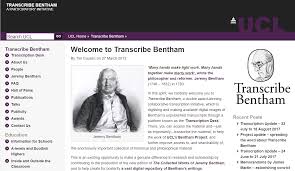 is located at the University College of London. This project uses crowds of volunteers to help transcribe the 60,000 folios of unpublished manuscripts of Jeremy Bentham, enlightenment philosopher of Democracy and the father and utilitarianism. The goal is to complete the publication of all Bentham’s collected writings. (Causer, et al, “Crowdsourcing and editing”). Individuals register and then participate in transcribing the manuscripts into a textbox using a customized tool bar. This creates the pre-edit compilation of the manuscripts for the published works and also forms basic encoding that makes the collection accessible in the digital format. (Causer, p. 120).
Papers of the War Department (http://wardepartmentpapers.org/transcribe.php) is an effort to  restore the archive of the U.S. War Department which burned to the ground in 1800. An extraordinary effort was made to compile the ‘lost’ documents by scanning copies that had been sent to other institutions across the country and Europe. While the documents were assembled from the 3,500 institutions a rough sort of index was constructed. The Roy Rosenzweig Center for History and New Media built a website with nearly 45,000 documents to make full text transcription and correction June 2007. The project uses a tool called Scripto a text compiler module that will work with existing content management systems. The success of this project in garnering massive participation has been somewhat limited, but the “lessons learned” about crowdsourcing and tool development have made the contributions of the Papers of the War Department project substantial.
One of the “latest and greatest” crowdsourcing projects’ which has been able to capitalize on these lessons is NYPL’s Building Inspector (http://buildinginspector.nypl.org/). This project was created with 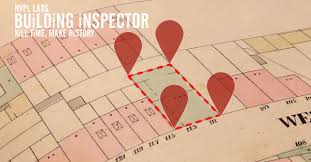 the intent of “gamification” (making the task feel like a game). Fire and Insurance maps of New York City from the 1850’s to 1950 were digitized. Because the maps were made to different scales and from different angles, the digitized information was then vectorized (this is a mathematical process which creates lines from the digital point data creating a graphing matrix. The Python Program was used to extract the polygons that formed the building footprints on the maps (80,000 polygons). For the mapping tasks NYPL labs have adapted LeafletJS (a the leading open-source JavaScript library for mobile-friendly interactive maps). Building Inspector is deployed on Heroku, with map tiles on Amazon’s CloudFront The adaptations for recognizing the buildings are tools developed by NYPL but have been made available on Github. These tools made it possible to identify recognizable building outlines. The goal of the overall project is to create year by year of maps that can be overlayed and manipulated to show the physical (and social) changes of New York City.
The current “Building Inspector” project is to gain help in verifying and identifying the the polygons of the various digital maps. There are 5 types of crowd sourced tasks in “Building Inspector”. The 5 tasks: I. Check Footprints presents a map section. A building footprint on the map is defined by red dots, the user simple clicks one of three colored boxes (No, Fix, Yes) to say if the dots match the shape of the building. II. Fix Footprints presents a small section of the map with a building outline. The corners of the buildings are marked by balloon pins. The “inspector” is asked to move, add, delete pins until the building shape is correctly outlined. III. For the Numbering tool, a small map section with numbers is presented. The “inspector” clicks next to the number by the building and a box appears, then the “inspector” types in the number verifying the address of the building. IV. The colors of the buildings (which represent materials and use) are displayed and the inspector clicks on the correct colored box to verify the color of the building. V. For identifying place names on the maps, a flag appears with a box. The “inspector” scrolls around the map to locate the name or location of the object.
A crowdsourcing project requires crowd participation to be successful. Individuals participated in Transcribing Bentham and the Papers of the War Department because they were interested in the specific history and documents with which they were working. Sharon Leon observes, “None of these projects are ‘If you build it, they will come. It just doesn’t work that way. People will not randomly find you.” (Crowdsourcing: Papers of the War Dept.) Melissa Terras describes “the goal as being to locate 25-30 core users with whom a relationship can be developed, who are committed to the project, locked on the goal and pitching in.” (Crowdsourcing: Transcribe Bentham) Notice these two projects are transcription projects which require patience, diligence and accuracy. Trove described by Tim Sherritt “as a community, with large numbers of users and some really passionate users….Text correction is one of the most active features on the site… 150 million newspaper articles covering 150 years of Australian history. There is something in there to attract anyone’s interest. (Sherritt, Crowdsourcing Trove)
Ayers brings this to a finer point…
“an average of more than 60,000 unique users visit Trove every day…. By July 2013, more than 100 million lines of newspaper text had been corrected by members of the public. We have estimated that this equates to more than 425,000 volunteer hours, or 270 standard Australian work years. Costed at the Library’s lowest pay rate, this means that text correctors have contributed more than AU$17 million in value to the service.” (Ayers, “Singing”)
Building Inspector inspired “77,447 inspections the first day ..(it) was available. ..By the 3rd day 163,035 inspections had been completed.” (Summers, “inkdroid”). To date 12 maps have been completed (http://buildinginspector.nypl.org/about accessed 11/27/17). According to Mauricio Giraldo Arteaga the Lead Building Inspector developer/designer, it is because “people like to help the library”. (Summers) Trove’s Marie-Louise Ayres believes “Trove text correctors are primarily motivated by their personal research interests, by the sense of being involved in something ‘bigger than them’ and ‘of lasting value’, and by a very strong sense of giving back or ‘singing for their supper’” (Ayers). The lesson I am taking away from these experts is that you need to understanding your project well enough to know who your potential crowd is and how they will benefit from participating.
Effective marketing is also useful, but needs to be strategic. An article about the War Department Papers was published in the New York Times attracting interest, but the site was not ready for participation and missed the bump. (Leon) Whereas Building Inspector’s released “with the (apparent) coordination with an article at Wired, and subsequent follow up on the nypl_labs Twitter account.” (Summers). All of these projects also works to create a “relationship” with its users, mainly through time and information. Trove’s “Engagement features: include tallies. For example:
- 111,952 newspaper text corrections today
- 1,453 images from users this month
- 15,923 items tagged this week
- 2,054 comments added this month
Building Inspector provides logs for its user on their personal contribution as well as the instantaneous gratification of seeing the polygon corrected! The transcription project editors keep communication flowing with their users on a more personal basis. Humans are not machines and while they may volunteer, they appreciate the recognition that comes with it.
My own contributions to the Papers of the War Department and Building Inspector have mirrored the above analysis. While I was more interested in the Papers, I was hoping to find some recognition of my locations connected to my NJ family; I quickly became frustrated with the interface. I was less interested in helping the NY Public Library, but “Inspecting” is so easy and rewarding that I have done it several times while talking on the phone just to keep myself occupied. The ability to get connected quickly and easily (Ayers observes that ‘long process, having to register, etc. are less likely to engage new users) is crucial. Being informed and feeling that your work is valued, easy to follow directions or quick responsiveness to questions are ‘Warm Fuzzies’ necessary to keep your crowd sourcing. So crowdsourcing requires a great deal of effort in preparation and management, but the value of then having a built ‘audience’ that contributes, shares, promotes and potentially engages with the project in new ways is of great value and an exciting prospect.
Notes:
Ayres, Marie-Louise. ”‘Singing for their supper’: Trove, Australian newspapers, and the crowd.” Paper presented at IFLA WLIC, Singapore, July 31, 2013. National Library of Australia.
Causer, Tim, Justin Tonra, and Valerie Wallace. “Transcription Maximized; expense minimized? Crowdsourcing and Editing: The
Collected Works of Jeremy Bentham.” Literary and Linguistic Computing 27, no. 2 (2012): 119-137.
Crowdsourcing: Transcribe Bentham https://www.youtube.com/watch?v=XB2J4pJQodo
Leon, Sharon M. “Build, Analyse and Generalise: Community Transcription of the Papers of the War Department and the Development of Scripto.” In Crowdsourcing Our Cultural Heritage, edited by Mia Ridge. UK: Ashgate, 2014.
Crowdsourcing: Trove https://www.youtube.com/watch?v=APa6-03hWkU
Summers, Ed. “NYPL’s Building Inspector.” inkdroid (blog), October 22, 2013. http://inkdroid.org/journal/2013/10/22/nypls-building-inspector/.
