Tag Archives: Cleveland OH

DPH 794: Progress Blog

What do you care about?  What do You collect?

The purpose of the Smithsonian Institute, embedded in the will of James Smithson (1765-1829) the illegitimate son of an English Duke and a wealthy widow… who never stepped foot in the United States, is “The increase and diffusion of knowledge”.[1]  “With 19 museums and the National Zoo, the Smithsonian is the largest museum, education and research complex in the world”.[2]  The purpose of the Smithsonian National Museum of American History (NMAH) is “the collection, care, and study of objects that reflect the experience of the American people,” which aligns with Smithson’s interest in the American experiment. [3]   The Division of Medicine and Science within the NMAH “acquires, preserves, studies, and interprets the material culture of the biological, medical, and physical sciences.”[4]   My purpose and task is to connect my regionally focused research on ‘Women and Healthcare in Cleveland’ to the national impact of women as demonstrated through an examination of the collections in Smithsonian Division of Medicine and Science and its local affiliate the Western Reserve Historical Society.[5]  This research aligns with the strategic goals of the current Smithsonian Vision and its American Women’s History Initiative–Because of Her Story, “one of the country’s most ambitious undertakings to research, collect, document, display and share the compelling story of women.”[6]

If one attempts to research the story and influence of women, it becomes immediately apparent that “her story” has not been collected or documented in traditional historical catalogues and methodologies.  “She” does not lay claim to the firsts, the foundings, and rarely appears among the famous, unless a fatale.  To uncover the evidence of women at the local level is difficult; the evidence of women at the national level is almost non-existent.  How can it be that half (50.8% in 2010) the population is so poorly recorded?[1]  Where are the women?  I am using the Smithsonian Learning Lab as a tool for exploring and communicating the connections between Cleveland and Washington, D.C.

“The Smithsonian Center for Learning and Digital Access created the Smithsonian Learning Lab to inspire the discovery and creative use of its rich digital materials—more than a million images, recordings, and texts. It is easy to find something of interest because search results display pictures rather than lists. Whether you’ve found what you were looking for or just discovered something new, it’s easy to personalize it. Add your own notes and tags, incorporate discussion questions, and save and share. The Learning Lab makes it simple. 

By encouraging users to create and share personalized collections of Smithsonian assets and user-generated resources, the Learning Lab aspires to build a global community of learners who are passionate about adding to and bringing to light new knowledge, ideas, and insight.”[2]

Women are not the only people “missing” from the historical record in general and museums in particular.  There is a relatively large literature dating to Fred Wilson’s ground breaking exhibit, “Mining the Museum” in 1992. Persons of color and uncomfortable ideas, often share the same fate and compound our ignorance of our full and authentic past.  For my project, I must examine what can and has been collected and consider what is missing.  Or, and I think this is more accurate pursuit, find the ‘hidden women’.  Aside from the few who managed a first or married a first or miraculously achieved some rank of notoriety, women are nameless in the collection.  But they appear in photographs as assistants, they are the workers in the companies whose products have been collected, they have taken care of supported both the family and the great scientist while “He” achieved success.  Reminiscent of the television sitcoms of the late 1960’s Bewitched and I Dream of Jeannie, women made the magic happen behind the scenes.  Reflecting on this type of history is not quick and easy.  Documenting it (necessary for a historian), is a nightmare.  However our collections reinterpreted, may hold some important knowledge treasures that have been lost in the ‘American Experiment’ as it exists today.

The work continues.


[1] U.S. Census. “Age and Sex Composition:2010.”  https://www.census.gov/prod/cen2010/briefs/c2010br-03.pdf  accessed 11/23/19.

[2] Smithsonian Institute.  “About the Smithsonian Learning Lab.” https://learninglab.si.edu/about  accessed 11/23/19.  


[1] Smithsonian Institution. “Purpose and Vision.” https://www.si.edu/about/mission accessed 11/23/19.

[2] Smithsonian Institution. “About the Smithsonian.” https://www.si.edu/about accessed 11/23/19.

[3] Smithsonian Institution. “Mission & History: National Museum of American History. ”https://americanhistory.si.edu/museum/mission-history  accessed 11/23/19. 

[4] Smithsonian Institution, “Division of Medicine and Science.” https://americanhistory.si.edu/about/departments/medicine-and-science  accessed 11/23/19.

[5] This Internship is part of the Roy Rosensweig Center for History & New Media: Digital Public Humanities Certificate Program within George Mason University.

[6] Smithsonian Institution. “Purpose and Vision” & “Because of Her Story” https://womenshistory.si.edu/about  accessed 11/23/19.
DPH Blog POST 7

  1.  What insights do you have about working in digital public humanities as a result of this experience? 

The first thing I have recognized about Digital Public Humanities is the ignorance and confusion about it among the public and in academia.

     When I introduce myself or attempt to explain my project, colleagues and acquaintances have difficulty both with the concept of “Humanities” as a multi-disciplinary subject and as an academic field of research.  I remind them of longer standing multi-disciplinary areas: American Studies, Ethnic Studies, Gender Studies, Labor Studies, etc.  Explain that “Studies” allows the individual the opportunity to draw from many disciplinary perspectives: History, Language, Literature, Psychology, Sociology, Religion, in order to form a fuller interpretation and understanding of a topic or society.  Then comes the inevitable follow up question, “What makes it “digital”?  Visual interpretation, academic interaction across media, crowd interaction  and using new tools based to access massive data bases (Big Data, GIS and Public Records) allow us to aggregate and reconstruct our interpretations of human activity and expression.

Another perception is that a ‘discipline’ or ‘area of study’ it is needed, but the “Humanities” aspect, even more importantly the “History” aspect needs to be affirmed as integral to the field.

     Academics seize on the “new tools” and think the field is strictly about learning how to use or create programs.  The idea of the impact of tools on interpretation is not “new” in American History, Charles & Mary Beard had to defend their “new” methods.  Socially, we have adopted computers as aids to searching and collecting, but just as we have discovered ‘scientific medicine’ has biases and unintended consequences; we are just in the infancy of discovering how computing will shape and inform our culture.

     “Professionalization” in the field is running ahead of its articulation of itself.  I attended a digital humanities conference this past summer (which I will not publicly defame).  It claimed design to facilitate the merging of technical skills and disciplines; but sessions skewed technical, discipline based or ‘sponsored’ by organizations with an agenda.  Cross disciplinary dialogue and integration was limited.  I have also noticed that already a “boiler plate” has been adopted by Human Resource Professionals, who have been charged with creating job descriptions for this new unfamiliar field.  In the short term (3 years) I have been studying the field, already an extraordinary number of Digital Humanities job openings are requiring Library Science degrees.  Library Science certainly aligns well, but for many projects, the analysis and interpretation of the humanities based disciplines is critical to meeting the goals of creativity, human insight and the creation of new knowledge.

Like any other Humanities discipline, research requires time and money. 

     Knowledge does not come cheap.  Research is a journey in detection.  Uncovering or following the threads of an idea require time-consuming investigation.  In Digital Humanities, a portion of the cost is in new tools: creating, gaining experience with or licenses.  Presentation requires preparation time and resources.  As we move from text-based to visual culture, the cost of digitizing must be incorporated.  Access to text has become cheaper, faster, but compilation, resolution, transference of images, while less cumbersome is still evolving.  Storage is still an issue.

Finally, ‘It Takes a Village!”

      Historians have always relied on communities; archivists & librarians that lead us to materials, experts that share insight or stories pertaining to streams in our topics and other artists, poets and scholars.  Digital Public Humanities requires a broader inclusion of technical skills, technicians and new emphasis on artistic and commercial skills.

Cleveland Foodbank www.Clevelandmemory.org

2. What new questions or ideas do you have as a result of this experience?

    Can Historians continue to capture and make ‘human experience over time’ relevant?  As the digital age has overtaken us, a culture of “immediacy” has also emerged.  Students and ‘the public’ want information that is immediately relevant, aesthetically designed and easy to digest.  “Pondering the Past” is not in fashion.  ‘Looking back’ to search for answers is devalued in the face of creating new solutions, methods and future goals.  Even the short 400 years of American Experience is being condensed or eliminated in our schools in favor of teaching more “applicable” skills.  I came to Digital Public Humanities in my search to make my discipline; that emphasizes reflection on the past, interpreting the deeper meanings of human experience and tracking historic patterns and forces to foster richer and strategic decision making, more relevant and accessible.  I am still asking, “How can I help people recognize the value of their past?”

George Mason DPH Internship Blog 1: Mission

The Smithsonian Division of Medicine and Science acquires, preserves, studies, and interprets the material culture of the biological, medical, and physical sciences. Connected to this particular project, the Staff of the division collects, researches, and disseminates information in the areas of the history of medicine and health, dentistry, pharmacy, psychology, disability and public health among other scientific areas.

The Mission of the Western Reserve Historical Society is to inspire people to discover the American experience by exploring the tangible history of Northeast Ohio.  The core values of the Western Reserve Historical Society rest upon four common words: integrity, stewardship, connectivity and innovation, with particular meaning for an institution dedicated to preserving and sharing the history of the people and communities of Northeast Ohio.

My role is the explorer: uncovering the hidden history and discovering the connections among local and national women who played a role in innovation, practice, delivery and policy-making in health care in Cleveland and Northeast OH.  The goal is to collect and catalog resources and present the history that lies within the archives of the Division of Science and Medicine and the archives of the Western Reserve Historical Society.

My role is interpreter:  identifying and highlighting intersections between the collections of the Smithsonian and its associate institution, the Western Reserve Historical Society.  Utilizing digital tools, I hope to visualize and exhibit how local women in the past influenced and were influenced by nationally prominent leaders, innovations and ideas. 

This internship supports the missions of the institutions which are aligned in the purpose acquiring, preserving, interpreting and sharing their material cultures to audiences.  This project will demonstrate how women’s experience and contributions in health care have local and national influence, utilizing the materials and archives of the institutions.   The development of products including: summary history, topic catalogue and digital project piece, will utilize and promote the collections of the institutions.  This history will inspire others to further ‘seek connections in the collections’ and gain a better understanding of hidden history.

I am excited to collect and identify this hidden history; create an accessible resource that can be shared by the institutions; and most excited to use digital tools and visualization to transform and share our understanding of women’s role in health care history.  There is a danger that perhaps there is no connection, but that is interesting also!  The mission is to explore, record, discover and share!  Seems totally AWESOME to me!

A Week of Women in cleveland

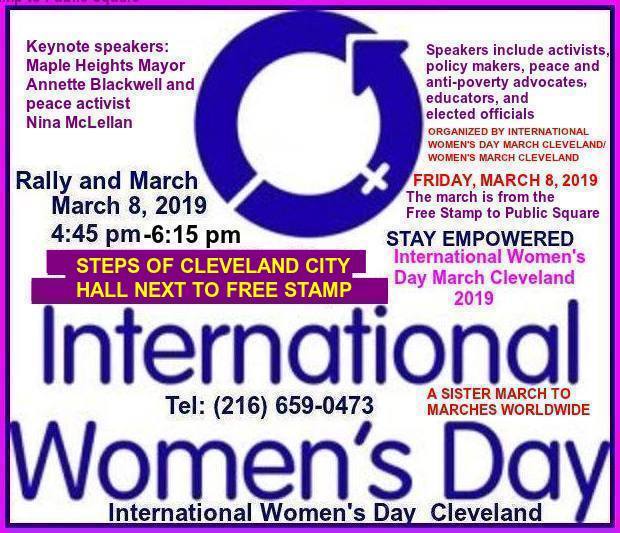
     While my long term project in stalled in administrative tedium, one project winds down and others wind up; I had the opportunity to participate in a few engagement activities that sparked reflection.  A public conversation between Carmen Twillie Ambar and Robyn Minter Smyers, moderated by Marianne Crosley that I expected to be more skill focused, was empowering.  The event I expected to be more empowering, the Cleveland International Women’s Day march, was less so.    

     The conversation held in the protected arena of the Metro Campus Center, promoted as discussing “the future of leadership”, focused on affirmation of women’s ability to succeed as women in the public space.  It provided a moment of context, recognition of hard earned and won success and commitment to “do more”.  These women’s candor, both agreed that work life balance is a struggle and competing demands require prioritizations, actually made aspirational hopes seem more achievable.  Meanwhile, I felt the March reflected a larger and more disturbing trend, the difficulty of public discourse in the modern environment.

   Grassroots movements were powerful in the 1960’s and 70’s, because they seemed to be built from collaborating efforts among organizations rather than competing efforts to “have my say” in front of the press.  In my Pollyanna optimism, the public microphone should be an opportunity to inform and build consensus. (https://www.facebook.com/clevelandcom/videos/2208899279372104/)

  This march, felt like a jumble of competing objectives that were displayed in front of a small audience and a visible opposition.  It was not the presence of the opposition that surprised me; it was their comfort in expressing extremist views. (To the person holding the sign calling for the extermination of all Black People… exactly what qualifies as a black person?  Since all of us have African DNA, it appears to me you are calling for the extinction of the Human Race.  Perhaps a little education would help you see the ramifications of your thinking, I digress.) 
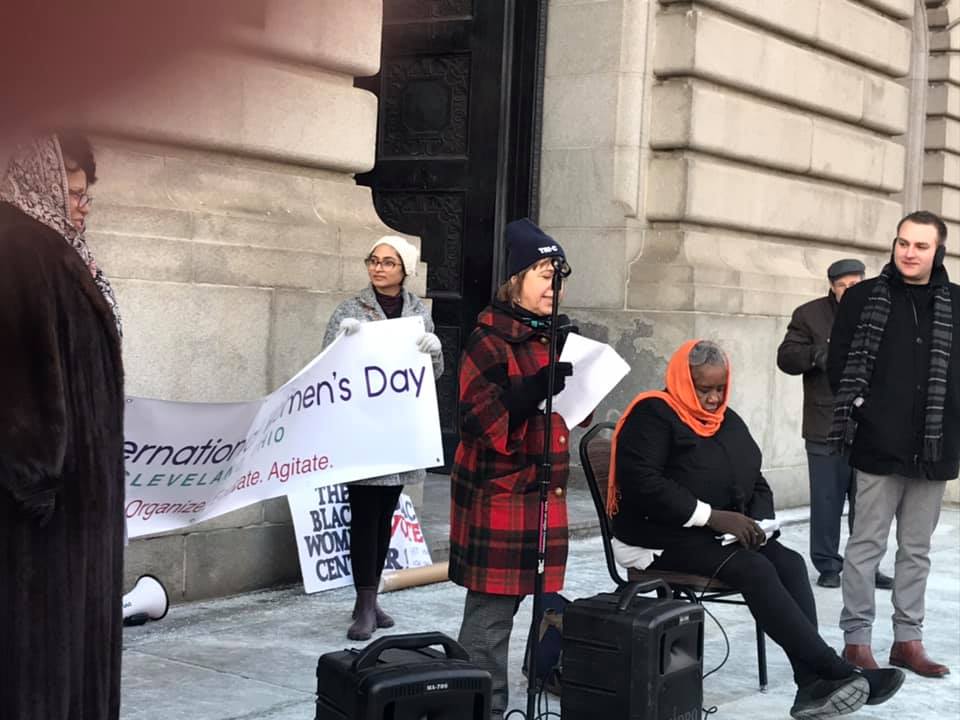
My role was to reflect on the topic of ‘Women and Education’. It was my pleasure to provide a quick 3 minute reflection on equity, visibility and a reminder of women’s leagacy of activism and promote consciousness of what needs to be done in the future.

Photo of Kim Lenahan giving a speech on the steps of Cleveland City Hall by Kim Lenahan for International Women's Day 2019.
Cleveland International Women’s Day, City Hall 2019. Taken by Kris Patt

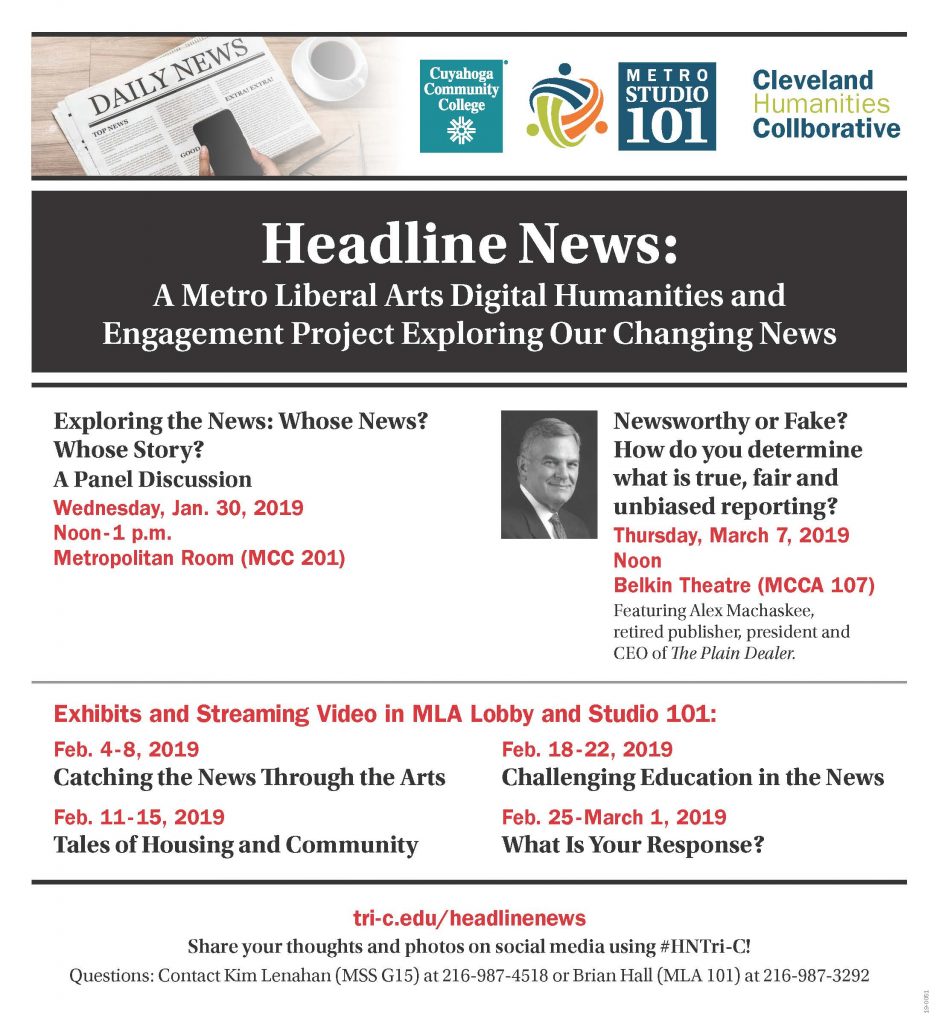
     A fear of the tyranny of the minority was expressed in the Federalist Papers, but the U.S. Constitution was constructed by flawed, prejudiced, patriarchal white males; they also had the Pollyanna faith that “In the extended republic of the United States, and among the great variety of interests, parties and sects which it embraces, a coalition of a majority of the whole society could seldom take place on any other principles than those of justice and the general good.”[1]  Theoretically, the public space provides all Americans the opportunity to present their case in the court of public opinion.  Women and other minorities in the past (including extremists), have used their soap boxes to express their beliefs, claim their rights and try to garner public support to shift a minority opinion to a majority stance. As public spaces have shifted to commodified, digital, international networks, our local public discourse is suffering.  Alex Machaskee, former editor and publisher of the Plain Dealer expressed his concern over the power of “click bait” in driving decisions and the formation of content during the final event of Headline News project.  He advocated investigating the sources and reading with a critical eye, but emanated an aura of confidence regarding the future of journalism.

     Where do these deep thoughts and debates leave Cleveland women?  In some ways, the same place we have always been– confronting the problems we face with the tools we have.  However, highly educated and president of historic Oberlin College, Carmen Twillie Ambar expressed she is only 2 generations removed from picking cotton.  Robyn Minter Smyers grew up in Cleveland and sits as one of 9 members of the International Board of Thompson, Hine & Fleury.  Mothers with young babies stood in 24 degree sunshine on the steps of Cleveland City Hall to support the idea of International Women’s Rights.  ‘As long as hope endures’, I agree with Susan B. “Failure is Impossible”!   


[1] Franck, Matthew.  “Religious Freedom” http://rootsofliberty.org/religious-freedom-in-the-federalist/ accessed 3/9/2019.

A Second Piece on the Puzzle

How will digital media and/or digital tools be important to teaching my target audience one of the essential lessons I’ll be focusing on in my project? What, specifically, about the digital environment will influence what you do and why?

I intend to use the tool Cleveland Historical  (https://clevelandhistorical.org/) to transform what is an expensive physical, but relatively passive historical tour of the History of Cleveland Women into a digital engagement experience.

“ Cleveland Historical is a free mobile app that puts Cleveland history at your fingertips. Developed by the Center for Public History + Digital Humanities at Cleveland State University, Cleveland Historical lets you explore the people, places, and moments that have shaped the city’s history. Learn about the region through layered, map-based, multimedia presentations, use social media to share your stories, and experience curated historical tours of Northeast Ohio.

The use of this mobile app enable will be an instantaneous window into the past.  A GIS locater brings up historical stories that occurred in the immediate area of the phone.

In place of a formal group tour, use of this application will allow students to track their daily activities and recognize how they move within the city.  Checking Cleveland Historical as they progress through their day will acquaint them with figures and events of the past who traveled where they travel.  This aspect of the “tour” will present a ‘Hall of Fame’ and start the process of connecting past to place.  It will not however, provide any sense of chronology, continuity or a deeper understanding of context & time.

These sensibilities will need to be created through other activities and engagements.  Students will work collaboratively in groups to share what they have learned in their various locations and build a concept of chronology and time.  Where individuals located in multiple sites across the city, what is similar within a group, what was different?  Was time a factor connected to place and how?

The use of technology and the means of transportation used around the city will also facilitate a larger conversation about the technologies we use today.  How does technology change daily life and opportunity?  I will also ask if the students accessed other apps to find more details about a particular individual or location?  Would this information have been accessible in the past?  What resources are available to find out about people today?  What resources do we use to find out about people of the past?  This makes a lovely segue into primary sources.

This application will also demonstrate how history has been collected, remembered and built. After using the app, we will discuss the type of history that is promoted.  What stories are included?  Are their missing stories?  What do the buildings in the areas we work, play, eat and shop, tell us about ourselves?  Is there any of this evidence demonstrated in the app to develop a sense of historical context?  How do we know what was presented, is true?  The digital technology is a tool, but it is a very useful tool for creating opportunities to engage with the past and draw upon resources.  It provides the opportunity to teach that collecting is only the first step in developing a history that involves reflection and questioning about the deeper connections and meanings  of what is visible and invisible.

First Piece of the Puzzle

This semester I am considering the application of a digital component for the History of Cleveland Course that is taught as part of the Mandel Humanities Scholars Academy within Cuyahoga Community College.  “The Mandel Scholars Academy curriculum nurtures the region’s future leaders through integrated learning that combines classes, seminars, lectures and events focused on civic and community engagement. You will work collaboratively with community organizations and leaders through guided coursework in the humanities — with a special focus on leadership — while learning about the community, our region and its vibrant history.”

Currently Professor David Bernatowicz teaches this course and this semester is introducing the Clio Application 

Another possible project is transforming  physical tours of the city which are currently part of the course into virtual experiences.

We could also utilize or collaborate with the Cleveland Historical application which has been developed by Cleveland State University and also provides access to GIS history.

The direction this product will take, will be determined by consideration and discussion of the following questions and their place within the course itself:

  1. What is the impact of physical space in history? (what is the connection between time & distance?)
  2. How does the conception of time & distance change over time?
  3. What are the factors causing changes in transportation, speed of communication, rie in population, etc.?
  4. How does longevity impact space and power? (What is the significance of where people live?)
  5. How did Cleveland grow and what are the factors in its expansion?
  6. How have changes in laws impacted the quality of life in Cleveland?
  7. What is the impact of ethnic and cultural ties and how has that changed?
  8. What has been the role of individuals in the City of Cleveland? How have the leaders changed and how have these changes impacted urban lifestyles?

It is difficult to imagine a city different from what is seen and experienced every day.  Many of the students who attend Cuyahoga Community College (Tri-C) have never been outside of the city or state.  To imagine the historical context of Cleveland, OH as “The West” or “Wilderness” takes a great deal of historical imagination.  Cleveland as a mid-western city, never had the national history ingrained in its urban identity the same way as other large historical cities (NY, Philadelphia, Boston, etc.).  Although the founding was made shortly after the Constitution was signed, Cleveland experienced its major growth following the Civil War  due to the confluence of water and railroad transportation and the emerging industries of oil and steel manufacturing.  Cleveland at its peak was the fourth largest city in America and for a while the center of national politics.  However, forces such as the decline of the steel industry, the failure of unions, shifting modes of transportation (which made Cleveland a fly over rather than ship through hub) have created the national characterization of “the mistake on the lake”.  The majority of Cleveland students cannot even see remnants of this past.  It’s heros in the latter years, as early as Rockefeller as recent as LeBron James, have made Cleveland a city one is ‘from’.   Often these forces are hidden or come from distant events.  Connecting to their past will strengthen these students understanding of their own identity and empower them to more fully direct their futures.

DPH689 New Course – New Goals

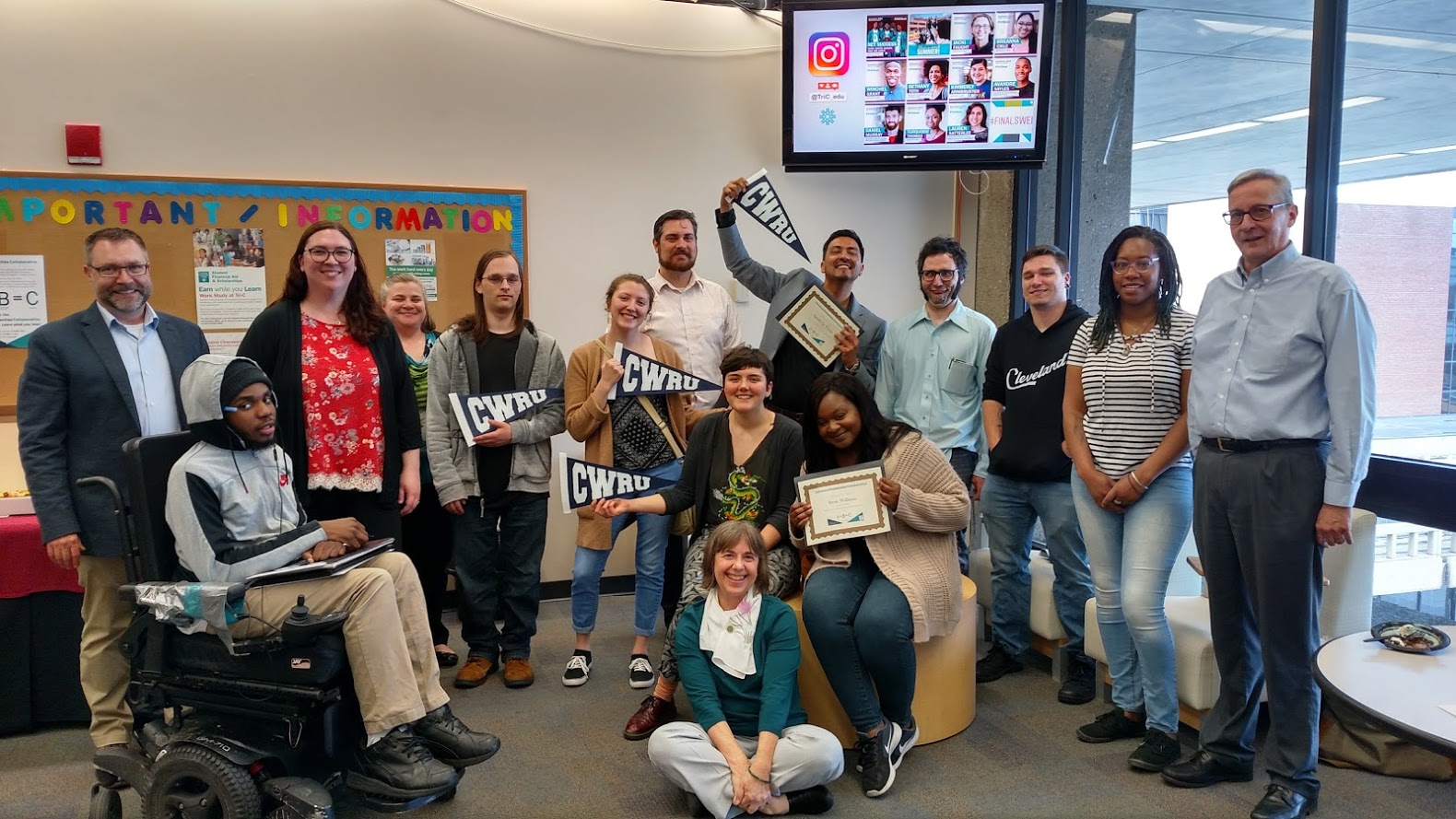
Cleveland Humanities Collaborative Celebrating Graduating Students with faculty & staff 

I work at Cuyahoga Community College teaching History, Women’s Studies and advising in a Transfer Pathway to Case Western Reserve University.  You may have heard of us in the previous 8 years when President and Mrs. Obama often used our college as a model for promoting community college education.

Having earned my Ph.D. in a very …very traditional program, I have great classic research skills and felt myself falling behind the Digital World.  I wanted to understand the “Digital” behind Digital Humanities and I wanted to add new dynamics to the teaching in my on-line classes.  Also I was struggling with a long-running research project.  I needed new tools to organize, diagram and (I now realize) ‘crowdsource’ the aspects of this work.  I was crowd-sourcing before it had a fancy name, but classic methods have been insufficient for what we have been trying to accomplish.

The Digital Humanities Certificate Program is helping me in many ways, broadening my awareness of the scholarship & literature of this field, creating deadlines and forcing me to develop technological skills and independence.  I have ventured into the new fields of mapping and blogging and tried utilizing new content management systems.  I had hoped to gain more technological proficiency which is my weakness.  Since this is a distance learning course and there are no nearby facilities to act as resources, that has been a challenge.

Considering the constantly changing dynamics, platforms and resources of Digital History, I am intrigued by the concept of ‘teaching’ it.  I have used digital tools in my courses, and as noted above, I have greatly expanded my understanding of the field.  My goal for this course is to consider how to balance theory and practice in the learning environment, where ‘expertise’ is one of the variables.  My fellow history professor David Bernatowicz (standing next to the window in the picture above) teaches a “History of Cleveland” course.  This course combines traditional class lecture and activities with actual physical tours.


 I have organized and taught the Cleveland  Women’s History class & tour.  A project I would like to envisage is transforming this physical class/tour into a digital/virtual experience.

Every class is a journey transforming the mind!


Digital Humanities Projects are Collaborative!

Cleveland Women’s Archive Project Update or “Digital Humanities Projects are Collaborative!”

The words of my mother ring in my ears, “how many times do I have to tell you”!  The things I know, but have to be repeated until I finally take action.  ‘Digital humanities projects are collaborative’ and like all good academics, I looked around for the collaboration within my institution and my (actually fairly wide) circle of friends.  But when my known resources failed me in resolving my issues with Omeka,  I swallowed my pride and reached out to strangers in my community.  What a concept!  Is that not what “community” is all about?  Cleveland is a Midwestern town, where folks still help others!  I made an appointment at the Center for Public History + Digital Humanities at Cleveland State University.  Extraordinarily generous with their time and expertise;  Erin Bell clarified my understanding of Curatescape and some of the nuances of Omeka while Dr. Mark Souther introduced me to their goals for the Cleveland Historical ‘living history archive’ and the activities of Center.  We shared our love of the city and its history.

Armed with these new perspectives, I am somewhat back at the drawing board.  My recent investigations into the Landscape and Oral history modules have reminded me of the need to focus on audience and more intentional design.  The Omeka User Manual  clearly states that planning is critical, but an individual cannot know, what they do not know.   My new understanding of Omeka will necessitate re-calibration of what I can and cannot do within the Omeka structure in the time available to complete the project.  Traditionally, I have been uncomfortable with trial and error, but a huge benefit of my collaboration, was Erin Bell’s assurance that is an on-going aspect of “digital” humanities.  I will be eternally grateful for that advice.

My immediate goal is to finish the administrative aspects of the collaboration with the CSU Special Collections division, complete the identification of all the resource materials to be included on the site while I ponder the design.  This  IS  Community History!