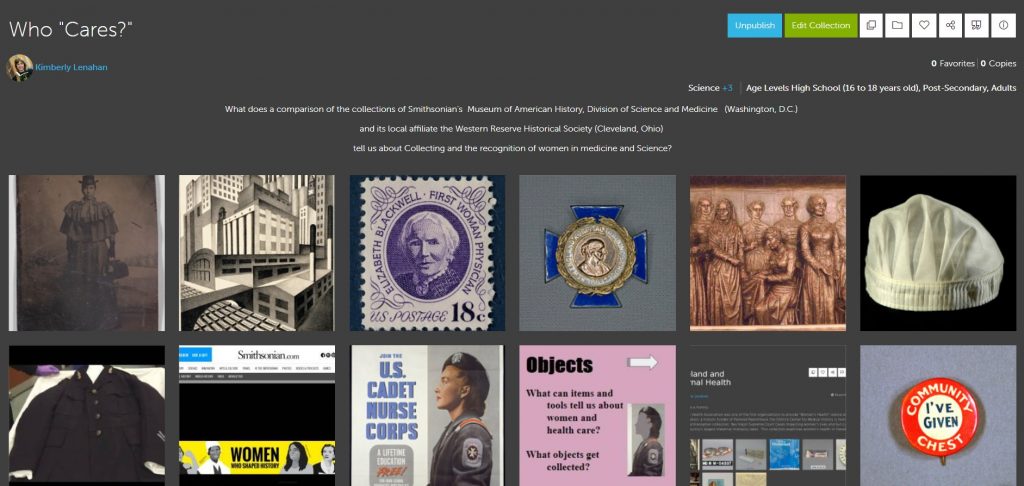
My internship was to create a Smithsonian Learning Lab exhibit that forged a bridge between the Smithsonian National Museum of American History: Medicine and Science CollectionsWashington, D.C., and those of the Western Reserve Historical Society, Cleveland, Ohio.
Proud of the work accomplished: as it broke new ground in highlighting women’s achievements in the area of medicine and science, that it has provided evidence for how women are seldom recognized or their artifacts collected; that it encourages attention to be drawn to women’s lives and stories; that a novel way of promoting this history has been developed on an innovative platform that will encourage use of the collections of NMAH Medicine & Science & the Western Reserve Historical Society.
Comforted by recognizing historic limits of medicine and science, which councils’ patience when I am caring for family members, or in the face my own health challenges. I am more empathetic with the striving of myself and others to achieve recognition. I commiserate with and seek to encourage those who are quiet or who have been overlooked, viewed as ordinary as their heroism may be greater than those whom we applaud.
More courageous having attempted something new, recognized it was more difficult than anticipated and still persevered. I am less fearful of looking foolish, breaking something, or violating rules. I am grateful for the space and opportunity to explore, collaborate with experts, rethink the use of standard practices, technological tools, and the limits of location, resources, and connections.
Wiser for having viewed my understanding of women, healthcare, place, and significance from an entirely different perspective. More thoughtful for having observed and experienced ‘teaching and learning’ in a different environment.
Committed to restoring what has been hidden, to being more intentional in valuing the students, the colleagues, and the people I interact with daily; to collecting their stories and their heritage and thereby the indomitable power of the human spirit.
What
insights do you have about working in digital public humanities as a result of
this experience?
The
first thing I have recognized about Digital Public Humanities is the ignorance
and confusion about it among the public and in academia.
When
I introduce myself or attempt to explain my project, colleagues and
acquaintances have difficulty both with the concept of “Humanities” as a
multi-disciplinary subject and as an academic field of research. I remind them of longer standing
multi-disciplinary areas: American Studies, Ethnic Studies, Gender Studies,
Labor Studies, etc. Explain that
“Studies” allows the individual the opportunity to draw from many disciplinary
perspectives: History, Language, Literature, Psychology, Sociology, Religion,
in order to form a fuller interpretation and understanding of a topic or
society. Then comes the inevitable
follow up question, “What makes it “digital”?
Visual interpretation, academic interaction across media, crowd
interaction and using new tools based to
access massive data bases (Big Data, GIS and Public Records) allow us to
aggregate and reconstruct our interpretations of human activity and expression.
Another
perception is that a ‘discipline’ or ‘area of study’ it is needed, but the
“Humanities” aspect, even more importantly the “History” aspect needs to be
affirmed as integral to the field.
Academics
seize on the “new tools” and think the field is strictly about learning how to
use or create programs. The idea of the
impact of tools on interpretation is not “new” in American History, Charles
& Mary Beard had to defend their “new” methods. Socially, we have adopted computers as aids
to searching and collecting, but just as we have discovered ‘scientific
medicine’ has biases and unintended consequences; we are just in the infancy of
discovering how computing will shape and inform our culture.
“Professionalization” in the field is running ahead of its articulation
of itself. I attended a digital
humanities conference this past summer (which I will not publicly defame). It claimed design to facilitate the merging
of technical skills and disciplines; but sessions skewed technical, discipline
based or ‘sponsored’ by organizations with an agenda. Cross disciplinary dialogue and integration
was limited. I have also noticed that
already a “boiler plate” has been adopted by Human Resource Professionals, who
have been charged with creating job descriptions for this new unfamiliar field. In the short term (3 years) I have been studying
the field, already an extraordinary number of Digital Humanities job openings
are requiring Library Science degrees.
Library Science certainly aligns well, but for many projects, the
analysis and interpretation of the humanities based disciplines is critical to
meeting the goals of creativity, human insight and the creation of new
knowledge.
Like
any other Humanities discipline, research requires time and money.
Knowledge does not come cheap.
Research is a journey in detection.
Uncovering or following the threads of an idea require time-consuming
investigation. In Digital Humanities, a
portion of the cost is in new tools: creating, gaining experience with or
licenses. Presentation requires
preparation time and resources. As we
move from text-based to visual culture, the cost of digitizing must be
incorporated. Access to text has become
cheaper, faster, but compilation, resolution, transference of images, while
less cumbersome is still evolving.
Storage is still an issue.
Finally,
‘It Takes a Village!”
Historians have always relied on communities; archivists & librarians that lead us to materials, experts that share insight or stories pertaining to streams in our topics and other artists, poets and scholars. Digital Public Humanities requires a broader inclusion of technical skills, technicians and new emphasis on artistic and commercial skills.
Cleveland Foodbank
www.Clevelandmemory.org
2. What new questions or ideas do you have as a result of this experience?
Can
Historians continue to capture and
make ‘human experience over time’ relevant?
As the digital age has overtaken us, a culture of “immediacy” has also
emerged. Students and ‘the public’ want
information that is immediately relevant, aesthetically designed and easy to digest. “Pondering the Past” is not in fashion. ‘Looking back’ to search for answers is
devalued in the face of creating new solutions, methods and future goals. Even the short 400 years of American
Experience is being condensed or eliminated in our schools in favor of teaching
more “applicable” skills. I came to
Digital Public Humanities in my search to make my discipline; that emphasizes reflection
on the past, interpreting the deeper meanings of human experience and tracking
historic patterns and forces to foster richer and strategic decision making,
more relevant and accessible. I am still
asking, “How can I help people recognize the value of their past?”
History, Women & Health Care in Cleveland and Digital Public Humanities