Category Archives: Project

DPH 794: Post 8 InTERNSHIP ReflectIonS

My internship was to create a Smithsonian Learning Lab exhibit that forged a bridge between the Smithsonian National Museum of American History: Medicine and Science Collections Washington, D.C., and those of the Western Reserve Historical Society, Cleveland, Ohio.

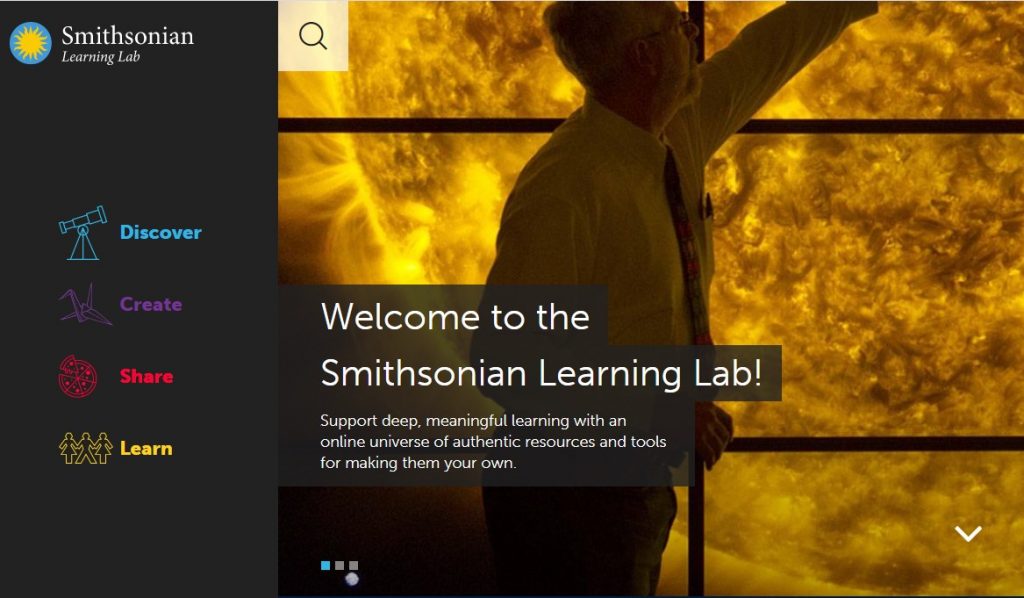
Image of the Home page of the Smithsonian Learning Lab

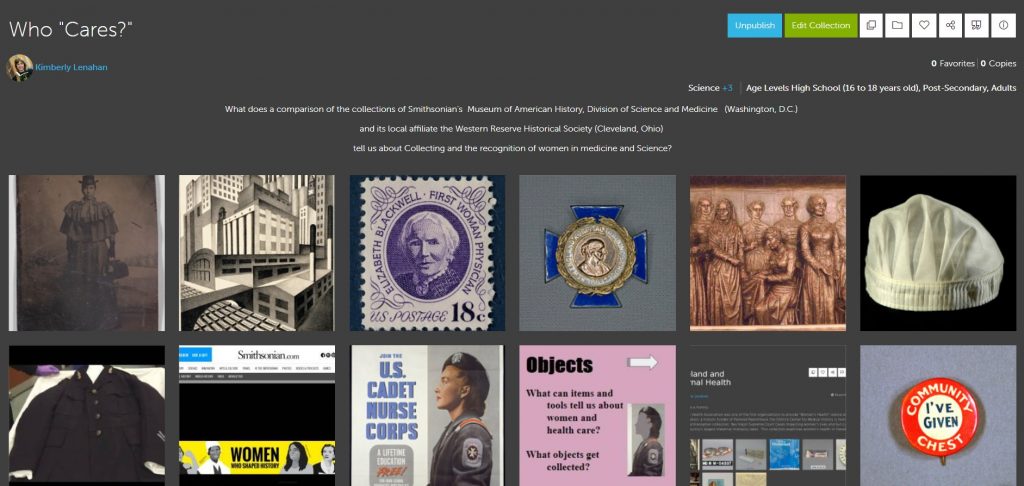
                 Please visit:  “Who Cares”  http://learninglab.si.edu/q/ll-c/3LXidXoP4xkEhBvH

Image of the exhibit created by Kim Lenahan entitled "Who Care" features thumbnails of exhibit artifacts.

“ Because of my internship, I am…”

Proud of the work accomplished: as it broke new ground in highlighting women’s achievements in the area of medicine and science, that it has provided evidence for how women are seldom recognized or their artifacts collected; that it encourages attention to be drawn to women’s lives and stories; that a novel way of promoting this history has been developed on an innovative platform that will encourage use of the collections of NMAH Medicine & Science & the Western Reserve Historical Society.

Comforted by recognizing historic limits of medicine and science, which councils’ patience when I am caring for family members, or in the face my own health challenges. I am more empathetic with the striving of myself and others to achieve recognition. I commiserate with and seek to encourage those who are quiet or who have been overlooked, viewed as ordinary as their heroism may be greater than those whom we applaud.

More courageous having attempted something new, recognized it was more difficult than anticipated and still persevered.  I am less fearful of looking foolish, breaking something, or violating rules.  I am grateful for the space and opportunity to explore, collaborate with experts, rethink the use of standard practices, technological tools, and the limits of location, resources, and connections.

Wiser for having viewed my understanding of women, healthcare, place, and significance from an entirely different perspective.  More thoughtful for having observed and experienced ‘teaching and learning’ in a different environment.

Committed to restoring what has been hidden, to being more intentional in valuing the students, the colleagues, and the people I interact with daily; to collecting their stories and their heritage and thereby the indomitable power of the human spirit.

Making History!

What skills or knowledge from your coursework are you using in your internship?  Have you noticed a difference between theory and practice? Why or Why not?  This is a challenging question for me, because I have been attempting to merge history and Digital Public Humanities (DPH) and it is difficult for me to now isolate them.  ‘What are the skills of DPH and how does the theory and practice differ from traditional history’ and is what the essence of my internship’ and another effort to merge the two (history and digital humanities).

During the process of arranging for this internship and coinciding with it; I have had some planned, some unanticipated, professional and personal opportunities providing DPH engagement experience.  These ventures have provided their own insights into the theory and practice.  As I have made a concerted effort to immerse myself in all things digital humanities over the past 2 years, the experiences tend to wind together in my brain.

In terms of theory, my natural bent is to the work of Sam Wineburg who discusses the nature of historical thinking and Digital Humanities processes reflecting on the intellectual differences between the two.[1] He applies historical thinking methodology to the data gathered through digital means, in other words, ‘digital humanities’ is just a new historical methodology.  That is what I thought when I decided I wanted to learn what ‘digital humanities’ was all about.  However, every historian is taught the significance of methodology and how the body of research impact interpretation.  The use of the term “corpus” has transformed the meaning of historical research to include digital textual and linguistic analysis rather than the socio-cultural contextual analysis traditionally practiced.  Digital historians seek to incorporate the digital into our research, which changes where we search for sources and eventually influence our interpretation.  

In my internship, I am seeking to create a new corpus from established collections and then interpret and present the findings using digital strategies.  To date, I have found helpful in this process, theory that is ‘methods’ rich, such as the work of Sheila Brennan and T. Mills Kelly.  Although I am not creating a crowd-sourcing project; their framing has been helpful.  I have applied their “lessons” in content collection, technical issues, attracting visitors & building trust with potential contributors and most  important adding 25% (50% if you are a newbie like me) to TIME Estimates.  Their idea that “low barrier entry is critical”I found very applicable when recruiting partners for this internship.  I promoted maximum benefit, minimal work and management to my supervising institutions as the “low barrier entry”.  Institutional collections, even when you think you are familiar with them, have their own idiosyncrasies and the assistance of ‘the insider’ is essential.[2] The literature of digital methods AND historical thinking is helping as I process the form of the Smithsonian Learning Lab collection I am creating.[3]  However, the experts make it appear so easy.  The challenges of research, the interference of daily obstacles and filling in the gaps of technical knowledge sometimes make this adventure feel more tedious then inspiring.  But then I remember: I am creating new knowledge, in a new way……Making History!


[1] Wineburg, Sam. “Why Historical Thinking is Not About History.” History News 71, no. 2 Spring. 2016.

[2] Brennan, Sheila A., and T. Mills Kelly. “Why Collecting History Online is Web 1.5” Roy Rosenzweig Center for History and New Media. 2009.

[3] Examples include: Kelly, T. Mills. “The History Curriculum in 2023.” edwired (blog). January 2013.  Schrum, K. (2012). “A tale of two goldfish bowls . . . Or what’s right with digital storytelling.” In D. Cohen & T. Scheinfeldt (Eds.) Hacking the academy: A book crowdsourced in one week. Ann Arbor, MI, University of Michigan Press. Calder, Lendol.  “Uncoverage: Toward a Signature Pedagogy for the History Survey”. Journal of American History.  P. 1358-1370. March 2006.

Sixth Piece of the Puzzle – Technology

Technology is a key component of Digital Learning.  Does that seem like a patently obvious statement?  Yes, but this simple statement has deep ramifications.  For some individuals technology comes easy.  Often these are the individuals who adopt the latest and greatest, are excited about changes and shift between screens, software, hardware and mobile apps like expert skiers navigating moguls.  Assumptions, there is a generational divide in the adoption of technology and soon we will “age out” of our technological hurdle, are misplaced.  In my Community college classes, I find the digital hurdles include: access, poverty, class, mental processing and perspectives.  I have also found that “tech users” are often, not the best instructors, because they do not understand why or how a hurdle exists.

As I have watched the expanding usage of technology, I realized that there was something I was just “not “getting”.  For me the “skills” were not transferable.  Every change in platform, software, hardware, & upgrade became a hurdle.  Another technology I had to learn, which I knew would last only until the next upgrade.  I resented the time spent learning the technology to ‘display history’ as opposed to “doing history”.  Techies argued, “there are great tools that “do everything for you” – just drop in your data!”  But if I “dropped my data”, do I really understand the results?  As we have learned in this certificate program, decisions are made at every step and they shape the outcome of the digital processing.  Manoff

Constructing the “Finding Women in Cleveland” project has been an adventure in digital teaching and learning.  How hard could it be to ‘transform the tour…to place images on a platform and ‘plug in’ images, video and audio?  I was thinking analogically.  I have been challenged to think digitally, to weave technology, historical ideas, urban artifacts and educational goals into the project.  Digital thinking transforms the product; the goal of education transforms the technology, the technology is transformed by the nature of the materials and artifacts, the use of the digital platform transforms the engagement and the process of integration transforms the educational goals.

Just as learning systems were developed to prepare workforces for the industrial age, learning systems must be  transformed for the digital age.  Large machines and large organizations were built to last.  Authorities told us what was important, and keeping “the line” was important.  But if the goal is creativity, flexibility and responsiveness to diverse populations and demands…teaching and learning must be adapted to promote these skills, even in understanding and presenting our past.

Thus, digital learning is incremental, flexible and engaged: “teach me what you are doing, so I can learn by doing, so I can not only participate but evolve.”  The human skill of teaching and learning becomes a collaborative endeavor.  Humanity and individuality is recognized and really, isn’t the goal of education to get people to live together peacefully and prosperously?  We can be lured by the Apple (pun intended); we can focus on the wrong things, mindfulness of what is gained and lost from our traditions and understanding of the past is critical.  We cannot halt the future, nor would we want to, but engagement can be the bridge between generations and the glue that holds the puzzle together.

Notes:

Manoff,​ ​Marlene.​ ​​”The​ ​Materiality​ ​of​ ​Digital​ ​Collections:​ ​Theoretical​ ​and​ ​Historical Perspectives.”​​ ​​Portal:​ Libraries and the Academy ​ ​6,​ ​no.​ ​3​ ​(07,​ ​2006):​ ​311-25.

Fifth Piece of the Puzzle: Finding Cleveland’s Women

“Like their personal lives women’s history is fragmented, interrupted; a shadow history of human beings whose existence has been shaped by the efforts and demands of others”

I am planning on using this quote by feminist and author Elizabeth Janeway as part of an introduction to a pre-class preparatory assignment.   Students will be asked to reflect on these words as they search for “Cleveland Women’s Daily Lives” through a Mobile History Exercise.

The reason I have chosen this particular quote is because it is an excellent analysis statement that calls for reflection.  Students can, consider how women’s lives are fragmentary, why they might be described as “interrupted and make judgement on the accuracy of the statement, “they have been shaped by the efforts and demands of others”.  I will ask them to consider if, in the exercise of exploring ‘mobile Cleveland history,’ they find women’s existence and history to be “a shadow”.

The assignment is basically to track daily activities through the Cleveland Historical Application.

Mobile Public History App

Students will be asked to log what they find in the historical entries pertaining to the inclusion of women, the location and activities of women, and identify the period/dates, as recorded of these entries.  The findings will be discussed in the class.

As part of the class discussion, we will also consider the comments of  Prof Jeanette Tuve  in her concluding analysis and summary of the  Oral History Project,  “Ethnic Women of Cleveland”, in the Cleveland Memory Project:  

“The histories of these 30 women strongly support the position of Dr. Martha Bohachevsky-Chomiak, professor of history at Johns Hopkins University, who has stated that early ethnic women in this country were in fact the first feminists, pragmatic feminists, but untitled as such and deliberately so. These interviews are stories of women of great strength, courage and creativity as they did what they had to do to maintain their families, their churches, their values and traditions while building their communities. Simultaneously, an implicit part of their perceived diffuse responsibilities was retention of traditional male and female role distinctions”.

Is there evidence that women built their churches and communities?  Why would “traditional male & female role distinctions” make a difference in their activities?   How can we find the “great strength, courage and creativity” of women in the public record and history?    Historical judgments are made and promoted…are the comments and evaluations of these historians reflected in the findings and experiences of the students’ engagement with the past?  Do we only find what we look for?  What is the role and value of interpretation as we search for women in Cleveland’s past?

These interpretations give us a link in which to connect and re-frame our own findings, beliefs and thinking about women.  They provide an entry point to the conversation about the significance of women in a city.

Janeway, Elizabeth, Man’s World; Women’s Place: A Study In Social Mythology. NY: Dell Pub. Co.,1971.

Fourth Piece of the Puzzle: Reflection in Bronze

The image in my banner above shows the image of the Bas-Relief Bronze Panel “Cleveland Soldier’s Aid Society” that is set in the central column of the Tablet Room in the Soldier and Sailors Monument, Public Square, Cleveland, OH.  The Soldier’s Aid Society organized at the beginning of the Civil War became one of the key branches of the U.S. Sanitary Commission.  This panel is the only 19th Century Civil War monument that included women.

Without knowing the larger context of the panel, it would be difficult to identify the purpose of the image.  It does not portray the women as “Heroines”, although these women were, giving up time at home and daily activities to promote and organize the collection of food, medical supplies and other items requested by the field stations and hospitals of the Union Army.  They collected articles & money, served as the conduit of information from the front line and cared for soldiers medical, transportation and sheltering needs from 5 days after Lincoln’s call for troops though the duration and about 3 years after the Civil War.   These women are portrayed simply as a group of women.  Once could probably date the context through the women’s attire.  Aside from the Sister of Charity holding an amputated arm, the setting could be anywhere in the mid-late 19th Century.

I believe this image is a wonderful place to begin the tour because it provides the opportunity to raise a variety of topics:

  • What is women’s role: in the Civil War; …on the home front; …in the city?
  • What are women’s jobs: on the cusp of the Civil War and after?
  • What is women’s relationship: to the War; ….to each other; ….to their families; …..to the City and Federal governments?
  • What are the attributes of women’s leadership?
  • What impact did race and class have on women’s ability to participate in society or demonstrate leadership?
  • What is the perception of women and their place in the public sphere?
  • How are women remembered?

This image grounds us in the fact that “women” are individuals who are living and their lives…when changes come… they meet them.

Third Piece of the Puzzle: FCW

FINDING CLEVELAND’S WOMEN: Audience

Students in the UST 112M History of Cleveland Course for Mandel Scholars Academy students attending Cuyahoga Community College

“The Jack, Joseph & Morton Mandel Humanities Center provides a distinctive academic experience that fosters the study of the humanities through innovative teaching, collaborative/team learning opportunities, seminars and lectures, and civic engagement opportunities designed to expand critical thinking skills and develop leadership skills. The mission of the Center is to provide a unique environment for meeting the intellectual and academic needs of Mandel Scholars in a holistic manner and to broaden engagement in humanities scholarship.”

Mandel Scholars are highly motivates students with a GPA of 3.0 or above.  This diverse (age, ethnicity, race and gender) students come from all areas of the city and their majors range across the academic disciplines of the college.  However, all of the students entering this course will have already taken the HUM 102M–The Individual and Society course.  This course defines what the “Humanities” are and mean. Through exploration of art, philosophies, and scientific views, students are introduced to examining and evaluating the interactions of individuals  and what it means to live in ‘society’.   This course also begins the process of building a “cohort” of students.  In addition to their Mandel classes (1 per semester) they are required to participate in City and Academic engagement activities and eventually they will work interactively in a project with community leaders and partners.

The History of Cleveland Course is the second “Mandel” Course.  The intent is to engage students in thinking about the City of Cleveland as a historical environment and gain a deep understanding of its growth, development and challenges.

CATALOG DESCRIPTION: This course traces the development of the City of Cleveland from the 1930s to the present through experiential and project-based learning activities. This course will discuss the social, political, and economic history of the city through a series of field trips to local historical societies, museums, and tours led by guest speakers and faculty.  Students may be responsible for additional fees for meals and entrance to some locations.

My project is to transform a physical bus tour, that explores the history of women in the city of Cleveland, into a stimulating virtual digital experience for these Mandel Scholars.

A Second Piece on the Puzzle

How will digital media and/or digital tools be important to teaching my target audience one of the essential lessons I’ll be focusing on in my project? What, specifically, about the digital environment will influence what you do and why?

I intend to use the tool Cleveland Historical  (https://clevelandhistorical.org/) to transform what is an expensive physical, but relatively passive historical tour of the History of Cleveland Women into a digital engagement experience.

“ Cleveland Historical is a free mobile app that puts Cleveland history at your fingertips. Developed by the Center for Public History + Digital Humanities at Cleveland State University, Cleveland Historical lets you explore the people, places, and moments that have shaped the city’s history. Learn about the region through layered, map-based, multimedia presentations, use social media to share your stories, and experience curated historical tours of Northeast Ohio.

The use of this mobile app enable will be an instantaneous window into the past.  A GIS locater brings up historical stories that occurred in the immediate area of the phone.

In place of a formal group tour, use of this application will allow students to track their daily activities and recognize how they move within the city.  Checking Cleveland Historical as they progress through their day will acquaint them with figures and events of the past who traveled where they travel.  This aspect of the “tour” will present a ‘Hall of Fame’ and start the process of connecting past to place.  It will not however, provide any sense of chronology, continuity or a deeper understanding of context & time.

These sensibilities will need to be created through other activities and engagements.  Students will work collaboratively in groups to share what they have learned in their various locations and build a concept of chronology and time.  Where individuals located in multiple sites across the city, what is similar within a group, what was different?  Was time a factor connected to place and how?

The use of technology and the means of transportation used around the city will also facilitate a larger conversation about the technologies we use today.  How does technology change daily life and opportunity?  I will also ask if the students accessed other apps to find more details about a particular individual or location?  Would this information have been accessible in the past?  What resources are available to find out about people today?  What resources do we use to find out about people of the past?  This makes a lovely segue into primary sources.

This application will also demonstrate how history has been collected, remembered and built. After using the app, we will discuss the type of history that is promoted.  What stories are included?  Are their missing stories?  What do the buildings in the areas we work, play, eat and shop, tell us about ourselves?  Is there any of this evidence demonstrated in the app to develop a sense of historical context?  How do we know what was presented, is true?  The digital technology is a tool, but it is a very useful tool for creating opportunities to engage with the past and draw upon resources.  It provides the opportunity to teach that collecting is only the first step in developing a history that involves reflection and questioning about the deeper connections and meanings  of what is visible and invisible.

First Piece of the Puzzle

This semester I am considering the application of a digital component for the History of Cleveland Course that is taught as part of the Mandel Humanities Scholars Academy within Cuyahoga Community College.  “The Mandel Scholars Academy curriculum nurtures the region’s future leaders through integrated learning that combines classes, seminars, lectures and events focused on civic and community engagement. You will work collaboratively with community organizations and leaders through guided coursework in the humanities — with a special focus on leadership — while learning about the community, our region and its vibrant history.”

Currently Professor David Bernatowicz teaches this course and this semester is introducing the Clio Application 

Another possible project is transforming  physical tours of the city which are currently part of the course into virtual experiences.

We could also utilize or collaborate with the Cleveland Historical application which has been developed by Cleveland State University and also provides access to GIS history.

The direction this product will take, will be determined by consideration and discussion of the following questions and their place within the course itself:

  1. What is the impact of physical space in history? (what is the connection between time & distance?)
  2. How does the conception of time & distance change over time?
  3. What are the factors causing changes in transportation, speed of communication, rie in population, etc.?
  4. How does longevity impact space and power? (What is the significance of where people live?)
  5. How did Cleveland grow and what are the factors in its expansion?
  6. How have changes in laws impacted the quality of life in Cleveland?
  7. What is the impact of ethnic and cultural ties and how has that changed?
  8. What has been the role of individuals in the City of Cleveland? How have the leaders changed and how have these changes impacted urban lifestyles?

It is difficult to imagine a city different from what is seen and experienced every day.  Many of the students who attend Cuyahoga Community College (Tri-C) have never been outside of the city or state.  To imagine the historical context of Cleveland, OH as “The West” or “Wilderness” takes a great deal of historical imagination.  Cleveland as a mid-western city, never had the national history ingrained in its urban identity the same way as other large historical cities (NY, Philadelphia, Boston, etc.).  Although the founding was made shortly after the Constitution was signed, Cleveland experienced its major growth following the Civil War  due to the confluence of water and railroad transportation and the emerging industries of oil and steel manufacturing.  Cleveland at its peak was the fourth largest city in America and for a while the center of national politics.  However, forces such as the decline of the steel industry, the failure of unions, shifting modes of transportation (which made Cleveland a fly over rather than ship through hub) have created the national characterization of “the mistake on the lake”.  The majority of Cleveland students cannot even see remnants of this past.  It’s heros in the latter years, as early as Rockefeller as recent as LeBron James, have made Cleveland a city one is ‘from’.   Often these forces are hidden or come from distant events.  Connecting to their past will strengthen these students understanding of their own identity and empower them to more fully direct their futures.

DPH689 New Course – New Goals

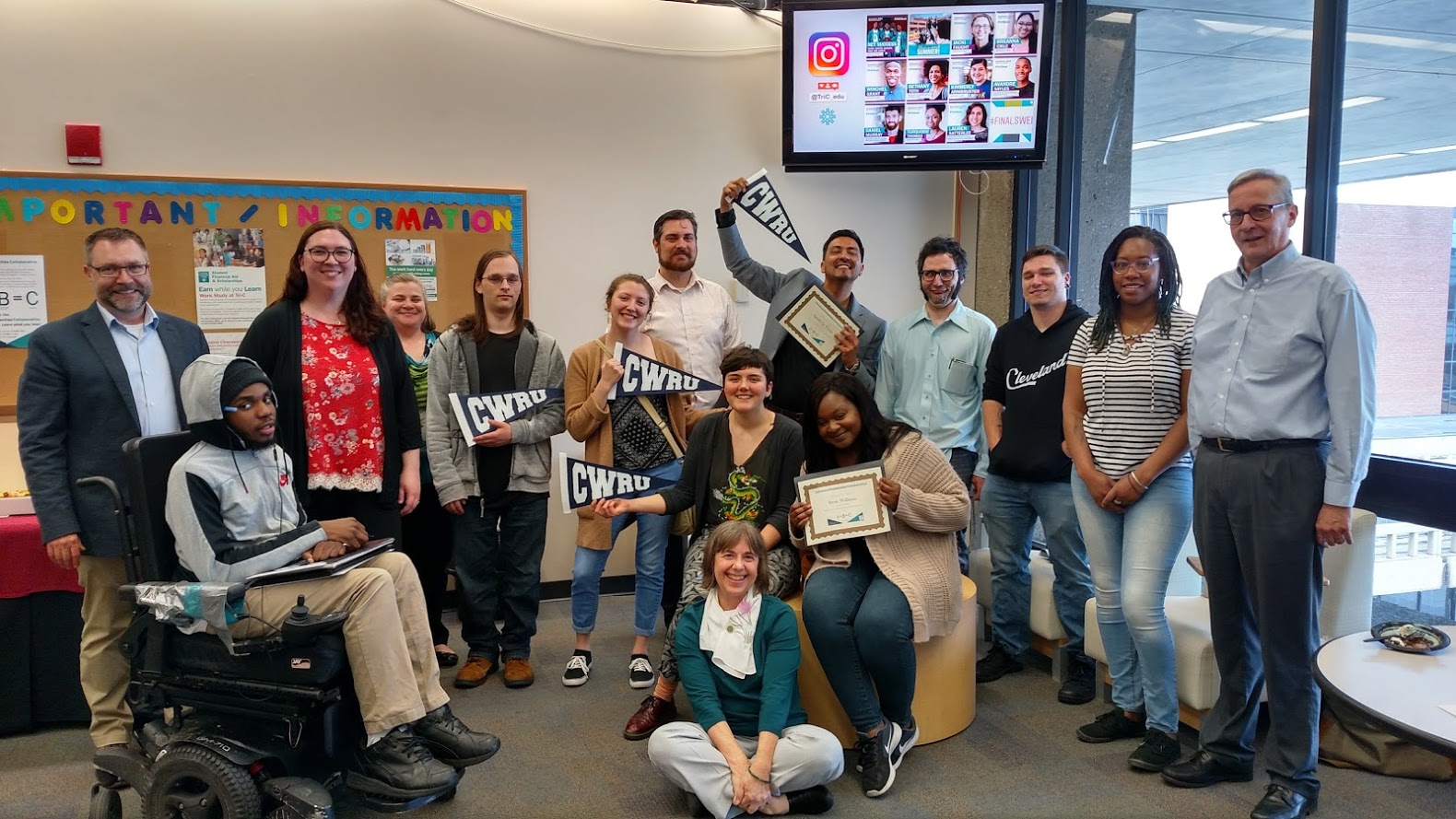
Cleveland Humanities Collaborative Celebrating Graduating Students with faculty & staff 

I work at Cuyahoga Community College teaching History, Women’s Studies and advising in a Transfer Pathway to Case Western Reserve University.  You may have heard of us in the previous 8 years when President and Mrs. Obama often used our college as a model for promoting community college education.

Having earned my Ph.D. in a very …very traditional program, I have great classic research skills and felt myself falling behind the Digital World.  I wanted to understand the “Digital” behind Digital Humanities and I wanted to add new dynamics to the teaching in my on-line classes.  Also I was struggling with a long-running research project.  I needed new tools to organize, diagram and (I now realize) ‘crowdsource’ the aspects of this work.  I was crowd-sourcing before it had a fancy name, but classic methods have been insufficient for what we have been trying to accomplish.

The Digital Humanities Certificate Program is helping me in many ways, broadening my awareness of the scholarship & literature of this field, creating deadlines and forcing me to develop technological skills and independence.  I have ventured into the new fields of mapping and blogging and tried utilizing new content management systems.  I had hoped to gain more technological proficiency which is my weakness.  Since this is a distance learning course and there are no nearby facilities to act as resources, that has been a challenge.

Considering the constantly changing dynamics, platforms and resources of Digital History, I am intrigued by the concept of ‘teaching’ it.  I have used digital tools in my courses, and as noted above, I have greatly expanded my understanding of the field.  My goal for this course is to consider how to balance theory and practice in the learning environment, where ‘expertise’ is one of the variables.  My fellow history professor David Bernatowicz (standing next to the window in the picture above) teaches a “History of Cleveland” course.  This course combines traditional class lecture and activities with actual physical tours.


 I have organized and taught the Cleveland  Women’s History class & tour.  A project I would like to envisage is transforming this physical class/tour into a digital/virtual experience.

Every class is a journey transforming the mind!


Phe Fyi Fo Fum… a giant journey!

PHE: Public Humanities Experience

This semester has been a journey in Public Humanities scholarship and engagement.  Juggling the creation of a public engagement web page for a university archive ‘special collection’ while learning about the theory underlying that engagement has been challenging.  Students like to dream high and while studying are exposed to the best practices, which builds high hopes and expectations.  We explored exciting Digital Public Websites such as “Bracero History Archive” (2010); The Great Chicago Fire and the Web of Memory (1999)and Driving Through Time: The Digital Blue Ridge Parkway.  Learning has been directed toward thinking about the unique aspects of humanities interaction as well as the structural & interpretive components of web presence and websites.

The goal of my particular journey has been to develop a web resource that will provide awareness of resources, connections between resources, encourage scholarship and research and promote on going work on Women and their history in Northeast Ohio.  The real ‘engagement’ aspects of my experience forced me into the application of political, strategic politics as well as challenges of hardware and software, all while being confronted with insights of experts who exposed fallacies in practices and promoted a deeper awareness of audience needs and the connections between tools and conveyance of information.  Each aspect of the education, challenged my conception of the project.  The struggle with deadlines certainly simulated real life production pressure.  Meeting with collaborating individuals and institutions resulted in constant refinement and the dynamic challenge of conflicting goals and interpretations.

Ideas are made real by experiences and when they take place in the public setting they create true human engagement.

FYI: For Your Information

The purpose of digital humanities is to engage people in the ideas, purposes and actions of the world about them.  This does not sound so difficult until it is realized that communicating big and complex ideas to individuals who vary in age, culture, intellectual experience and ability is also being mediated by space, context and technology.  “Interaction (between presenter & receiver) is almost always necessary to accomplish your goals.”  Perspectives and cultures not only of people, but of the ‘organizations of collection’ themselves, among the objectives of the public education, and the audience which varies in capability & experience are all approaching this communication very differently.  It is only through building relationships, that clear and engaging communication can be developed.[1]  It is not merely thinking about the idea we wish to communicate, it is about rethinking about what the visitor is able to receive.  The idea of thinking about “visitors” to public museums, institutions and parks in terms of ‘relationships’ results in a radically different engagement.[2]  When “visiting” was solely defined by physical space, often difficult and expensive to access the “engagement” was much different than when access  to technology demands multi-sensory and multi-platform intersection.  Even though it still may be difficult and expensive to create, it is necessary for the audience to perceive the information we are trying to exchange.

If we want the audience to understand appreciate and act upon or incorporate our information; we must understand and intersect with their modes of communication.

FO: Field Operations

While Citizen Archivist,  The Postville Project and Digital Harlem have provided ideal types for my own ideas, it is not until I got into trying to create a project, that the complexity, collaboration and comprehensive strategy of these undertakings became evident.  These websites are masters of design and integration.  The elements of my project seemed fairly simple:

  • create a list of resource links to make resources accessible in a centralized portal
  • install an exhibit space where women’s history can be demonstrated
  • provide a contact sheet so that information can be exchanged and
  • enable a dynamic space where interesting projects can be announced and engage contribution

Immediately I was challenged by the concept of ‘is my concept of sharing information’ really sharing?[3]  Or am I maintaining control over the sharing, which is not really sharing.  Is there a deeper way to engage?  Am I providing a “newsletter” or a collaborative space?  Am I providing a design that invites the user into the topic and enables them to develop their own thinking as well as absorbing mine?[4]

Considering the audience as a specific individual, is an exercise forced me, as the creator of the site, to move from general concepts and overblown expectations as to who would really access this site.  It also made clear that engaging the content from different perspectives, helps define and present that content in more accessible ways.[5]  I experienced these different perspectives in meetings where interested potential users asked me questions I couldn’t answer.  So much for being an authority on the topic.  But even more humbling was translating my vision into technical reality.  Tools have always been limited.  They are extensions and helpers, but they are not the same thing as a concept.  The vision must be altered by what is possible to accomplish with the tool.  If the tool is insufficient it must be altered or exchanged for a different tool.  I tried to force a dynamic collaborative website concept into a tool that was meant for identifying and collecting things.  If I had technologic expertise or a collaborative team, I might have been able to adapt the tool.  However, I am also working with an established system and there was an unwillingness to adapt their system to my vision.  Back to the drawing board for reconception of how to convey my meaning within and established format.  It was necessary to share control, concept and expression.[6]

FUM: Formative Understandings & Musings

I had envisioned myself as an open and forward thinker.  My journey into digital humanities has challenged that self-conception.  I realize how my training in critical thinking has created its own set of biases and obstacles to communication.  Considering users as specific people with needs has shaped my thinking in terms of content selection. It also demands a broadening my use of tools, to facilitate my communication, rather than expecting others to put forth the effort to grasp my meaning.  Using technology has made me more aware of the multiple layers of interfaces and how that may limit our expressions and reshape our interpretations by focusing our content in “easily accessible tools or images”.  It has deepened my appreciation of the past and the present.  It has sharpened my awareness of the need to communicate ideas more frequently and engagingly.  It has indeed been a giant journey!

[1] Allen-Greil, D., et al. “Social Media and Organizational Change.” In J. Trant and D. Bearman (eds.) Museums and the Web 2011: Proceedings.Toronto: Archives & Museum Informatics. Published March 31, 2011. And Corbett, Katharine T. and Howard S. (Dick) Miller. “A Shared Inquiry into Shared Inquiry.” The Public Historian 28.1 (2006): 15-38.

[2] Lindsay, Anne. “#VirtualTourist: Embracing Our Audience through Public History Web Experience.” The Public Historian 35.1 (February 2013): 67-86.

[3] Michael Frisch, “From A Shared Authority to the Digital Kitchen, and Back,” in Letting Go?: Sharing Historical Authority in a User-Generated World. Edited by Bill Adair, Benjamin Filene, and Laura Koloski (Philadelphia: The Pew Center for Arts and Heritage, 2011) 126-137.

[4]Tim Sherratt, “It’s All About the Stuff: Collections, Interfaces, Power, and People,” Journal of Digital Humanities 1, no. 1 (March 9, 2012), http://journalofdigitalhumanities.org/1-1/its-all-about-the-stuff-by-tim-sherratt/

[5] Tim Sherratt, “It’s All About the Stuff: Collections, Interfaces, Power, and People,” Journal of Digital Humanities 1, no. 1 (March 9, 2012) and Steve Lubar, “Exhibit and Exhibit Labels Workshop, On Public Humanities, March 31, 2015.

[6] Tammy S. Gordon, “Community Exhibition: History, Identity, and Dialogue,” Private History in Public: Exhibition and the Settings of Everyday Life (Lanham: AltaMira Press, 2010). 33-57 plus notes.