“Like their personal lives women’s history is fragmented, interrupted; a shadow history of human beings whose existence has been shaped by the efforts and demands of others”
I am planning on using this quote by feminist and author Elizabeth Janeway as part of an introduction to a pre-class preparatory assignment. Students will be asked to reflect on these words as they search for “Cleveland Women’s Daily Lives” through a Mobile History Exercise.
The reason I have chosen this particular quote is because it is an excellent analysis statement that calls for reflection. Students can, consider how women’s lives are fragmentary, why they might be described as “interrupted and make judgement on the accuracy of the statement, “they have been shaped by the efforts and demands of others”. I will ask them to consider if, in the exercise of exploring ‘mobile Cleveland history,’ they find women’s existence and history to be “a shadow”.
The assignment is basically to track daily activities through the Cleveland Historical Application.
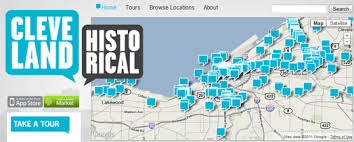
Students will be asked to log what they find in the historical entries pertaining to the inclusion of women, the location and activities of women, and identify the period/dates, as recorded of these entries. The findings will be discussed in the class.
As part of the class discussion, we will also consider the comments of Prof Jeanette Tuve in her concluding analysis and summary of the Oral History Project, “Ethnic Women of Cleveland”, in the  Cleveland Memory Project:
“The histories of these 30 women strongly support the position of Dr. Martha Bohachevsky-Chomiak, professor of history at Johns Hopkins University, who has stated that early ethnic women in this country were in fact the first feminists, pragmatic feminists, but untitled as such and deliberately so. These interviews are stories of women of great strength, courage and creativity as they did what they had to do to maintain their families, their churches, their values and traditions while building their communities. Simultaneously, an implicit part of their perceived diffuse responsibilities was retention of traditional male and female role distinctions”.
Is there evidence that women built their churches and communities? Why would “traditional male & female role distinctions” make a difference in their activities? How can we find the “great strength, courage and creativity” of women in the public record and history? Historical judgments are made and promoted…are the comments and evaluations of these historians reflected in the findings and experiences of the students’ engagement with the past? Do we only find what we look for? What is the role and value of interpretation as we search for women in Cleveland’s past?
These interpretations give us a link in which to connect and re-frame our own findings, beliefs and thinking about women. They provide an entry point to the conversation about the significance of women in a city.
Janeway, Elizabeth, Man’s World; Women’s Place: A Study In Social Mythology. NY: Dell Pub. Co.,1971.
