I downloaded the Cleveland Historical, produced by the Center for Public History & Digital Humanities at Cleveland State University.
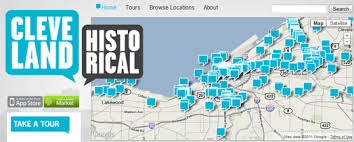
Cleveland Historical is promoted as a mobile application that provides a GPS-enabled map, historic images from Cleveland’s top archival institutions and an interpretive view of Cleveland and Northeast Ohio history. I had seen Cleveland Historical in its infancy as it is connected to Cleveland Memory and the CSU Center for Public History.

The on-line version is more of an archival record format. In its early state, the architecture was clumsy, the images fuzzy and many in the historical community viewed it as a ‘limited repository’. When I tried to download Cleveland Historical from my home in a nearby suburb, it did bring up lots of great photos for Lakewood and the nearby communities. Seemingly a random collection of documents and photos, I could not get a clear idea of what was chosen & why. Either none of the sites had audio or they wouldn’t load. Basically I reverted to my earlier judgment, ‘Kinda klunky but interesting, at least Cleveland is trying’ (it’s a motto here).
When I tried the mobile app from my office downtown, I was stunned by the difference. Cleveland Historical really is a dramatic leap forward in technology and engagement! When I opened it, the GPS-enabled map popped up a series of “Stories” historic images between .25 mi and progressively distant to my immediate location. The top of the screen navigation bar gave the options: Stories, Tours, Map
- Clicking on the Story selection brought up related thumbnails. Each entry had thumbnail image, a log distance and name. Clicking the thumbnail brought up a larger photo and historical description.
- Clicking on the folded map brings up a location map that can be enlarged or reduced, scrolled or there is a bar to get directions which locates with directions the photo you have opened.
Back conveniently takes you back to the previous item. Several ‘stories’ that have audio & video options indicated in the navigation bar at the top of the page. Clicking on a headset or movie reel will produce a new list of clips: interviews, reports, images, newsreels. The user can continue to scroll to distant locations or search on keywords.
Many of the clips and short documentary videos are drawn from CSU’s Cleveland Regional Oral History collection. Cleveland Historical is designed to be a collaborative project with stories created by teachers, students, professors and community members. While curated by the Center for Public History + Digital Humanities, the goal is to have the community actively participating in making and remaking its understandings of place and identity. Tebeau believes “Listening and the human voice, in particular, evoke ‘place’ in visceral and profound ways.” Human voices call forth memory, time, and context. Other images are drawn from a full range of collections from local institutions such as the Cleveland Museum of Art to family photos or the Cleveland Press, journalistic collection. The selections are chosen based on location and engagement for example near to the grounds of the prestigious University Circle area with many significant institutions, a thumbnail of the Hessler Street Fair is included (this is an alleyway, which still maintains its original woodblock construction, and hosts a neighborhood festival every year). The “Tours” option is very useful for visitors, providing walking or driving options to cover a topic area such as the Underground Railroad, Great Migration or history of Rock n Roll! It did inspire me to ‘get on’ with my project as when I searched on women the thumbnails were obviously architecture or events that included “women” in the text or metadata. As with all public history, there is more work to be done! But Cleveland Historical is a very cool app and a great start!
https://clevelandhistorical.org/ accessed 4/8/2018.
Tebeau, Mark. “Listening to the City: Oral History and Place in the Digital Era.” Oral History Review 40.1 (2013): 25-35.
http://urbanhumanist.org/2011/07/30/from-cleveland-historical-to-mobile-historical/ accessed 4/8/2018.