Category Archives: DPH 794

A Week of Women in cleveland

     While my long term project in stalled in administrative tedium, one project winds down and others wind up; I had the opportunity to participate in a few engagement activities that sparked reflection.  A public conversation between Carmen Twillie Ambar and Robyn Minter Smyers, moderated by Marianne Crosley that I expected to be more skill focused, was empowering.  The event I expected to be more empowering, the Cleveland International Women’s Day march, was less so.    

     The conversation held in the protected arena of the Metro Campus Center, promoted as discussing “the future of leadership”, focused on affirmation of women’s ability to succeed as women in the public space.  It provided a moment of context, recognition of hard earned and won success and commitment to “do more”.  These women’s candor, both agreed that work life balance is a struggle and competing demands require prioritizations, actually made aspirational hopes seem more achievable.  Meanwhile, I felt the March reflected a larger and more disturbing trend, the difficulty of public discourse in the modern environment.
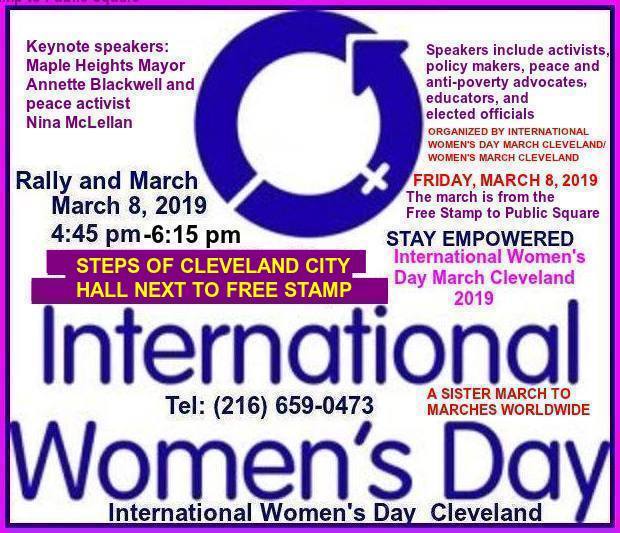
   Grassroots movements were powerful in the 1960’s and 70’s, because they seemed to be built from collaborating efforts among organizations rather than competing efforts to “have my say” in front of the press.  In my Pollyanna optimism, the public microphone should be an opportunity to inform and build consensus. (https://www.facebook.com/clevelandcom/videos/2208899279372104/)

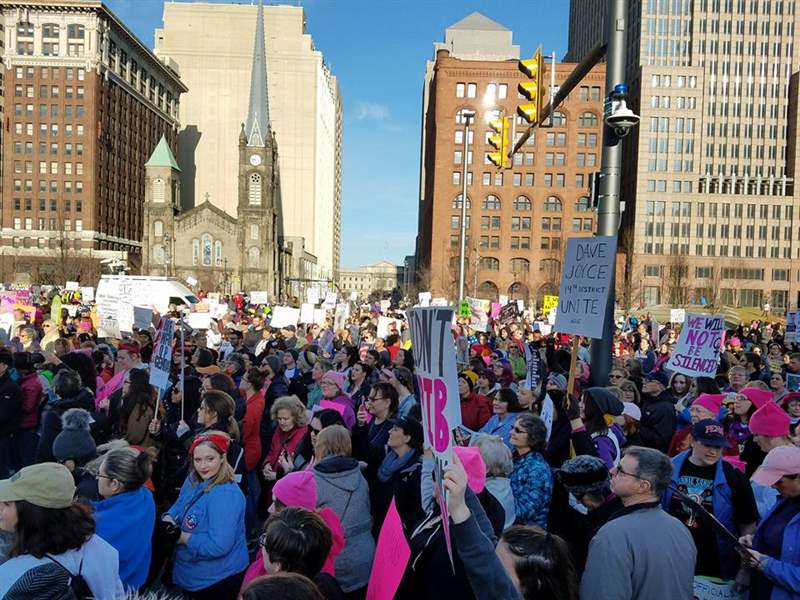
  This march, felt like a jumble of competing objectives that were displayed in front of a small audience and a visible opposition.  It was not the presence of the opposition that surprised me; it was their comfort in expressing extremist views. (To the person holding the sign calling for the extermination of all Black People… exactly what qualifies as a black person?  Since all of us have African DNA, it appears to me you are calling for the extinction of the Human Race.  Perhaps a little education would help you see the ramifications of your thinking, I digress.) 
My role was to reflect on the topic of ‘Women and Education’. It was my pleasure to provide a quick 3 minute reflection on equity, visibility and a reminder of women’s leagacy of activism and promote consciousness of what needs to be done in the future.
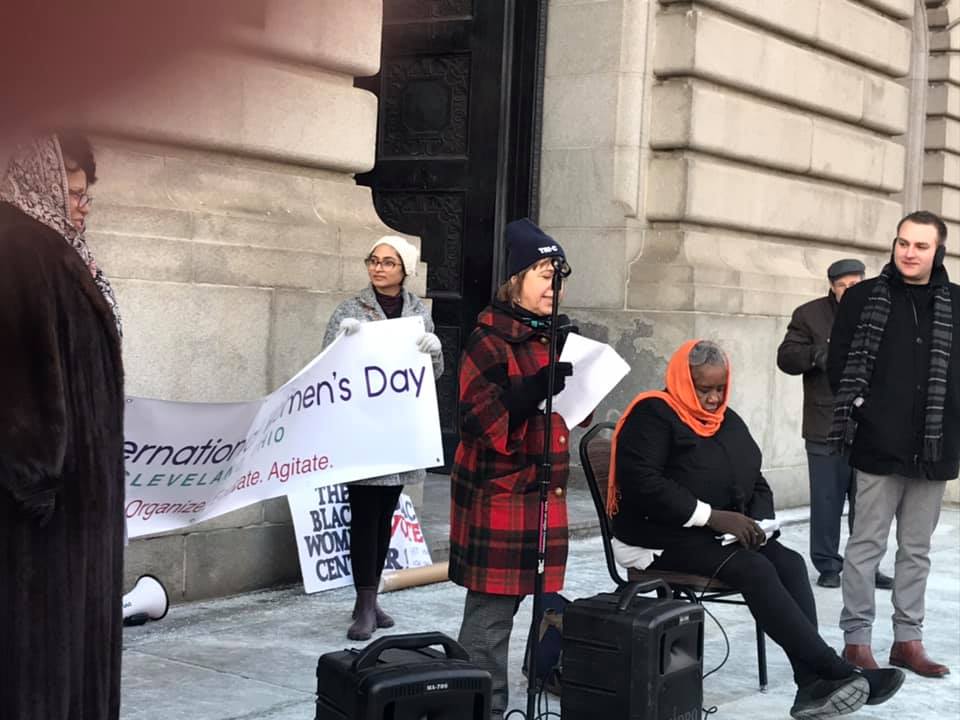
Photo of Kim Lenahan giving a speech on the steps of Cleveland City Hall by Kim Lenahan for International Women's Day 2019.
Cleveland International Women’s Day, City Hall 2019. Taken by Kris Patt

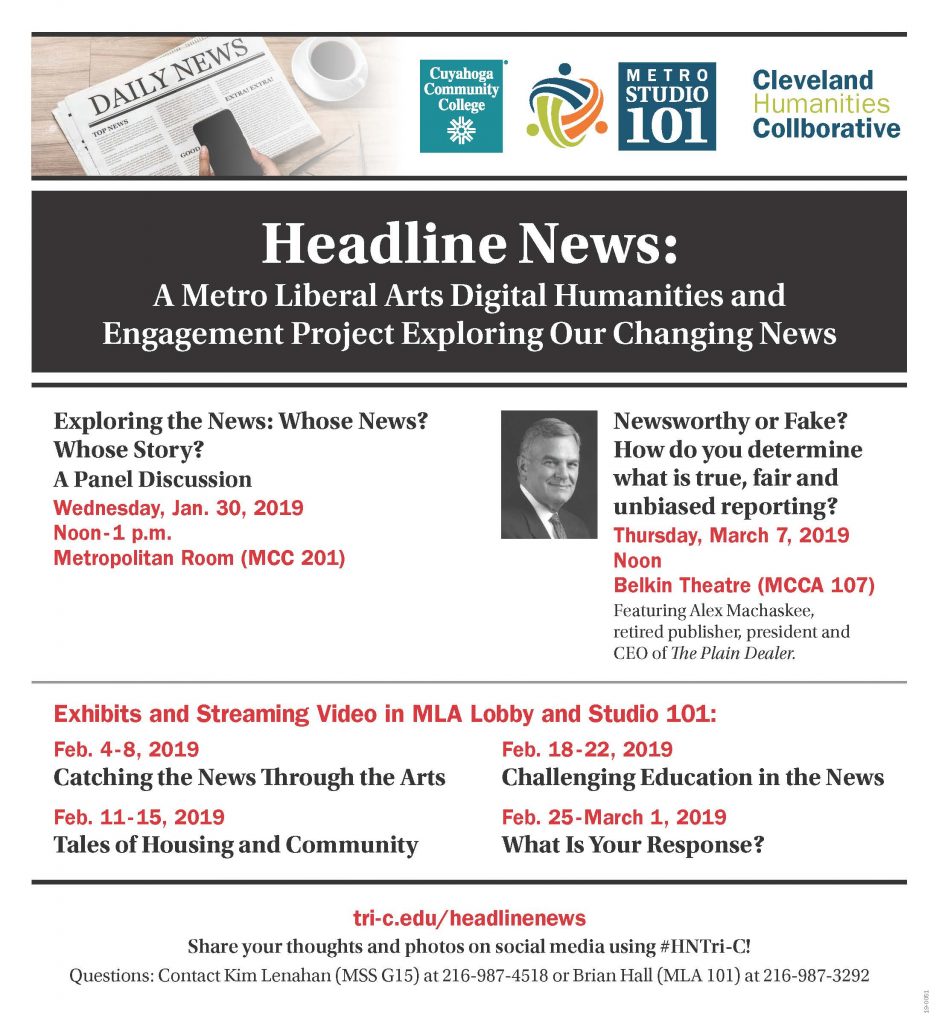
     A fear of the tyranny of the minority was expressed in the Federalist Papers, but the U.S. Constitution was constructed by flawed, prejudiced, patriarchal white males; they also had the Pollyanna faith that “In the extended republic of the United States, and among the great variety of interests, parties and sects which it embraces, a coalition of a majority of the whole society could seldom take place on any other principles than those of justice and the general good.”[1]  Theoretically, the public space provides all Americans the opportunity to present their case in the court of public opinion.  Women and other minorities in the past (including extremists), have used their soap boxes to express their beliefs, claim their rights and try to garner public support to shift a minority opinion to a majority stance. As public spaces have shifted to commodified, digital, international networks, our local public discourse is suffering.  Alex Machaskee, former editor and publisher of the Plain Dealer expressed his concern over the power of “click bait” in driving decisions and the formation of content during the final event of Headline News project.  He advocated investigating the sources and reading with a critical eye, but emanated an aura of confidence regarding the future of journalism.
     Where do these deep thoughts and debates leave Cleveland women?  In some ways, the same place we have always been– confronting the problems we face with the tools we have.  However, highly educated and president of historic Oberlin College, Carmen Twillie Ambar expressed she is only 2 generations removed from picking cotton.  Robyn Minter Smyers grew up in Cleveland and sits as one of 9 members of the International Board of Thompson, Hine & Fleury.  Mothers with young babies stood in 24 degree sunshine on the steps of Cleveland City Hall to support the idea of International Women’s Rights.  ‘As long as hope endures’, I agree with Susan B. “Failure is Impossible”!   


[1] Franck, Matthew.  “Religious Freedom” http://rootsofliberty.org/religious-freedom-in-the-federalist/ accessed 3/9/2019.
STASIS

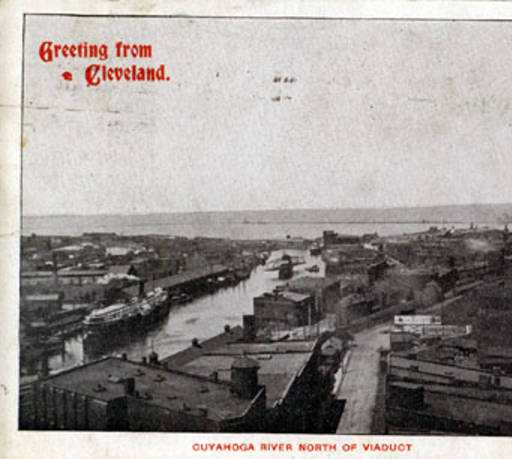
    It is Winter in Cleveland, OH.  Here on the North coast when the ice comes, the “shipping season” comes to a halt.  Ohio was the Western frontier when America was young. The fastest way to the interior of the new country was down the St. Lawrence Seaway or up the Mississippi River. The building of the Erie Canal in the 1830s was Cleveland’s first boom period. Our location in the North, the abundance of immigrant workers and again our importance as a port made Cleveland a hub for supplying Union Troops during the Civil War and its location between the ore mines of the Upper Great Lakes, coal mines of West Virginia and oil fields of Western Pennsylvania made it a primary hub of manufacturing after the war.  
 But the country grew Westward, it passed us by. Airplanes and Amazon have taken their toll on these Midwest rust belt cities. In the winter, Cleveland waits, hoping for Spring.

Postcards of Cleveland http://www.cleveland memory.org/postcards/leedy.html Cleveland State University, Michael Schwartz Library, Special collections.

    The current political waves are choppy and unpredictable.  Surrounded by books I am cozy in my living room. With my computer and technological devices I could reach out to the world, but it is winter and I am just waiting for circumstances beyond my control to resolve themselves.  According to the most erudite of all scholars, “Sometimes, when I am going somewhere, I wait. And then somewhere comes to me” (A.A. Miline, Winnie-the Pooh). Winnie and winter remind us humans that we are not always in control. We live day to day, assuming it will turn out as we plan, but as we examine the past we recognize things happen and lives are impacted.

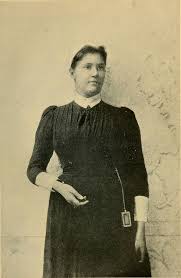
Isabel Hampton Robb

    Isabel Hampton Robb, known by nurses as the mother of Nursing Education, was the Superintendent of nurses and principal at Johns Hopkins School of Nursing. She was a force to be reckoned with in training nurses, publishing textbooks, advocating for and organizing the nursing profession. Robb came to Cleveland as the bride of Dr. Hunter Robb who was hired to teach gynecology at Case Western Reserve University in 1894.  It would have been socially unthinkable, then, for a married woman to “work”, so she organized and wrote. Mrs. Robb traveled to meetings, developed nursing practices and wrote the rules of efficiency. Until she died abruptly in a streetcar accident…in downtown Cleveland…in 1910 …..at the age of fifty one.

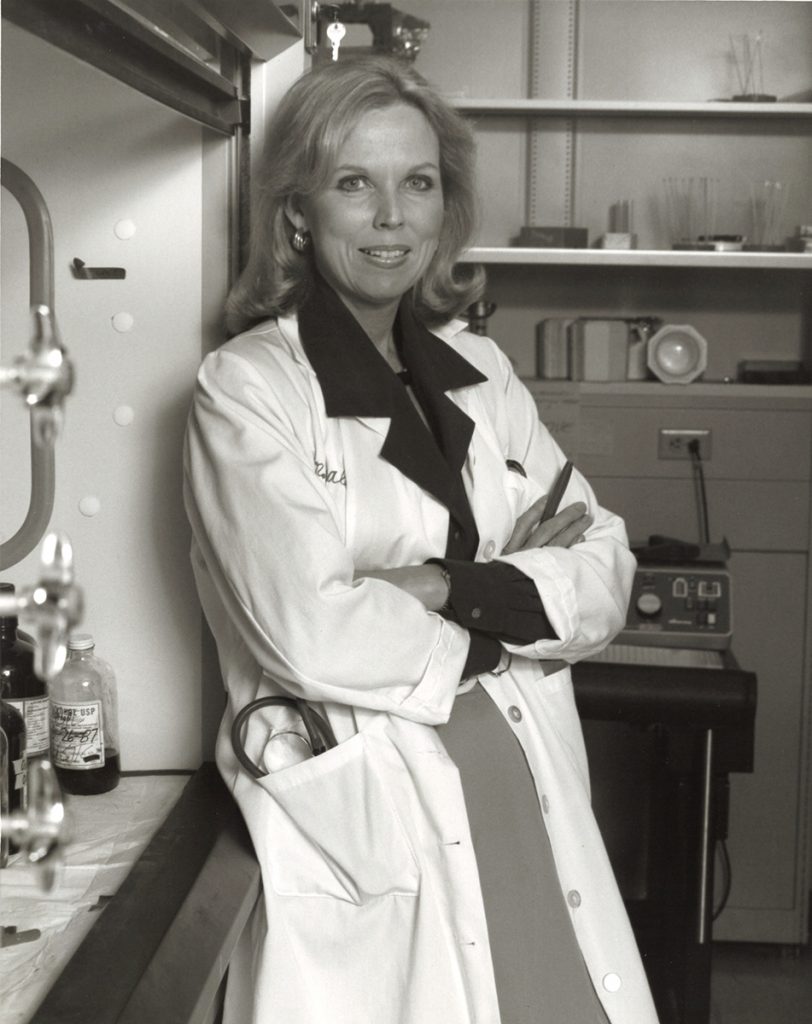
    Bernadine Healy, Vassar alumna, Harvard Med, Cleveland cardiologist, was the first woman to be named head of the National Institutes of Health.  She had previously successfully reorganized and managed the Cleveland Clinic’s Research Institute. A staunch Republican, she was a natural for George Bush to choose to reorganize and revitalize the NIH.  Healy launched the Women’s Health Initiative, a pioneering and critical study of women’s health that resulted in significant changes in the diagnosis of heart disease, and improved understanding of the role of estrogen in the body and the treatment of cancer in women.  The tides of politics shifted, Bill Clinton, a Democrat, became president and Healy stepped down. Healy later ran into difficulties with the embedded staff and board of the American Red Cross,complicated by organizational difficulties of the Red Cross’s response to 9-11. She left that organization in 2001.  Dr. Healy then became a TV health commentator and author, but her brain cancer returned. She died in her home in Shaker Hts. in 2011, at the age of 67.

    I imagine what you are thinking, is this author obsessed with death and what does this have to do with “Digital Public Humanities”?  These women were particularly brilliant and beautiful and renowned. Separated by over one hundred years, they cared for people, influenced medicine, and had lives that made a difference. They too lived through Cleveland winters with their families.  Digital Public Humanities gives us a lens to look at other lives–perhaps those with less notoriety, but no less important to their families and the people for whom they care. In my research and in my internship, I hope to uncover the work and connections of Cleveland’s women, using new tools.  But the political winds are blowing and the times are uncertain. Persons working for the government today are unsettled and afraid to make plans. We are waiting for forces beyond control. Medical practitioners try to uncover patterns of disease and wrest control. Politicians try to force their will and navigate our society’s future in alignment with their goals.  The power of the historian is to look backward and see how these threads of life, both wild and controlled, intertwine and eventually create a past worth remembering. We find and share stories in ways that help us understand one hundred years later, how we got here.

Chronicle Telegram 1/22/17

     A quote from Isabel Hampton Robb is inscribed on the Johns Hopkins University’s School of Nursing building, “Nurses are trusted with the most precious thing on earth: the life, health, and happiness of other human beings.”  I have been entrusted to tell the stories of some nurses and other women who hoped to improve the lives around them. In Cleveland, I am hopefully waiting for the thaw and for Spring.

STORMS

As I write this the Northeast is battening down for a weekend of blizzard.  I am old enough to remember the days before global warming when this was a common occurrence.   I would still have to go to school in below zero weather (where we would sit in our coats) and trudge back through the snow to get home.

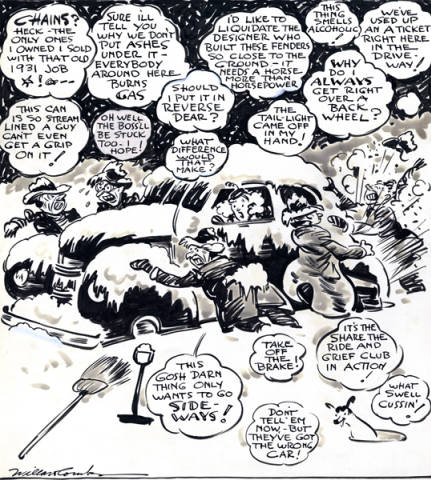
Cartoon of woman stuck in a car in a blizzard c1944
Yes Sir, It’s One Winter We’ll Remember! Cleveland Memory Project

There is another storm, the crisis of government workers – working or not, trapped by not being paid, yet not really free to ‘move on’, as America plays politics.  I have lived through a government shutdown as a worker – I did not face a long shutdown, but however long – the uncertainty takes a toll.  It is not a holiday.  I have been also been impacted directly by this shut down as the internship I was supposed to begin with the Smithsonian hangs in limbo land.  I am fortunate; it is not my bread and butter.  But it puts me into the “unease,” will I complete my certificate this summer as planned? 

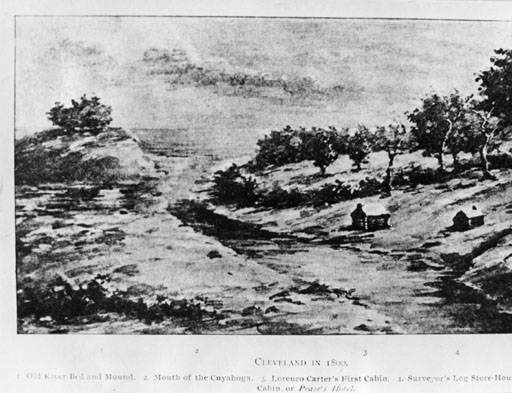
Storms of uncertainty can be powerful motivators.  Cleveland women throughout the generations have not been idle when faced with questions they could not answer and problems they could not solve.  They have taken action to solve them. In the earliest days, survival was an issue.  Due to the nature of the crooked (meaning of the Indian name) Cuyahoga River, Clevelanders faced waves of malaria as well as other epidemics during its settlement period in the early 1800’s.  Also from the beginning Cleveland women relied upon each other.  Talitha Stiles one of the first settlers came to the Western Reserve with her husband and the Moses Cleveland Survey party in 1796.  Talitha gave birth to the first ‘Cleveland child’ the following year, reportedly attended by Indian Women.[1]

The history of women and health care in Cleveland has mostly been unrecognized, because Western tradition and social practice has emphasized “firsts”, otherwise predicated as Great Men and Great Deeds.  While men were “conquering the West”, women accompanied them, cooked for them, patched their clothes and their wounds, birthed the children and mostly received no recognition.  No one ever recorded, ‘Talitha Stiles was the first woman to cook beans and muffins in Cleveland’.  But, she was the first woman to birth a child in this Western wilderness, Charles Phelps Stiles.[2]  I wonder if it would have been recorded had he been a she?

Cleveland Settlement 1800 (Lorenzo Carter & Surveyor’s Cabin – Courtesy Cleveland Memory

The projected internship: Women and Health Care in Cleveland: Utilizing the Digital Collections to Expand Community Connections and Collaboration  focuses on network visualization & mapping of the changing organizations in women’s health care in Cleveland, OH during the 1960’s & 70’s.  Women and Health Care in Cleveland is an ongoing research project that explores the impact of relationships in the development of our regional health care infrastructure. This Digital Public Humanities internship will focus on the intersection of changing Public Health policy, technology, and social cultures on the community and health care institutions.  The components will feature the creation of a digital catalog of pertinent artifacts and resources as well as interpretation and visualizations of the collections, connections and impact of these changes.


[1] Scharf, Lois. :Women”, Encyclopedia of Cleveland History, 1988 case.edu/ech/articles/w/women (accessed 1/21/19)

[2] “Stiles, Job Phelps”, Ibid.