All posts by admin

A Week of Women in cleveland

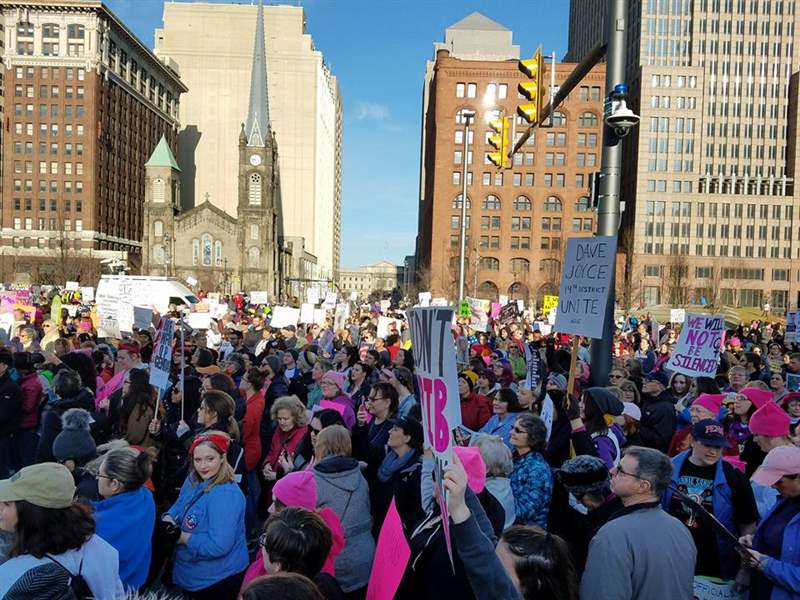
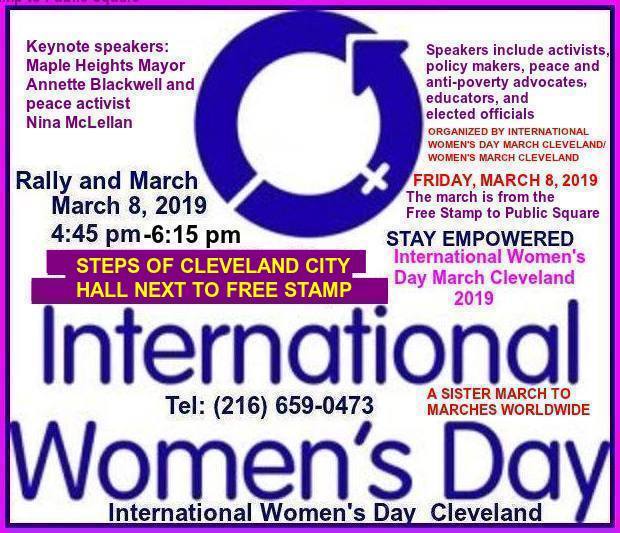
     While my long term project in stalled in administrative tedium, one project winds down and others wind up; I had the opportunity to participate in a few engagement activities that sparked reflection.  A public conversation between Carmen Twillie Ambar and Robyn Minter Smyers, moderated by Marianne Crosley that I expected to be more skill focused, was empowering.  The event I expected to be more empowering, the Cleveland International Women’s Day march, was less so.    

     The conversation held in the protected arena of the Metro Campus Center, promoted as discussing “the future of leadership”, focused on affirmation of women’s ability to succeed as women in the public space.  It provided a moment of context, recognition of hard earned and won success and commitment to “do more”.  These women’s candor, both agreed that work life balance is a struggle and competing demands require prioritizations, actually made aspirational hopes seem more achievable.  Meanwhile, I felt the March reflected a larger and more disturbing trend, the difficulty of public discourse in the modern environment.
   Grassroots movements were powerful in the 1960’s and 70’s, because they seemed to be built from collaborating efforts among organizations rather than competing efforts to “have my say” in front of the press.  In my Pollyanna optimism, the public microphone should be an opportunity to inform and build consensus. (https://www.facebook.com/clevelandcom/videos/2208899279372104/)

  This march, felt like a jumble of competing objectives that were displayed in front of a small audience and a visible opposition.  It was not the presence of the opposition that surprised me; it was their comfort in expressing extremist views. (To the person holding the sign calling for the extermination of all Black People… exactly what qualifies as a black person?  Since all of us have African DNA, it appears to me you are calling for the extinction of the Human Race.  Perhaps a little education would help you see the ramifications of your thinking, I digress.) 
My role was to reflect on the topic of ‘Women and Education’. It was my pleasure to provide a quick 3 minute reflection on equity, visibility and a reminder of women’s leagacy of activism and promote consciousness of what needs to be done in the future.
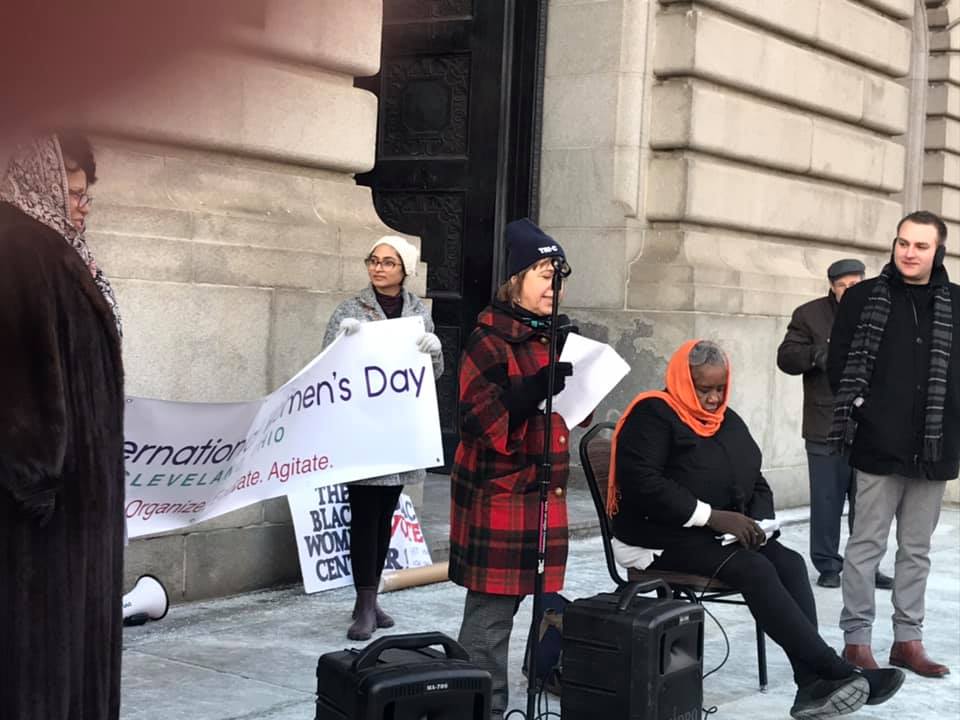
Photo of Kim Lenahan giving a speech on the steps of Cleveland City Hall by Kim Lenahan for International Women's Day 2019.
Cleveland International Women’s Day, City Hall 2019. Taken by Kris Patt

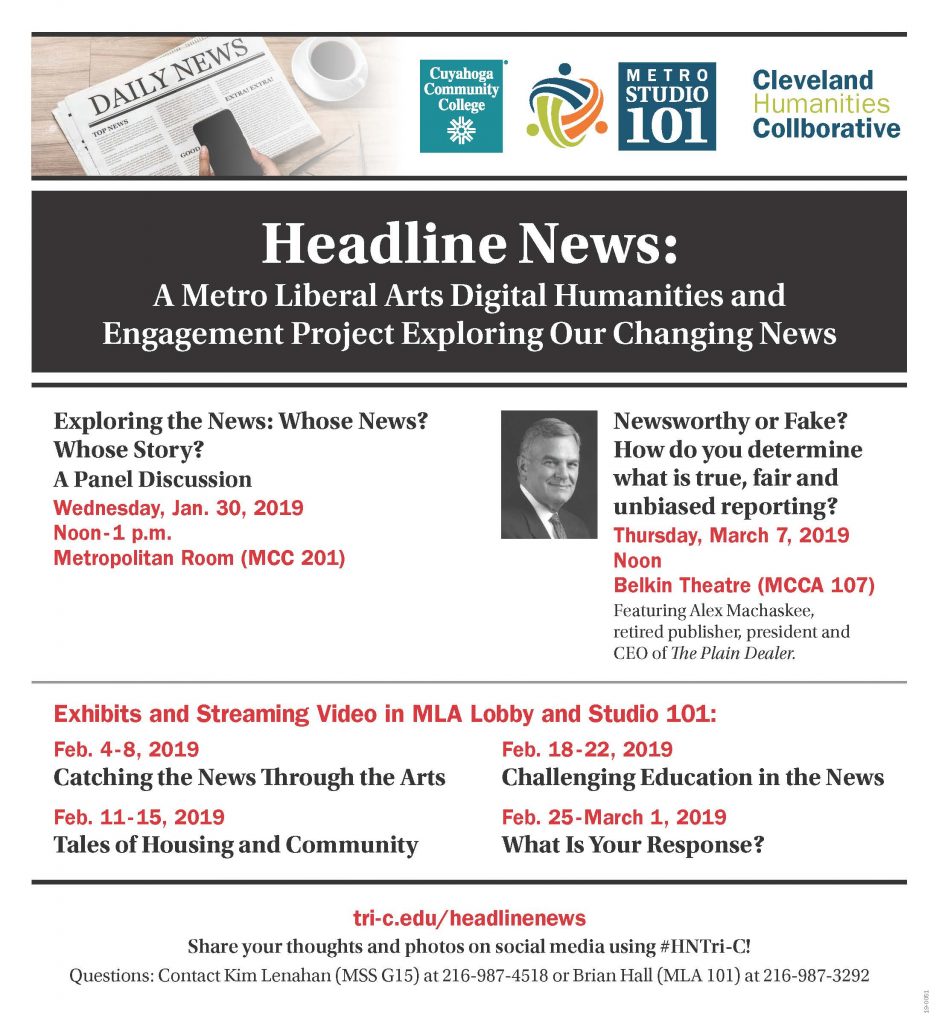
     A fear of the tyranny of the minority was expressed in the Federalist Papers, but the U.S. Constitution was constructed by flawed, prejudiced, patriarchal white males; they also had the Pollyanna faith that “In the extended republic of the United States, and among the great variety of interests, parties and sects which it embraces, a coalition of a majority of the whole society could seldom take place on any other principles than those of justice and the general good.”[1]  Theoretically, the public space provides all Americans the opportunity to present their case in the court of public opinion.  Women and other minorities in the past (including extremists), have used their soap boxes to express their beliefs, claim their rights and try to garner public support to shift a minority opinion to a majority stance. As public spaces have shifted to commodified, digital, international networks, our local public discourse is suffering.  Alex Machaskee, former editor and publisher of the Plain Dealer expressed his concern over the power of “click bait” in driving decisions and the formation of content during the final event of Headline News project.  He advocated investigating the sources and reading with a critical eye, but emanated an aura of confidence regarding the future of journalism.
     Where do these deep thoughts and debates leave Cleveland women?  In some ways, the same place we have always been– confronting the problems we face with the tools we have.  However, highly educated and president of historic Oberlin College, Carmen Twillie Ambar expressed she is only 2 generations removed from picking cotton.  Robyn Minter Smyers grew up in Cleveland and sits as one of 9 members of the International Board of Thompson, Hine & Fleury.  Mothers with young babies stood in 24 degree sunshine on the steps of Cleveland City Hall to support the idea of International Women’s Rights.  ‘As long as hope endures’, I agree with Susan B. “Failure is Impossible”!   


[1] Franck, Matthew.  “Religious Freedom” http://rootsofliberty.org/religious-freedom-in-the-federalist/ accessed 3/9/2019.
STASIS

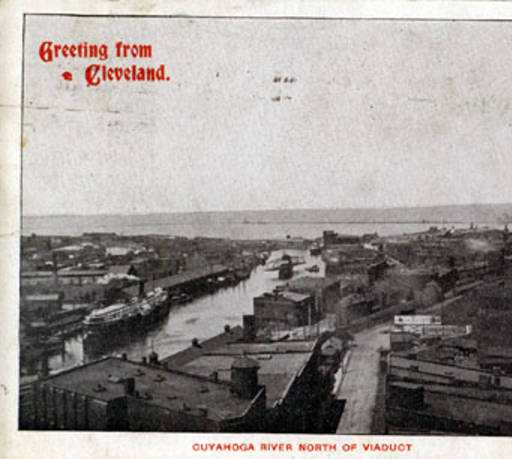
    It is Winter in Cleveland, OH.  Here on the North coast when the ice comes, the “shipping season” comes to a halt.  Ohio was the Western frontier when America was young. The fastest way to the interior of the new country was down the St. Lawrence Seaway or up the Mississippi River. The building of the Erie Canal in the 1830s was Cleveland’s first boom period. Our location in the North, the abundance of immigrant workers and again our importance as a port made Cleveland a hub for supplying Union Troops during the Civil War and its location between the ore mines of the Upper Great Lakes, coal mines of West Virginia and oil fields of Western Pennsylvania made it a primary hub of manufacturing after the war.  
 But the country grew Westward, it passed us by. Airplanes and Amazon have taken their toll on these Midwest rust belt cities. In the winter, Cleveland waits, hoping for Spring.

Postcards of Cleveland http://www.cleveland memory.org/postcards/leedy.html Cleveland State University, Michael Schwartz Library, Special collections.

    The current political waves are choppy and unpredictable.  Surrounded by books I am cozy in my living room. With my computer and technological devices I could reach out to the world, but it is winter and I am just waiting for circumstances beyond my control to resolve themselves.  According to the most erudite of all scholars, “Sometimes, when I am going somewhere, I wait. And then somewhere comes to me” (A.A. Miline, Winnie-the Pooh). Winnie and winter remind us humans that we are not always in control. We live day to day, assuming it will turn out as we plan, but as we examine the past we recognize things happen and lives are impacted.

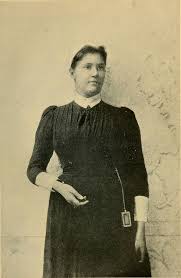
Isabel Hampton Robb

    Isabel Hampton Robb, known by nurses as the mother of Nursing Education, was the Superintendent of nurses and principal at Johns Hopkins School of Nursing. She was a force to be reckoned with in training nurses, publishing textbooks, advocating for and organizing the nursing profession. Robb came to Cleveland as the bride of Dr. Hunter Robb who was hired to teach gynecology at Case Western Reserve University in 1894.  It would have been socially unthinkable, then, for a married woman to “work”, so she organized and wrote. Mrs. Robb traveled to meetings, developed nursing practices and wrote the rules of efficiency. Until she died abruptly in a streetcar accident…in downtown Cleveland…in 1910 …..at the age of fifty one.

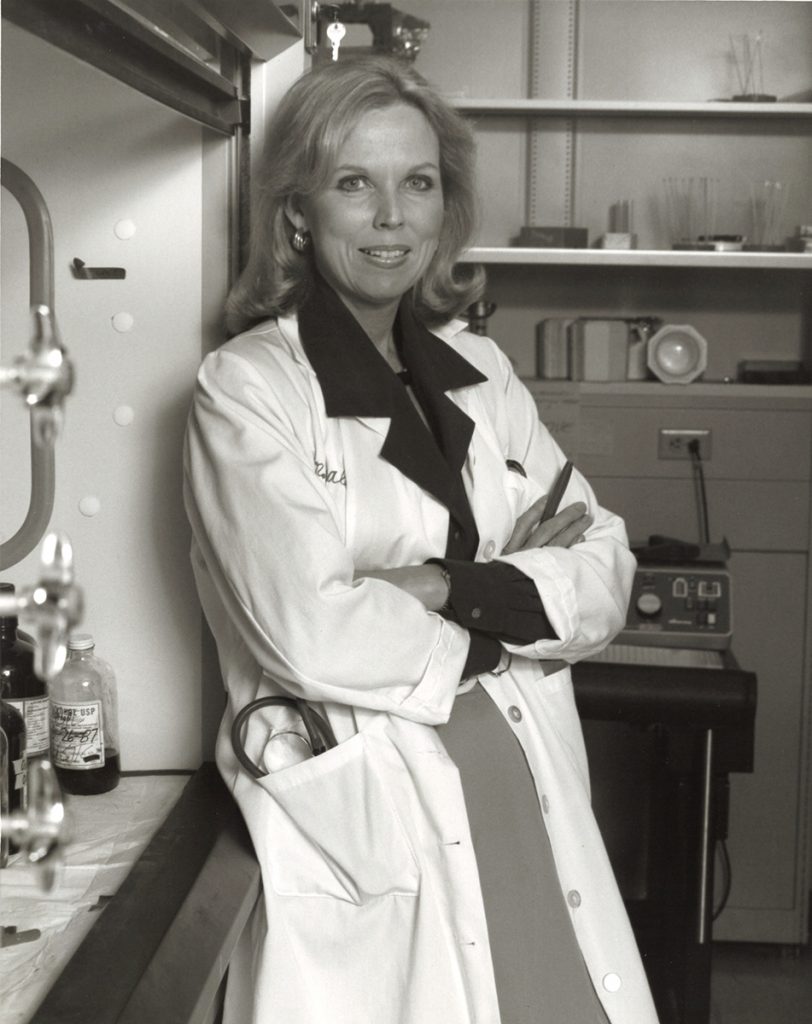
    Bernadine Healy, Vassar alumna, Harvard Med, Cleveland cardiologist, was the first woman to be named head of the National Institutes of Health.  She had previously successfully reorganized and managed the Cleveland Clinic’s Research Institute. A staunch Republican, she was a natural for George Bush to choose to reorganize and revitalize the NIH.  Healy launched the Women’s Health Initiative, a pioneering and critical study of women’s health that resulted in significant changes in the diagnosis of heart disease, and improved understanding of the role of estrogen in the body and the treatment of cancer in women.  The tides of politics shifted, Bill Clinton, a Democrat, became president and Healy stepped down. Healy later ran into difficulties with the embedded staff and board of the American Red Cross,complicated by organizational difficulties of the Red Cross’s response to 9-11. She left that organization in 2001.  Dr. Healy then became a TV health commentator and author, but her brain cancer returned. She died in her home in Shaker Hts. in 2011, at the age of 67.

    I imagine what you are thinking, is this author obsessed with death and what does this have to do with “Digital Public Humanities”?  These women were particularly brilliant and beautiful and renowned. Separated by over one hundred years, they cared for people, influenced medicine, and had lives that made a difference. They too lived through Cleveland winters with their families.  Digital Public Humanities gives us a lens to look at other lives–perhaps those with less notoriety, but no less important to their families and the people for whom they care. In my research and in my internship, I hope to uncover the work and connections of Cleveland’s women, using new tools.  But the political winds are blowing and the times are uncertain. Persons working for the government today are unsettled and afraid to make plans. We are waiting for forces beyond control. Medical practitioners try to uncover patterns of disease and wrest control. Politicians try to force their will and navigate our society’s future in alignment with their goals.  The power of the historian is to look backward and see how these threads of life, both wild and controlled, intertwine and eventually create a past worth remembering. We find and share stories in ways that help us understand one hundred years later, how we got here.

Chronicle Telegram 1/22/17

     A quote from Isabel Hampton Robb is inscribed on the Johns Hopkins University’s School of Nursing building, “Nurses are trusted with the most precious thing on earth: the life, health, and happiness of other human beings.”  I have been entrusted to tell the stories of some nurses and other women who hoped to improve the lives around them. In Cleveland, I am hopefully waiting for the thaw and for Spring.

STORMS

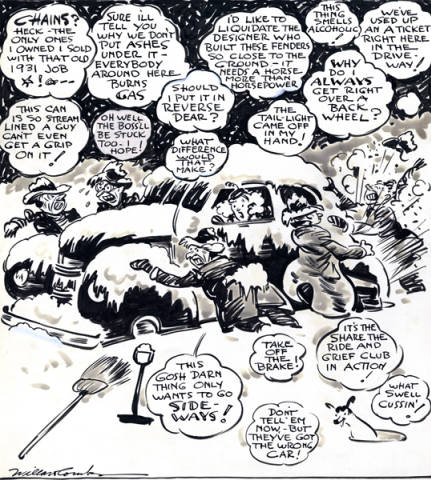
As I write this the Northeast is battening down for a weekend of blizzard.  I am old enough to remember the days before global warming when this was a common occurrence.   I would still have to go to school in below zero weather (where we would sit in our coats) and trudge back through the snow to get home.

Cartoon of woman stuck in a car in a blizzard c1944
Yes Sir, It’s One Winter We’ll Remember! Cleveland Memory Project

There is another storm, the crisis of government workers – working or not, trapped by not being paid, yet not really free to ‘move on’, as America plays politics.  I have lived through a government shutdown as a worker – I did not face a long shutdown, but however long – the uncertainty takes a toll.  It is not a holiday.  I have been also been impacted directly by this shut down as the internship I was supposed to begin with the Smithsonian hangs in limbo land.  I am fortunate; it is not my bread and butter.  But it puts me into the “unease,” will I complete my certificate this summer as planned? 

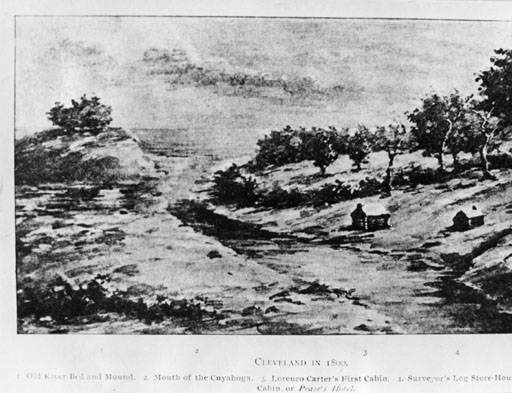
Storms of uncertainty can be powerful motivators.  Cleveland women throughout the generations have not been idle when faced with questions they could not answer and problems they could not solve.  They have taken action to solve them. In the earliest days, survival was an issue.  Due to the nature of the crooked (meaning of the Indian name) Cuyahoga River, Clevelanders faced waves of malaria as well as other epidemics during its settlement period in the early 1800’s.  Also from the beginning Cleveland women relied upon each other.  Talitha Stiles one of the first settlers came to the Western Reserve with her husband and the Moses Cleveland Survey party in 1796.  Talitha gave birth to the first ‘Cleveland child’ the following year, reportedly attended by Indian Women.[1]

The history of women and health care in Cleveland has mostly been unrecognized, because Western tradition and social practice has emphasized “firsts”, otherwise predicated as Great Men and Great Deeds.  While men were “conquering the West”, women accompanied them, cooked for them, patched their clothes and their wounds, birthed the children and mostly received no recognition.  No one ever recorded, ‘Talitha Stiles was the first woman to cook beans and muffins in Cleveland’.  But, she was the first woman to birth a child in this Western wilderness, Charles Phelps Stiles.[2]  I wonder if it would have been recorded had he been a she?

Cleveland Settlement 1800 (Lorenzo Carter & Surveyor’s Cabin – Courtesy Cleveland Memory

The projected internship: Women and Health Care in Cleveland: Utilizing the Digital Collections to Expand Community Connections and Collaboration  focuses on network visualization & mapping of the changing organizations in women’s health care in Cleveland, OH during the 1960’s & 70’s.  Women and Health Care in Cleveland is an ongoing research project that explores the impact of relationships in the development of our regional health care infrastructure. This Digital Public Humanities internship will focus on the intersection of changing Public Health policy, technology, and social cultures on the community and health care institutions.  The components will feature the creation of a digital catalog of pertinent artifacts and resources as well as interpretation and visualizations of the collections, connections and impact of these changes.


[1] Scharf, Lois. :Women”, Encyclopedia of Cleveland History, 1988 case.edu/ech/articles/w/women (accessed 1/21/19)

[2] “Stiles, Job Phelps”, Ibid.

Sixth Piece of the Puzzle – Technology

Technology is a key component of Digital Learning.  Does that seem like a patently obvious statement?  Yes, but this simple statement has deep ramifications.  For some individuals technology comes easy.  Often these are the individuals who adopt the latest and greatest, are excited about changes and shift between screens, software, hardware and mobile apps like expert skiers navigating moguls.  Assumptions, there is a generational divide in the adoption of technology and soon we will “age out” of our technological hurdle, are misplaced.  In my Community college classes, I find the digital hurdles include: access, poverty, class, mental processing and perspectives.  I have also found that “tech users” are often, not the best instructors, because they do not understand why or how a hurdle exists.

As I have watched the expanding usage of technology, I realized that there was something I was just “not “getting”.  For me the “skills” were not transferable.  Every change in platform, software, hardware, & upgrade became a hurdle.  Another technology I had to learn, which I knew would last only until the next upgrade.  I resented the time spent learning the technology to ‘display history’ as opposed to “doing history”.  Techies argued, “there are great tools that “do everything for you” – just drop in your data!”  But if I “dropped my data”, do I really understand the results?  As we have learned in this certificate program, decisions are made at every step and they shape the outcome of the digital processing.  Manoff

Constructing the “Finding Women in Cleveland” project has been an adventure in digital teaching and learning.  How hard could it be to ‘transform the tour…to place images on a platform and ‘plug in’ images, video and audio?  I was thinking analogically.  I have been challenged to think digitally, to weave technology, historical ideas, urban artifacts and educational goals into the project.  Digital thinking transforms the product; the goal of education transforms the technology, the technology is transformed by the nature of the materials and artifacts, the use of the digital platform transforms the engagement and the process of integration transforms the educational goals.

Just as learning systems were developed to prepare workforces for the industrial age, learning systems must be  transformed for the digital age.  Large machines and large organizations were built to last.  Authorities told us what was important, and keeping “the line” was important.  But if the goal is creativity, flexibility and responsiveness to diverse populations and demands…teaching and learning must be adapted to promote these skills, even in understanding and presenting our past.

Thus, digital learning is incremental, flexible and engaged: “teach me what you are doing, so I can learn by doing, so I can not only participate but evolve.”  The human skill of teaching and learning becomes a collaborative endeavor.  Humanity and individuality is recognized and really, isn’t the goal of education to get people to live together peacefully and prosperously?  We can be lured by the Apple (pun intended); we can focus on the wrong things, mindfulness of what is gained and lost from our traditions and understanding of the past is critical.  We cannot halt the future, nor would we want to, but engagement can be the bridge between generations and the glue that holds the puzzle together.

Notes:

Manoff,​ ​Marlene.​ ​​”The​ ​Materiality​ ​of​ ​Digital​ ​Collections:​ ​Theoretical​ ​and​ ​Historical Perspectives.”​​ ​​Portal:​ Libraries and the Academy ​ ​6,​ ​no.​ ​3​ ​(07,​ ​2006):​ ​311-25.

Parks and Presenting the Past

I feel the two questions asked:

  • What are the challenges we face as history educators with presenting the past in the digital world?
  • How have digital tools made it easier to teach about and help our audience(s) engage with the past?

have been answered in previous assignments.  But as I read, Coslett and Chalana I was drawn into other questions which have been touched on, but seem to justify more conscious thought.

  • How are digital tools and methods changing our “public history identity”?
  • What potential forms of history can be developed utilizing digital methods?
  • How can historians master these forms as they arise?
  • What is the appropriate role of history in shaping a changing national culture?

I feel even Coslett and Chalana’s recent review of the challenges faced by the National Park Service in recognizing and responding to demographic tides and trying to create more inclusive “stories”, was dated and missing the point.  The fundamental decline in visitors is not just about the presentation of “stories” told, it is about a culture that no longer sees the outdoors as a space to relax and escape the pressures of life.  It is about a culture that no longer seeks to “memorialize”, preserve traditions or educate by viewing monuments or homes of the past.  How is our “digital world” removing us from the physical one and what does that mean?

This reflection does not mean in any way to disparage the efforts of the National Parks.  I agree with the articles’ premise that our “stories” need to reflect the complexity and diversity of the true populations and our history, but we need to do more than that.  The fundamental message of this course has been engagement – learning by doing.  Most of our traditions, institutions and structures were created in the last century to respond to the needs of an industrial society.  We are just moving into the digital economy, industry and culture and as historians we have to be more diligent in recognizing the cultural shifts that are occurring through the transition.  Sitting was a luxury when people stood at machines all day.  Families went to the parks for healthy “fresh air & sunlight” apart from the dark factories and smog.  History was authoritarian and monumental.  In a culture that sits at screens all day, yet views gaming as preferred entertainment, individual tweets or self-publication as significant public information and sunlight as threatening (are you armed with lotion and bug spray?) – we are going to have adapt our interpretations and methods.

How can San Juan Island investigate its prehistoric past and can modern crowd-sourcing methods help?  Could digital mapping help the Cayuse regain and expand its understanding of the past?  What were the epidemic diseases of the Oregon Trail and could their causes, remedies, impacts and genetics be identified, interpreted and used to forge bonds between the many peoples of the West?  Is there such a thing as a “future past” that can be created and how much must we rely on the ‘Ancients’ to create it? (Grethlein)  Or can we draw the public into creating digital histories and identities?  Can we make fiction  more engaging then nonfiction and mythology?  Perhaps the next marketing campaign for the National Parks can be “Help us Create a New National Identity!”

Note:

Coslett, Daniel E., and Manish Chalana. “National Parks for New Audiences. Diversifying Interpretation for Enhanced Contemporary Relevance.” The Public Historian 38, no. 4: 101-128. November 2016.

Grethlein, Jonas. “Future Past”: Time and Teleology in (Ancient) Historiography” in History & Theory v. 53 n. 3, October 2014. https://onlinelibrary.wiley.com/doi/abs/10.1111/hith.10715 accessed 7/11/2018.

Historical Thinking

Sam Wineburg in “Why Historical Thinking is Not About History” states, “The Internet has obliterated authority”. p.14  I  agree  the internet has contributed  to the  decline of authority and more significantly an “anti-intellectualism”.  When one was faced with ‘reading books’ to gain knowledge, the individual chose the books and their use of time carefully.  There was also a basic agreement that a common core (pardon the pun) of cultural literacy and history needed to be acquired.  The ‘felt need’ to remember public names, facts and dates is completely erased.  “Ask Siri” or “Google it” never seems to raise the question of who wrote the script for Siri or the entry we read.  Even more important, the question of “why did this entry appear first” is not usually asked either.

While “facts” might always have been subject to ‘interpretation’, there were sources which were given authority or credence.  Now a multitude of alternative explanations can be raised instantaneously and we exist in a political climate that confuses philosophy with character.  What “we believe or want” always receives some kind of validation from the web; whereas critical thinking takes time, investigation and may not provide simple gratifying answers.  ‘Founding Myths’ where “the Good Guy always wins”, may validate a position or make a group feel powerful or just; but often distort the reasons the ‘Good Guy’ was in conflict.  To “counter” these trends; we have to move away from the fight!  Rather than utilizing ‘polar debate’ or ‘authoritarian’ traditions, civic culture requires the development of “the questioning mind”.   As Sam Wineburg indicates, this is the skill developed by ‘Historical thinking’.

A huge shift for historians is to take our ‘smoke and mirrors’ methodology and display it before and more prominently than our interpretations.  ‘Scientific Method’ has been able (to this point) to effectively distill the core elements of a process or element, which because of the ‘repeatable’ process brought its own authority.  The discourses of “the Arts” have relied on authorities rather than teaching their processes, because the volumes of material, effort and physical realities of access to sources limited their use.  Digital tools makes access possible.  It is possible to scale projects to promote a more accurate understanding of how accurate interpretations can be made.  Utilization of historical methods in a few steps can debunk the “Feel Good” rhetoric that obscures the complex history of problems we face.

Wineburg’s “Digital Toolbox” is history’s ‘scientific method’.  The worldwide web brings images and resources to the palm of our hands.  Asking a few questions can help us distill the purposes of the messages we are examining.  Sharing questions can defuse political vehemence and bring the public into the analytical conversation.  We may all learn there that most of us are “good people”.

Wineburg, Sam. “Why Historical Thinking is Not About History.” History News 71, no. 2 Spring. 2016.

Thinking about Thinking & Learning

This is not news but…a very interesting and extremely useful component of on-line learning is the flexibility to watch & learn on your own schedule.  Also, to stop a lecture or interview to listen again and/or to reflect on what is being said.

Internet Book Archive/ Flicker

Erin Bush’s advice to rethink the syllabus caused me to ‘rethink’ the way I am thinking about Learning Objectives.  I have been considering learning objectives as a checklist rather than a scaffold. My process had been to designing a course and then return to the objectives to assure they were all being met.   However, thinking about objectives as “engagements” and then layering them into a course in a novel idea for me.   Her reflections on considering what resources she would have to create, also stimulated my thinking regarding how I am approaching resources.  These considerations will be impacting how I design my fall courses.

The challenges expressed by Wieringa and Sharp, were similar to the issues that stimulated my interest in the George Mason Digital Public Humanities course.  Their goal of practice, which mirrors my own concern with developing historical writing, helped me recognize that shorter length and greater diversity (actually lowering what was demanded in each assignment) might help meet the ultimate goal in a more realistic fashion.

Examples and interpretive styles demonstrated in the Hardy, Swain and Pethel & Gris interviews have expanded my awareness of tools.  Specific application and adaptation of: Smithsonian resources, guides that others have created and utilization of the wider array of primary and secondary sources online; will need development.  The stimulation renews my enthusiasm and energy for thinking more carefully about the essence of teaching and learning.

I appreciated Andris Straumanis’ reflection, not so much for new ideas, but significant disciplinary insights.  His comment on helping students understand the role of poetry in 19th Century journalism reminds us of teaching the details of historical context.  His recognition of the significance of working with other students in this course reminds us of the importance of collaboration, not only with fellow students, but with colleagues inside and outside of our disciplines.  As internet resources become vaster and we collaborate on-line with other experts in our own areas, it is important to remember that talking with people and listening to the experience of others can profoundly impact our awareness.


Fifth Piece of the Puzzle: Finding Cleveland’s Women

“Like their personal lives women’s history is fragmented, interrupted; a shadow history of human beings whose existence has been shaped by the efforts and demands of others”

I am planning on using this quote by feminist and author Elizabeth Janeway as part of an introduction to a pre-class preparatory assignment.   Students will be asked to reflect on these words as they search for “Cleveland Women’s Daily Lives” through a Mobile History Exercise.

The reason I have chosen this particular quote is because it is an excellent analysis statement that calls for reflection.  Students can, consider how women’s lives are fragmentary, why they might be described as “interrupted and make judgement on the accuracy of the statement, “they have been shaped by the efforts and demands of others”.  I will ask them to consider if, in the exercise of exploring ‘mobile Cleveland history,’ they find women’s existence and history to be “a shadow”.

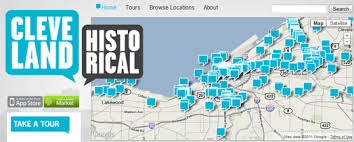
The assignment is basically to track daily activities through the Cleveland Historical Application.

Mobile Public History App

Students will be asked to log what they find in the historical entries pertaining to the inclusion of women, the location and activities of women, and identify the period/dates, as recorded of these entries.  The findings will be discussed in the class.

As part of the class discussion, we will also consider the comments of  Prof Jeanette Tuve  in her concluding analysis and summary of the  Oral History Project,  “Ethnic Women of Cleveland”, in the Cleveland Memory Project:  

“The histories of these 30 women strongly support the position of Dr. Martha Bohachevsky-Chomiak, professor of history at Johns Hopkins University, who has stated that early ethnic women in this country were in fact the first feminists, pragmatic feminists, but untitled as such and deliberately so. These interviews are stories of women of great strength, courage and creativity as they did what they had to do to maintain their families, their churches, their values and traditions while building their communities. Simultaneously, an implicit part of their perceived diffuse responsibilities was retention of traditional male and female role distinctions”.

Is there evidence that women built their churches and communities?  Why would “traditional male & female role distinctions” make a difference in their activities?   How can we find the “great strength, courage and creativity” of women in the public record and history?    Historical judgments are made and promoted…are the comments and evaluations of these historians reflected in the findings and experiences of the students’ engagement with the past?  Do we only find what we look for?  What is the role and value of interpretation as we search for women in Cleveland’s past?

These interpretations give us a link in which to connect and re-frame our own findings, beliefs and thinking about women.  They provide an entry point to the conversation about the significance of women in a city.

Janeway, Elizabeth, Man’s World; Women’s Place: A Study In Social Mythology. NY: Dell Pub. Co.,1971.

Fourth Piece of the Puzzle: Reflection in Bronze

The image in my banner above shows the image of the Bas-Relief Bronze Panel “Cleveland Soldier’s Aid Society” that is set in the central column of the Tablet Room in the Soldier and Sailors Monument, Public Square, Cleveland, OH.  The Soldier’s Aid Society organized at the beginning of the Civil War became one of the key branches of the U.S. Sanitary Commission.  This panel is the only 19th Century Civil War monument that included women.

Without knowing the larger context of the panel, it would be difficult to identify the purpose of the image.  It does not portray the women as “Heroines”, although these women were, giving up time at home and daily activities to promote and organize the collection of food, medical supplies and other items requested by the field stations and hospitals of the Union Army.  They collected articles & money, served as the conduit of information from the front line and cared for soldiers medical, transportation and sheltering needs from 5 days after Lincoln’s call for troops though the duration and about 3 years after the Civil War.   These women are portrayed simply as a group of women.  Once could probably date the context through the women’s attire.  Aside from the Sister of Charity holding an amputated arm, the setting could be anywhere in the mid-late 19th Century.

I believe this image is a wonderful place to begin the tour because it provides the opportunity to raise a variety of topics:

  • What is women’s role: in the Civil War; …on the home front; …in the city?
  • What are women’s jobs: on the cusp of the Civil War and after?
  • What is women’s relationship: to the War; ….to each other; ….to their families; …..to the City and Federal governments?
  • What are the attributes of women’s leadership?
  • What impact did race and class have on women’s ability to participate in society or demonstrate leadership?
  • What is the perception of women and their place in the public sphere?
  • How are women remembered?

This image grounds us in the fact that “women” are individuals who are living and their lives…when changes come… they meet them.

Insight to Film

The way that I have used images in the past has been primarily as exemplary exhibits.  Images do make powerful connections. PowerPoint and advancements first to Web 1.0 and then 2.0 made dramatic steps in making the use of images in the classroom possible.  For those of us, who were teaching at the time, they were “add ons”, used to make concepts clearer.  They have been the accessories to teaching rather than an integral part of it.  I probably would not have thought intentionally about their use until this program.  My experience with film has consisted mostly of “homework” assignments that enabled students to ‘experience’ the emotion of historical context and draw connections to the past.  These have been primarily “passive” assignments.  I have been reluctant to bring film into the classroom, because the time involved in ‘watching’ that I viewed as distracting from active thinking.  (and probably a deeply ingrained bias from the Funky Winkerbean comic strip).  Natalie Zemon Davis’ demonstrated how film comparison can engage historical analysis on multiple levels.   Brent Toplin’s article written in April 1966 was an excellent expression of the bifurcated view of the discipline as acknowledging the usefulness of film, but not quite having the intellectual tools to balance its usefulness in the classroom setting.

I have worked on/with a few documentary pieces for community partners and the circumspect quality of the history being presented due to equipment and editing decisions and/or the exploitation of history for marketing purposes has cautioned my participation in that realm.  In this vein, I found Peter Seixas exploration into the impact of film on students’ historical cultural perspective quite interesting.  Historians, via the incorporation of the American Historical Assoc. through Congress, are the guardians of the national historical consciousness.  Film has advanced to become so much a part of our culture. As my secondary school teacher classmate Kathy indicates children and teens are making and expressing themselves through film creation.  Ken Burns has launched a movement, the discipline needs to be shepherding the understanding of the uses and implications of cinematic history.

How will this insight change my teaching?  I have already used the engaged examination of image in a demonstration lesson this week.  Incorporating critical analysis and a sense of dynamic interaction with film will play an increasing role in my courses as part of my instruction on historical interpretation and perspective.  I can foresee the use of film creation as special projects; but given a semester format, I think utilizing images as part of engagement, rather than examples will encompass the bulk of the change in my pedagogy.

As a consumer, I will seek images that demonstrate action or engagement more than the art or artifact.  Using images or comparison of cultural standards, I will ask questions to engage the audience to think about the image as not just evidence but a launch pad for inquiry.  As a producer, I will be more conscious of the impact of the images I am using and approach their incorporation in a more intentional manner.